US Pet Laws by State and Territory: Honest 2026 Guide.
This is general information, not legal advice. Pet laws change often and frequently vary by city or county on top of state law — always verify current requirements with your state’s department of agriculture, your local animal control office, or a lawyer before making a decision based on your specific situation.
Us pet laws by state and territory don’t just vary at the state line — they can vary at the city limit, too. A breed that’s completely unrestricted one town over can require a special permit, mandatory spay/neuter, or an outright ban a few miles away. Most “pet laws by state” guides stop at the 50 states and ignore the territories entirely, which leaves a real gap if you’re moving to or traveling with a pet to Puerto Rico, Guam, or the US Virgin Islands.
Quick Answer
| Question | Short Answer |
|---|---|
| Is there one federal pet law that covers everything? | No — the federal Animal Welfare Act covers breeders, dealers, and interstate transport, but day-to-day ownership rules (licensing, breed restrictions, leash laws) are set at the state and local level |
| Do all states allow breed-specific bans? | No — some states (including California, New York, Texas, and Illinois) restrict or prohibit local governments from banning specific breeds outright |
| Does “no statewide ban” mean a breed is unrestricted? | Not necessarily — cities and counties can still impose mandatory spay/neuter or registration rules even where outright bans are prohibited |
| Do the territories follow the same rules as the states? | No — Guam, Puerto Rico, and the US Virgin Islands each have their own distinct import and ownership requirements |
| Is Hawaii different too? | Yes — due to its rabies-free status, Hawaii has its own stricter import process separate from the mainland US |
Table of Contents
- The Federal Baseline
- Why “It Varies by State” Undersells It
- California: A Case Study in Getting This Wrong
- States That Restrict Local Breed Bans
- Rabies Vaccination and Licensing Basics
- The Territories Most Guides Skip
- Hawaii’s Unique Position
- What People Get Wrong
- How to Actually Verify Your Local Rules
- The Bottom Line
The Federal Baseline
The federal Animal Welfare Act sets minimum standards for commercial breeders, dealers, and transporters, and federal rules govern rabies documentation for interstate and international pet travel. What it doesn’t do is set uniform rules for everyday ownership — whether you need a license, which breeds face restrictions, and how strictly leash laws are enforced are all left to states, which frequently delegate further down to cities and counties.
Why “It Varies by State” Undersells It
More than 700 US cities have enacted their own breed-specific laws, according to the ASPCA — a number that alone tells you state-level information isn’t the finish line. A dog can be completely unrestricted under state law and still face a real local ordinance the moment you cross into a specific city or county. This is exactly why a guide that only tells you “your state allows X” can leave you with an incomplete, and sometimes wrong, picture.
California: A Case Study in Getting This Wrong
This is worth walking through in detail, because it’s a genuinely common misconception, repeated across multiple lower-quality guides. California Food and Agricultural Code § 31683, passed in 1989, explicitly prohibits cities and counties from banning specific dog breeds outright — there is no statewide ban on Pit Bull-type dogs, Rottweilers, or any other breed in California, and local governments cannot pass one either.
What California does allow is narrower: cities and counties can still require mandatory spay/neuter specifically for pit bull-type breeds (including American Pit Bull Terriers, American Staffordshire Terriers, and Staffordshire Bull Terriers), which several California jurisdictions — including San Francisco, Riverside County, and San Bernardino County — actually enforce. That’s a meaningfully different rule than an outright ban, and getting the distinction backwards is exactly the kind of error that shows up in guides that didn’t check the actual statute.
States That Restrict Local Breed Bans
New York, Texas, and Illinois are among the states that favor identifying and regulating individual dangerous dogs regardless of breed, rather than allowing blanket breed bans. California takes a similar approach with its specific carve-out for spay/neuter ordinances described above. This is genuinely useful to know before assuming a breed you own is unrestricted just because you’ve heard a state is “breed-friendly” — the specific carve-outs matter, and they differ state to state even among states that broadly restrict BSL.
On the other end, plenty of states still permit full local breed bans, and Ohio’s history is a useful illustration of how quickly this can change: the state repealed its own statewide “vicious dog” designation targeting pit bull-type dogs in 2012, shifting enforcement to individual dangerous-dog behavior — but individual Ohio cities retain the authority to enact their own local breed bans regardless of that state-level shift.
Rabies Vaccination and Licensing Basics
Every state requires rabies vaccination for dogs, and most require it for cats too, though the specific interval (one-year versus three-year vaccine) and enforcement mechanism vary. Licensing requirements are almost universally handled at the county or city level rather than the state level, which means two dogs in the same state can have completely different renewal schedules, fees, and required documentation depending on which county they’re registered in. This is one of the most common points of confusion for people who’ve just moved between counties within the same state, not just between states.
The Territories Most Guides Skip
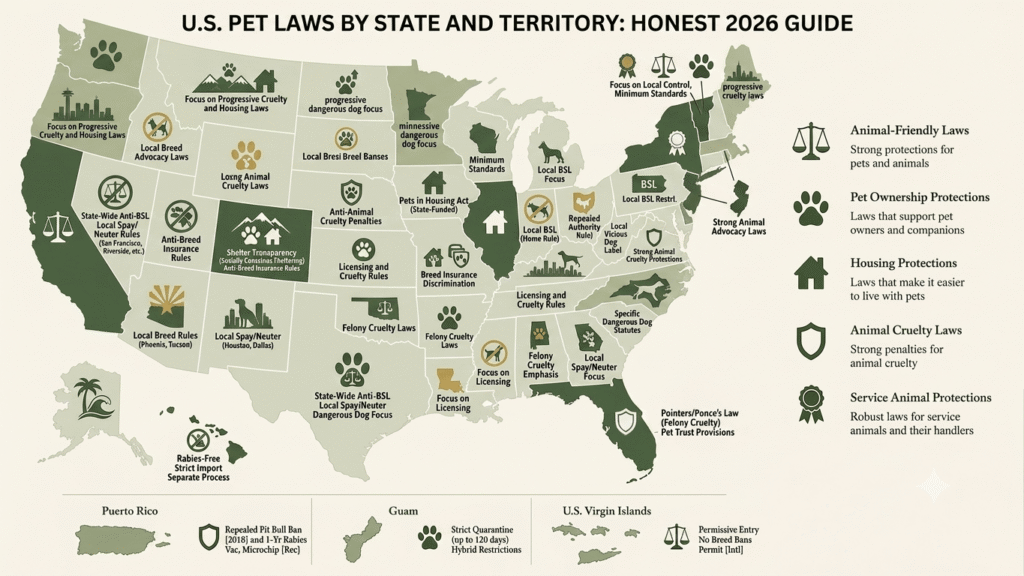
This is the part almost no “pet laws by state” article covers, and it’s genuinely useful if you’re moving to or traveling with a pet to a US territory.
Puerto Rico enacted a ban on Pit Bull-type dogs in 1998 under Act 159 (also referenced as HB585), and this is one case where we’re not going to state a confident repeal date, because the sources genuinely conflict even after checking primary legal text. Some sources report the ban was repealed years ago; others, including Puerto Rico’s own compiled statutes as published by Justia, still show the prohibition language present as of the most recent available text. If you own or are considering bringing a Pit Bull-type dog to Puerto Rico, treat this as unresolved and confirm current status directly with Puerto Rico’s Department of Agriculture before making any decision — this is exactly the kind of case where a quick official phone call beats trusting any single article, including this one. Separately, microchipping isn’t currently required for entry (though it’s recommended), and dogs and cats need rabies vaccination administered between 28 days and 6 months before entry, with the one-year vaccine variety rather than the three-year version common on the mainland.
Guam is considerably stricter than the mainland US or Puerto Rico. Pets face up to a 120-day quarantine unless microchipped before rabies vaccination, and the health certificate must confirm the microchip was successfully scanned by the certifying veterinarian. Guam also restricts wolf hybrids and certain hybrid cat breeds (Savannah and Bengal) unless they’re five generations removed from their wild-type ancestor.
The US Virgin Islands are the most permissive of the three for pets arriving directly from the US mainland or Puerto Rico: no import permit is required for a pet traveling with its owner, and there’s no published list of banned breeds. Microchipping isn’t an entry requirement, though it’s recommended for identification purposes. That said, pets arriving from anywhere outside the US or Puerto Rico fall under the international import category and do require a formal permit issued by the territory’s Veterinary Services Directorate.
Hawaii’s Unique Position
Hawaii isn’t a territory, but it’s worth including here because its rules genuinely don’t resemble the rest of the mainland US. Because Hawaii is rabies-free, its import requirements are handled entirely separately from the standard US pet import process, with their own quarantine and documentation system designed specifically to keep the state rabies-free. If you’re moving from the mainland with a pet, treat Hawaii as its own distinct process, not a variation on standard US interstate rules.
What People Get Wrong
The most common mistake is checking state law and stopping there. State law is a starting point, not the finish line — county and city ordinances can add real, binding restrictions on top of whatever the state allows or prohibits, and the only way to know for certain is to check both levels for your specific address, not just your state.
The second mistake is assuming “no statewide ban” means a breed is fully unrestricted, when several states (California being the clearest example) explicitly prohibit outright bans while still permitting narrower restrictions like mandatory spay/neuter for specific breeds.
How to Actually Verify Your Local Rules
Start with your state’s department of agriculture or the equivalent state licensing agency, then check your specific city and county government websites separately — don’t assume state-level information covers local ordinances. For interstate or territory travel, USDA APHIS’s Pet Travel resource is the authoritative federal starting point for rabies documentation requirements. If you’re moving somewhere with a breed that’s faced restrictions anywhere else you’ve lived, a quick call to the local animal control office before you move is worth the ten minutes it takes.
The Bottom Line
Us pet laws by state and territory genuinely differ enough that “check your state” isn’t sufficient advice on its own — city and county ordinances layer on top of state law constantly, and the territories (Puerto Rico, Guam, the US Virgin Islands) each run entirely separate systems from the mainland and from each other.
If you take one thing from this guide, let it be this: verify at the state, county, and city level before you assume anything about what’s allowed where you live, and treat Hawaii and the territories as their own distinct cases rather than variations on the mainland rules.
If you like this post, you might like our other post regarding pet anxiety products => here
Sources Referenced
Editorial and government sources (linked):
Wikipedia — Breed-Specific Legislation
ASPCA — What Is Breed-Specific Legislation?
Personal Injury Law Cal — Are Pitbulls Legal in California?
Shouse Law Group — Are There Special Rules in California as to Pit Bulls?
ESA Doctors — Guide to Emotional Support Animals in Puerto Rico
PetTravel.com — Guam Pet Import Requirements
PetTravel.com — US Virgin Islands Pet Import Requirements
US Virgin Islands Department of Agriculture — Animal Imports