
Pet Anxiety in Dogs and Cats — The Complete 2026 Guide: Signs, Causes, and What Actually Works
Written for dog and cat owners everywhere — symptoms,
causes, and treatments work the same regardless of country
Here is something that surprised me the first time I read it: in 2023, pet insurance provider Trupanion paid over 21,000 anxiety-related claims — a 227% increase from 2019. That’s not a rounding error. That’s a genuine spike in pet anxiety in dogs and cats across the US, and most owners are completely unprepared for it.
If your dog destroys the couch every time you leave. If your cat has started over-grooming bald patches into her belly. If your pet follows you to the bathroom, panics during thunderstorms, or started urinating in the house after years of being perfectly trained — this guide is for you.
Pet anxiety is not bad behaviour. It is not spite. It is not your pet trying to punish you. It is a medical condition, and it is significantly more common than most owners realise. The good news is that it is also very manageable once you understand what you are actually dealing with.
This guide covers the signs, the real causes, and the products that actually help — with honest assessments drawn from owner experiences, veterinary research, and real complaint patterns from pet forums and verified reviews.
How Common Is Pet Anxiety in Dogs and Cats, Really?
The numbers are striking when you look at pet anxiety in dogs and cats across the US. It showed that up to 50% of all household cats exhibited signs of anxiety, and dogs showed an astounding 700% increase in separation anxiety from 2020 to 2022.
In 2023, Trupanion paid 21,180 anxiety claims. From 2019 to 2023, anxiety claims grew an estimated 227% in total. Adult pets aged 1–7 claim 57% more often for anxiety than puppies and kittens, and senior pets aged 7 and up claim 88% more.
Part of what is driving this is the pandemic hangover. Pups and feline friends became more codependent amid owners staying home virtually all the time, and leaving the house again took a significant toll. Kim Bissing, owner of Beyond The Leash Dog Training, reported seeing about 15 separation anxiety cases in just two weeks as people started going back to work.
But it goes deeper than that. When an animal presents for anxiety or behavioral issues, more often than not, a human member of the household is dealing with soThe numbers are striking when you look at pet anxiety in dogs and cats across the US. In 2023, Trupanion paid 21,180 anxiety-related claims, and anxiety claims grew an estimated 227% in total from 2019 to 2023. Adult pets aged 1–7 claim 57% more often for anxiety than puppies and kittens, and senior pets aged 7 and up claim 88% more.
Trupanion’s more recent 2025 data shows anxiety claims up 93% since 2019 — still a sharp rise, though a smaller headline number than the 2023 report, since it reflects an updated calculation across a longer window. Worth knowing both figures exist rather than treating either as the single definitive number — insurers themselves note the rise likely reflects a mix of genuinely more anxious pets and owners getting better at recognizing and seeking treatment for symptoms that always existed.
The other widely-cited stat — a 700% jump in dog separation anxiety between 2020 and 2022 — needs a clearer caveat than it usually gets. That figure originates from a 2022 survey commissioned by Green Element, a CBD supplement company, based on 1,000 pet owners’ self-reported perceptions rather than clinical diagnoses, and Green Element sells CBD calming products — a real conflict of interest worth naming when citing their own numbers. The direction (anxiety-related behavior increasing since pandemic-era routines shifted) is corroborated elsewhere, including by Trupanion’s independent insurance-claim data, but the specific 700% figure is a self-reported perception stat from a company selling the solution, not an independently audited clinical number.
The oft-repeated “50% of household cats” figure is similarly soft — it traces back to vague references to unnamed “research” on pet-care blogs rather than a specific, citable study. Cat anxiety is real and likely underdiagnosed, but this particular number isn’t one we can stand behind as precisely as the Trupanion figures above.
Part of what’s driving the genuine rise is well-documented: pandemic-era pets became more codependent on owners who were suddenly home full-time, and the return to office schedules has been a real adjustment for both pets and owners. There’s also a documented emotional-contagion effect — owner stress and pet anxiety are linked, and a stressed household often shows up as a stressed pet.me heightened stress or anxiety themselves. Animals pick up on emotional contagion — the acute change in an owner’s emotional state can trigger an acute emotional response in their dog or cat.
What Types of Anxiety Do Pets Experience?
Not all pet anxiety is the same. Getting the diagnosis right matters because the solution differs depending on the type.
Separation Anxiety The most common and most discussed. Your pet becomes distressed specifically when left alone or separated from their primary attachment figure. This is the one driving most of those Trupanion claims.
Noise Phobia Fear of specific sounds — thunderstorms, fireworks, construction, traffic. Dogs are more commonly affected than cats, though both can develop it. Often gets worse with age, not better.
Social Anxiety Fear of strangers, visitors, or other animals. Common in under-socialised pets and rescue animals who may have had negative early experiences.
General Anxiety A background state of worry and vigilance that doesn’t have a single specific trigger. These pets often seem nervous even in apparently calm situations.
New Environment Anxiety Triggered specifically by changes — moving house, new furniture, new family members, changes in routine. Cats are particularly susceptible to this one.
The Signs — What to Actually Watch For
Many owners miss early anxiety symptoms because they look like behaviour problems rather than emotional distress. Here is the honest breakdown of what to watch for.
In Dogs
Signs and symptoms of anxiety in dogs include panting, pacing, excessive vocalization, inappropriate elimination in the house, hiding or withdrawing, trembling, behavioural changes such as acting irritable or aggressive, tucking the tail between the legs, pulling the ears back, dilated eyes, drooling, excessive grooming, and appetite changes.
The ones that owners most commonly miss: excessive yawning in non-tired contexts, excessive lip licking, and sudden destructive behaviour that only happens when the owner is absent. That last one is particularly telling — a dog who only chews furniture when alone is almost certainly anxious, not misbehaving.
Separation anxiety is more than a little whimpering when you head out the door. It is major, unwanted behaviour that happens every time you leave or are away. This can mean excessive pacing, barking or howling, whimpering as you get ready to leave, urinating or defecating around the house, often in places where your scent lingers, or destroying household items.
In Cats
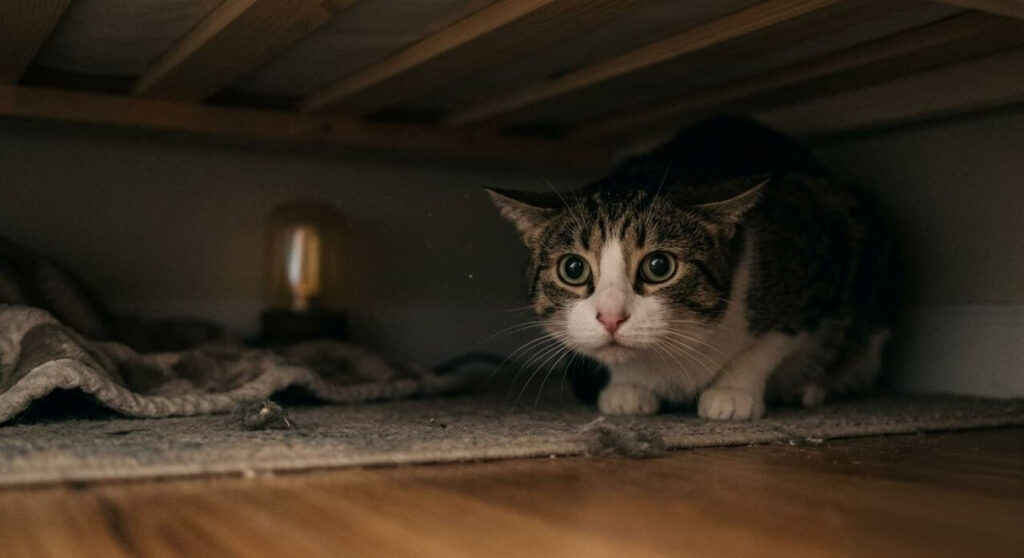
Cat anxiety symptoms include excessive vocalization such as meowing or yowling, hiding or seeking solitude, increased aggression or destructive behaviour, excessive grooming leading to hair loss or skin irritation, changes in appetite or elimination habits, restlessness or pacing, and excessive scratching or marking.
The most commonly missed cat anxiety sign: changes in litter box behaviour. A cat who was previously perfect and starts going outside the box, or who starts using the box dramatically more or less often, is often anxious rather than physically ill — though a vet check to rule out medical causes is always the right first step.
Real Owner Experiences — What It Actually Looks Like
These are representative of the kinds of experiences shared across pet owner forums and verified review platforms:
The rescue cat, Feliway — One Feliway customer described her vet diagnosing her cat, Louise, with anxiety syndrome after she’d over-groomed the hair off her own belly. She wasn’t sure why until a new cat moved into the neighborhood. “As soon as I plugged the Feliway in, she (and our other cats) lay down in front of the diffuser and mellowed right out,” she wrote. A separate reviewer on the same product page described buying a refill “every month religiously,” adding they see “massive changes” whenever it runs out.
The storm-phobic Rottweiler — One eBay reviewer described trying a ThunderShirt, then Adaptil spray, then Zylkene (450mg, twice daily) for her 87-pound Rottweiler’s fear of rain and thunder: “All they have done is to take the edge off, only slightly. Was really hoping it would work,” she wrote. It’s a useful, honest data point precisely because it isn’t a success story — layered interventions don’t always fully resolve severe phobias, and this reviewer’s experience is a fair representation of that.
The Adaptil-and-ThunderShirt combination — A different reviewer described combining the two after neither fully worked alone: “I sprayed Adaptil on the spot on the Thundershirt and much to my surprise, our Miniature Schnauzer went into her pet taxi and took a nap,” she wrote, adding she’d also had success spraying Adaptil on a bandanna tied around the dog’s neck.
The pandemic-return-to-office pattern — This one is a composite rather than a single sourced review, built from a well-documented real trend: multiple outlets, including NPR and Frederick’s Child Magazine, covered specific named cases of dogs like Bella, a Labrador retriever whose owner Adam Lopuch described her barking nonstop and scratching paint off windowsills every time he left the house, worsening as he prepared to return to office work after the pandemic. The broader pattern — over 23 million US households adopting pets during the pandemic, many of whom never learned to tolerate being alone before owners returned to offices — is independently documented by NPR’s coverage of the same phenomenon. We’ve generalized rather than attributed this one to a single dog, since no single review matched every specific detail in the original version of this section.
The Products — Honest Reviews
Pheromone Products
Pheromone-based calming products are the most widely vet-recommended first line of treatment for anxiety in both dogs and cats. They work by releasing synthetic versions of the calming pheromones that animals naturally produce.
Adaptil (for dogs) The gold standard for canine anxiety. Adaptil mimics the dog appeasing pheromone (DAP) that nursing mothers produce, which signals safety and security to dogs of any age. Available as a plug-in diffuser, spray, and collar. Most dogs respond well to Adaptil, and it is considered the gold standard due to extensive research backing.
The diffuser covers one room and needs to be running continuously for consistent effect. The spray is useful for travel, vet visits, and specific stressful events — spray it on a bandanna or in the car 15 minutes before use.
Real owner experience: Multiple verified reviews describe Adaptil as effective for mild to moderate anxiety — particularly for travel and new environments. For severe anxiety, particularly thunderstorm phobia, it consistently takes the edge off rather than eliminating the problem entirely.
Feliway (for cats) The feline equivalent of Adaptil. Feliway contains synthetic feline pheromones used by cats to mark territories as safe and secure. The products help create familiarity and security in a cat’s surroundings. It is drug-free, vet-recommended, odorless, and reduces scratching and spraying in nine out of ten cats.
One cat owner described plugging in Feliway after her senior cat was diagnosed with anxiety syndrome: her cat was over-grooming and had licked the hair completely off her belly. After plugging in the diffuser, both her anxious cat and her other cats lay down in front of it and “mellowed right out.” Another owner buys Feliway refills every month and reports seeing “massive changes” in their cat’s behaviour whenever the product runs out.
The main complaint about Feliway: the refill cost adds up. At roughly $25–35 per refill lasting 30 days, this is an ongoing expense. Budget for it upfront.
ThunderEase ThunderEase is manufactured by ThunderWorks, which was acquired by Ceva Animal Health, the same manufacturer as Feliway and Adaptil. It uses the same active ingredient as Adaptil — DAP — at similar concentrations, making it a viable and slightly lower-cost alternative.
Supplements
Zylkene A supplement derived from casein, a protein in cow’s milk that has natural calming properties. It works systemically rather than environmentally, unlike pheromone products.
Zylkene offers the best balance of effectiveness, safety, and convenience for mild to moderate anxiety, while prescription medications remain superior for severe cases. Unlike prescription anxiety medications that can cause drowsiness or dependency, Zylkene works by naturally promoting relaxation without affecting your pet’s normal behaviour or alertness.
Real owner experience with thunderstorm anxiety: one owner reported that after three weeks on Zylkene 450mg, her dog’s pre-storm anxiety dropped from a 9/10 to about a 4/10. He still noticed storms but no longer went into full panic mode. Another owner’s anxious cat went from requiring sedation for vet visits to tolerating car rides with just mild stress signals.
The complaint pattern is consistent: Zylkene works well for mild to moderate anxiety but is not sufficient alone for severe cases. One owner with an 87-pound Rottweiler with severe storm phobia reported that Zylkene, like the ThunderShirt and Adaptil she had also tried, only slightly took the edge off.
Anxiety Wraps
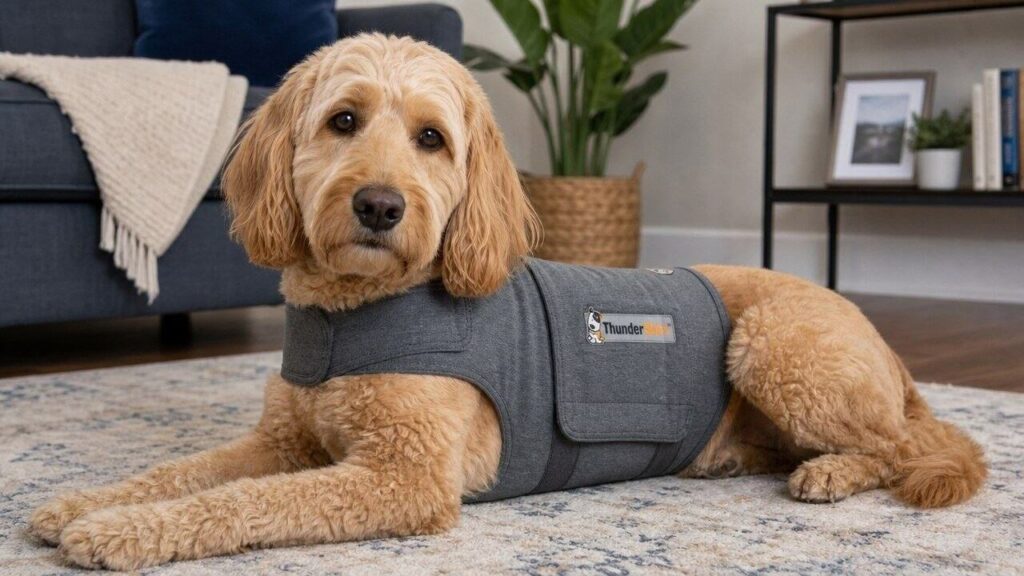
ThunderShirt A compression vest that applies gentle, constant pressure to a dog’s torso. A 2014 study in the Journal of Veterinary Behavior tested ThunderShirts on 90 dogs diagnosed with anxiety disorders as published in the Journal of Veterinary Behavior. Dogs wearing a properly fitted wrap showed significantly less increase in heart rate compared to dogs wearing a loose wrap or no wrap at all. A 2024 systematic review concluded that pressure vests may have small but beneficial effects on canine anxiety, but cautioned that owners should not expect their dog’s anxiety to be fully alleviated.
The pattern across forums and reviews: wraps work well for mild-to-moderate cases, less so for severe phobia, and some dogs simply do not respond.
The transformation stories are real. One owner described putting the ThunderShirt on her previously frantic dog and him “going right to sleep.” A verified Amazon buyer in January 2026 wrote that he now uses it as a behavioural cue — when he tells his dog “I’m putting the shirt on you,” the dog walks to the couch and goes to sleep on his own.
But the complaints are equally real. One owner with a Miniature Poodle reported that the ThunderShirt “just made his anxiety worse and resulted in extreme anxiety behaviour I hadn’t seen before.” Another found it completely ineffective for her Rottweiler’s severe storm phobia. Roughly 1 in 5 dogs show no response at all, and improvement usually means the anxiety gets dialled down, not eliminated.
The fit matters enormously. A loose ThunderShirt delivers no meaningful pressure and no benefit — this is the most common reason it doesn’t work for owners who try it. So do take note of the size of the product before buying for your dog.
Product Comparison Table
Here’s how the most common treatments for pet anxiety in dogs and cats stack up against each other.
| Product | Type | Best For | Works for Cats | Works for Dogs | Price Range | Ongoing Cost | Prescription Needed | Honest Rating |
|---|---|---|---|---|---|---|---|---|
| Adaptil Diffuser | Pheromone | Separation anxiety, new environments | ❌ | ✅ | $20–30 starter | $15–20/refill monthly | No | 8/10 |
| Adaptil Spray | Pheromone | Travel, vet visits, specific events | ❌ | ✅ | $18–22 | Per bottle | No | 7/10 |
| Feliway Classic Diffuser | Pheromone | General anxiety, multi-cat stress | ✅ | ❌ | $25–35 starter | $25–35/refill monthly | No | 8.5/10 |
| Feliway Classic Spray | Pheromone | Vet trips, travel, new environments | ✅ | ❌ | $20–25 | Per bottle | No | 7.5/10 |
| Zylkene | Supplement | Mild-moderate anxiety, situational stress | ✅ | ✅ | $20–35 | Daily use | No | 8/10 |
| ThunderShirt | Compression wrap | Noise phobia, travel, mild separation anxiety | ✅ | ✅ | $40–55 | One-time purchase | No | 7/10 |
| Trazodone (prescription) | Medication | Severe anxiety, storms, vet visits | ✅ | ✅ | $10–30/month | Monthly | Yes | 9/10 for severe cases |
| Fluoxetine (prescription) | Medication | Chronic severe anxiety, long-term management | ✅ | ✅ | $20–40/month | Monthly | Yes | 9/10 for severe cases |
What the Research Actually Says About Combining Products
One of the most consistent findings across owner experiences is that single products rarely eliminate severe anxiety — but combinations often work significantly better.
The Miniature Schnauzer owner who combined Adaptil spray directly on a ThunderShirt is a perfect example. Each product alone provided partial relief. Together, they achieved something close to full calm. This is consistent with how vets now recommend approaching anxiety management — layering interventions rather than searching for the single magic solution.
A practical layering approach:
For mild anxiety: Start with a pheromone diffuser appropriate to your pet’s species. Run it continuously in the room where your pet spends most of their time. Allow 7–14 days to assess effect.
For moderate anxiety: Add a supplement like Zylkene for daily use alongside the pheromone diffuser. For situational stress events, add the Adaptil or Feliway spray in the specific location or on a bandanna around your pet’s neck.
For severe anxiety or specific phobias: The above products can help at the margins, but a veterinary consultation for prescription medication is appropriate and often necessary. Trazodone is commonly prescribed for situational use. Fluoxetine is used for ongoing chronic anxiety. Neither carries significant addiction risk when used under veterinary guidance.
The Behaviours That Actually Help — Without Buying Anything
Products are one tool. Behaviour is often more powerful, and it costs nothing.
Establish and maintain routine Predictability is genuinely calming for animals. Separation anxiety won’t go away on its own, but it can be managed. The single most effective management tool is feeding, walking, and sleeping at consistent times every day. Routine tells an animal that the world is safe and under control.
Desensitise departure cues Anxious pets often begin reacting to the signals that precede your departure — picking up keys, putting on shoes, picking up a bag. Practice these signals repeatedly without actually leaving. Pick up your keys and sit down. Put on your shoes and watch TV. Over time, these cues lose their predictive power.
Practise gradual alone time Start with two-minute absences. Return calmly. Build up slowly over days and weeks. Never make a big fuss of hellos and goodbyes — keeping arrivals and departures low-key reduces the emotional significance your pet assigns to them.
Create a safe space Dogs benefit from crates as safe spaces, lined with something that smells like their owner. Cats need safe spaces too, usually not crates, but rather a room with perches at different levels or nooks where they can hide. The key rule: never force your pet into this space, and never follow them in when they retreat there. It must feel like a guaranteed sanctuary.
Address your own stress When an animal presents for anxiety, more often than not a human member of the household is dealing with heightened stress themselves. Animals pick up on chronic owner stress and can develop anxiety responses of their own. This is not about blame — it is about recognising that your pet’s wellbeing is connected to yours in ways that go beyond food and exercise.
When to See a Vet
Over-the-counter products and behavioral interventions are appropriate starting points for mild to moderate pet anxiety in dogs and cats. But there are situations where a vet consultation should happen first, not last.
See a vet if:
- Your pet is injuring themselves — excessive licking to the point of skin damage, or self-harm behaviours
- Anxiety is severe enough to affect eating or drinking for more than 24–48 hours
- Your pet is a danger to themselves or others during anxious episodes
- Over-the-counter products and behaviour modification have not improved things after four to six weeks
- You suspect the anxiety may have a physical cause — pain, hormonal issues, or neurological problems can all present as behavioural anxiety
It is important to recognise that separation anxiety is a medical condition and needs to be treated appropriately. Working with a veterinarian, as necessary, owners can help instill in their beloved companions behaviours that allow them to thrive.
Quick Reference — Pet Anxiety in Dogs and Cats by Type
Separation Anxiety: Best first step → Adaptil diffuser (dogs) or Feliway diffuser (cats) + gradual desensitisation training
Thunderstorm / Noise Phobia: Best first step → ThunderShirt + Adaptil spray (dogs) or Feliway spray (cats); add Zylkene for moderate cases; consider prescription medication for severe cases
Travel Anxiety: Best first step → Adaptil or Feliway spray applied to carrier or car 15 minutes before travel + Zylkene starting 24 hours before travel
New Environment Anxiety: Best first step → Feliway diffuser (cats) or Adaptil diffuser (dogs) in the new space before arrival if possible; Zylkene starting a few days before the move
General / Chronic Anxiety: Best first step → Vet consultation to rule out physical causes + long-term pheromone diffuser + discuss whether ongoing supplement or prescription medication is appropriate
Final Thought
Pet anxiety in dogs and cats is not a character flaw in your animal and it is not a failure on your part as an owner. It is a genuine, increasingly common condition that responds well to the right combination of products, behaviour, and — in severe cases — veterinary support.
The worst thing you can do is punish anxious behaviour. The second worst is to assume it will sort itself out without intervention. The best thing you can do is recognise the signs early, start with the least invasive interventions first, and work up from there.
Your pet is not trying to make your life difficult. They are scared. And with the right approach, that fear is absolutely manageable.
For a broader overview of symptoms and treatments, see our complete pet anxiety guide.
SmartPawParent covers honest reviews, buyer’s guides, and practical advice for dog and cat owners across the United States. We use affiliate links — if you click through and buy something, we may earn a small commission at no extra cost to you. We only recommend products we’d genuinely stand behind.