
New Pet Owner Guide Singapore: The Complete Starter Edition
This new pet owner guide Singapore edition starts with the rule nobody else mentions: your flat type decides which dog you’re legally allowed to own, before you even pick a breed. That’s the thing that gets new owners fined.
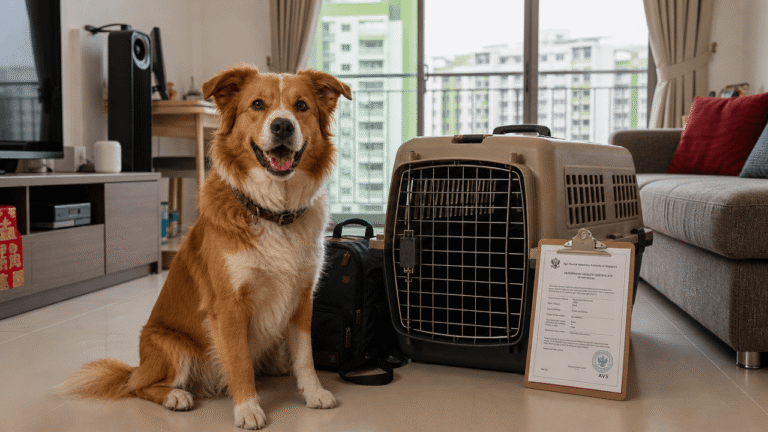
If you live in an HDB flat, you can keep exactly one dog, and it has to come from a list of 62 approved breeds. If you live in a condo or landed property, the rules loosen considerably. Get this backwards and you’re not looking at a warning — you’re looking at a fine of up to S$4,000 and a forced rehoming of a pet your family has already fallen in love with.
This guide covers what actually matters before you bring a pet home in Singapore: the HDB rules, the licensing system, the exact parasite-prevention dosing by weight, the real costs in SGD and USD, and a licensing deadline for cat owners that’s closing faster than most people realise.
Quick Answer — What You Need to Know Right Now:
| Your Situation | What You Need to Do | Deadline |
|---|---|---|
| You live in an HDB flat, want a dog | Check the 62-breed approved list first | Before you buy/adopt |
| You live in an HDB flat, want a cat | Up to 2 cats allowed, no breed restriction | Licence by 31 Aug 2026 |
| You already own a cat | License it on PALS — it’s still free | 31 Aug 2026 (then fees apply) |
| You want a “Singapore Special” | Look into Project ADORE, not the standard list | Apply through an approved AWG |
| You’re considering a Pit Bull, Akita, or similar | Don’t — it’s prohibited from import entirely | N/A |
| You live in private property | Up to 3 pets, more breed flexibility | Still requires AVS licensing |
All prices in this guide are listed in SGD with USD conversions for reference. Exchange rates fluctuate — treat USD figures as approximate.
Table of Contents
- Can You Even Get the Dog You Want? HDB vs Private Property Rules
- The 62-Breed List, Project ADORE, and What Happens If You Get It Wrong
- Cats Are Different: The 2024 Rule Change and Your August 2026 Deadline
- Licensing Your Pet: AVS, PALS, and the Exact Fees by Scenario
- Before Your Pet Comes Home: The Singapore-Specific Checklist
- The First 24 Hours
- Parasite Prevention in a Tropical Climate: Exact Weight Classes
- What New Singapore Pet Owners Get Wrong
- Where to Buy:
- The Real Cost of Pet Ownership in Singapore
- Official Links & Regulatory Checklist
- The Verdict: Your New Pet Owner Guide Singapore Takeaway
1. Can You Even Get the Dog You Want? HDB vs Private Property Rules
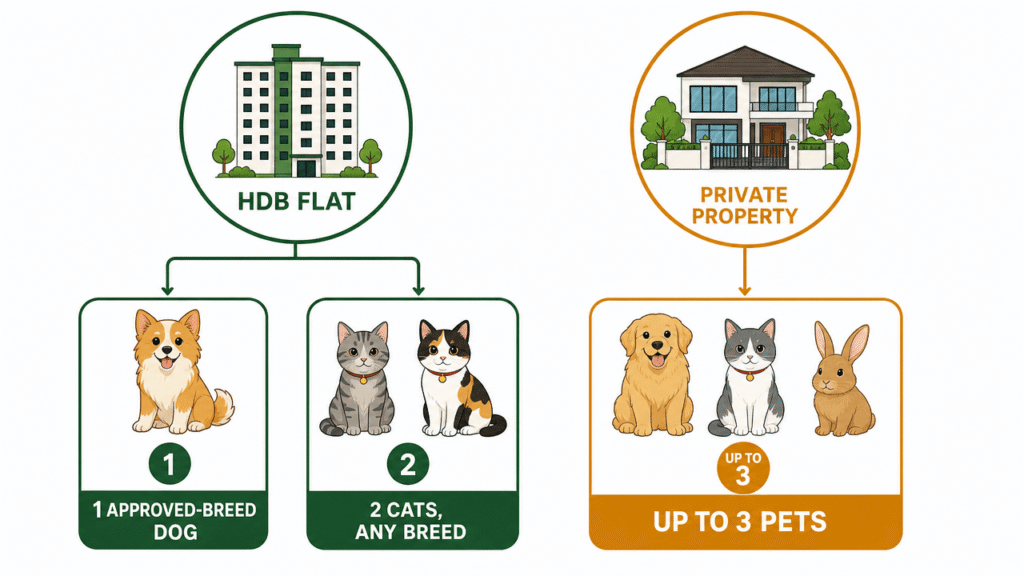
About 80% of Singapore residents live in HDB flats, which makes this the rule that affects nearly everyone reading this.
HDB flat: One dog, and it must be from the HDB-approved breed list (covered next). No exceptions for “he’s basically the same size” or “she’s really well behaved.” Cats are different — up to two per flat, any breed, since the rules changed in September 2024.
Private property (condo, landed house): Up to three dogs total. Breed restrictions loosen significantly — most breeds outside the prohibited/specified list are fine. Condos can still set their own by-laws through the Management Corporation Strata Title (MCST), so check your specific development’s rules even if AVS says you’re fine.
The fine for keeping a non-approved breed in an HDB flat is up to S$4,000, and HDB can require you to rehome the dog. This isn’t a theoretical risk — it’s actively enforced.
2. The 62-Breed List, Project ADORE, and What Happens If You Get It Wrong
The HDB-approved list runs alphabetically from Affenpinscher to Yorkshire Terrier — 62 breeds in total, generally small-to-compact dogs suited to high-density living. Popular examples include the Maltese, Shih Tzu, Pomeranian, Chihuahua, Bichon Frise, Toy and Miniature Poodle, Dachshund, and Border Terrier.
Notably not on the approved list, despite being common in Singapore homes: Corgis, Golden Retrievers, Siberian Huskies, Labrador Retrievers, and Shiba Inus. These are excluded mainly for size, energy level, or barking/working instincts that don’t suit flat living — not because they’re dangerous.
If you want a larger or mixed-breed dog, there’s a real pathway: Project ADORE. This scheme, run by AVS and HDB together with approved animal welfare groups, lets HDB residents adopt local mixed-breed dogs (“Singapore Specials”) that would otherwise be excluded for size.
Project ADORE requirements:
- Shoulder height up to 55cm (the old 15kg weight cap was removed in 2020 — height is now the only physical limit)
- Must be sterilised, microchipped, and licensed
- Adoption must go through an AVS-approved Animal Welfare Group — SPCA, SOSD, Action for Singapore Dogs (ASD), or Causes for Animals Singapore
- Mandatory obedience training with an AVS-accredited or ADORE-approved trainer
- A signed Code of Responsible Behaviour
- Adoption fee around S$300 (~US$220), which typically covers vaccination, microchipping, and sterilisation
- One dog per flat, same as the standard rule
There’s also a lesser-known Project ADORE K-9 Scheme for adopting retired sniffer dogs from SAF, SCDF, and SPF K-9 units. Only four breeds qualify: Labrador Retriever, English Springer Spaniel, Cocker Spaniel, and Pointer. This is open to the general public, not just former handlers, through organised adoption drives.
Breeds you cannot bring into Singapore at all
AVS maintains a list of “Specified Dogs” — breeds it considers higher-risk. Some are prohibited from import entirely; others can be kept under heavy restriction in non-HDB housing only.
Prohibited from import for sale, visit, or permanent stay: Pit Bull types (including American Pit Bull Terrier, American Staffordshire Terrier, Staffordshire Bull Terrier, and American Bulldog), Akita, Neapolitan Mastiff, Tosa, Dogo Argentino, Fila Brasileiro, Boerboel, and Perro de Presa Canario — plus any crosses of these breeds.
If a Specified Dog is already licensed (grandfathered in under older rules) and kept on private, non-HDB property only, the owner faces additional conditions: mandatory leash and secure muzzle in all public places, sterilisation if over six months old, a minimum S$100,000 liability insurance policy, and a banker’s guarantee (figures cited range S$2,000–S$5,000 depending on source — confirm the current figure directly with AVS before relying on it). None of this is permitted in an HDB flat under any circumstances, regardless of licensing status.
If you’re not sure whether a breed or mix is on the Specified list, don’t guess. Crosses involving any Specified breed are classified the same as the purebred — including a Labrador/Pit Bull mix, which is fully prohibited despite the Labrador parentage.
3. Cats Are Different: The 2024 Rule Change and Your August 2026 Deadline
Cats were banned from HDB flats for 34 years. That changed on 1 September 2024.
Under the Cat Management Framework 2024, HDB residents can now keep up to 2 cats per flat, with no breed restriction at all. The catch — and this is the part with a genuine deadline — is licensing.
Every pet cat in Singapore must now be microchipped and licensed through PALS (Pet Animal Licensing System). During the transition period, from 1 September 2024 to 31 August 2026, licensing is completely free. After that date, fees apply, and an unlicensed cat can be fined up to S$5,000.
As of writing, you have a little over two months left in the free window. If you own a cat and haven’t licensed it yet, this is genuinely one of the more time-sensitive things in this entire guide.
To license your cat:
- Microchip your cat (if not already done) — your vet can do this in a routine visit
- Complete the free, one-time online Pet Ownership Course (roughly 30 minutes) on the AVS website
- Apply via PALS at pals.avs.gov.sg using SingPass
- Upload your sterilisation certificate if applicable — sterilised cats get a free lifetime licence during the transition period; if you don’t have the certificate yet, you can self-declare during this window
Community cat caregivers don’t need to license community cats, but registering them with AVS for traceability is encouraged.
4. Licensing Your Pet: AVS, PALS, and the Exact Fees by Scenario
All dogs and cats aged 3 months or older must be licensed under the Animals and Birds (Licensing and Control of Cats and Dogs) Rules, managed by AVS via PALS at pals.avs.gov.sg. Microchipping comes first — you need the chip number before you can even start the application. As a baseline: a sterilised dog runs S$15 for a 1-year licence, an unsterilised one up to S$90, and cats are completely free to license right now, but only until 31 August 2026.
That’s the version most people need. If you want every fee tier broken down (including Project ADORE rates, the full Specified Dog insurance and guarantee requirements, the exact PALS step-by-step process, and what to do at life events like moving house or losing a pet), we cover all of it in a dedicated guide: 👉 AVS Dog & Cat Licensing in Singapore — The Complete Guide
5. Before Your Pet Comes Home: The Singapore-Specific Checklist
- Confirm your housing type’s rules before you commit to a breed — this is the single most common and most expensive mistake.
- Book the microchipping appointment early. You need the chip number before you can even start the PALS application.
- Heat and humidity planning. Singapore’s climate means short walks during peak heat (typically late morning to mid-afternoon), constant access to water, and caution with flat-faced breeds that already struggle with heat regulation.
- Check your specific condo’s pet by-laws if you’re in private property — MCSTs can restrict pets independently of AVS rules.
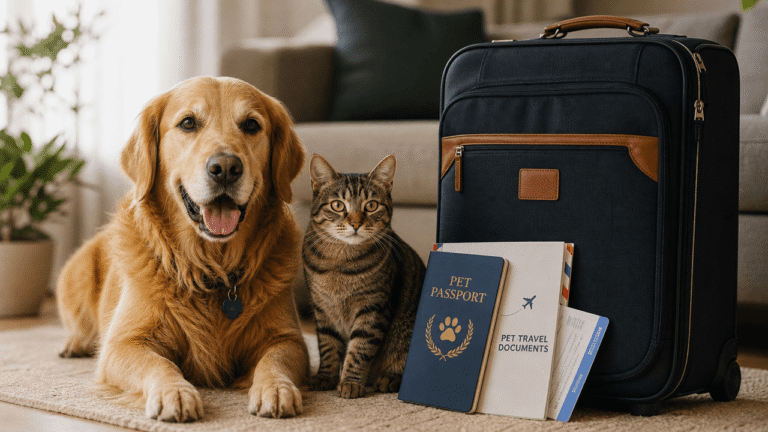
- If importing a pet from overseas, check AVS’s country-category import requirements (vaccination timing, rabies serology windows) well in advance — these requirements vary by the exporting country’s disease-risk category and can change, so re-check close to your travel date.
6. The First 24 Hours
The adjustment period is identical in substance to anywhere else in the world — a new pet experiencing unfamiliar smells, sounds, and absence of littermates is under real stress, and the first 72 hours set the tone. What’s different here is the environment: HDB corridors carry sound easily (a barking dog is a neighbour-relations issue fast), lift rides can be genuinely frightening for a small dog’s first exposure, and the heat means car transport (if you’re using one) needs air-conditioning running before the pet gets in, not after.
Keep the first walk short, keep introductions to neighbours calm and brief, and don’t schedule the vet visit and the microchip appointment for the same overwhelming first day unless necessary.
7. Parasite Prevention in a Tropical Climate: Exact Weight Classes
Singapore’s climate means flea, tick, and mosquito exposure is realistically year-round, not seasonal. Mosquito-borne heartworm risk in particular doesn’t take a break the way it might in a temperate climate, so “treat in summer” advice from US or UK sources doesn’t apply here.
NexGard (afoxolaner) is dosed strictly by weight, and giving the wrong size either underdoses your dog or wastes product. Here’s the official chart:
| Dog Weight | Chewable Size | Afoxolaner per Chew |
|---|---|---|
| 2 – 4 kg | 0.5 g | 11.3 mg |
| 4.1 – 10 kg | 1.25 g | 28.3 mg |
| 10.1 – 25 kg | 3 g | 68.0 mg |
| 25.1 – 50 kg | 6 g | 136.0 mg |
| Over 50 kg | Combine chewables per vet guidance | — |
Standard dosage across all sizes is 2.5 mg of afoxolaner per kg of bodyweight, once monthly. Never split or combine smaller chews to approximate a larger dose — the active ingredient isn’t evenly distributed for cutting, and stacking small doses isn’t equivalent to one correctly-sized chew. Suitable from 8 weeks of age. NexGard covers fleas and ticks but not heartworm — for that, you need a separate heartworm preventive, or a combination product. Talk to your vet about a complete parasite plan given Singapore’s year-round mosquito exposure.
Side effects are uncommon but can include vomiting, diarrhoea, lethargy, reduced appetite, itching, and rarely seizures — dogs with a seizure history should be evaluated by a vet before starting any isoxazoline-class product.
8. What New Singapore Pet Owners Get Wrong
The single most common mistake: falling in love with a breed online, then discovering it’s not HDB-approved after the deposit is paid or the adoption is half-arranged. Check the approved list — or whether Project ADORE applies — before you commit emotionally or financially.
Second most common: assuming a microchip and a licence are the same step. They’re not. You need the microchip number before you can even start the PALS licence application — book the vet appointment first.
Cat owners specifically: a real number of long-time cat owners simply haven’t licensed yet, on the assumption that “free” means “optional” or “not urgent.” It’s neither. The free window closes 31 August 2026, and after that the fee structure and the fines both apply in full.
First-time owners in HDB flats consistently underestimate sound transfer through walls and corridors. A dog that’s perfectly calm in your unit can become a noise complaint generator the moment it reacts to corridor foot traffic — invest in basic settling training before it becomes a neighbour dispute.
9. Where to Buy:
| Platform | Best For | Trade-off |
|---|---|---|
| Pet Me Please SG (Joo Chiat) | On-demand, ethical sourcing. Unlike traditional pet stores where animals wait behind glass panels, they primarily secure and import the puppy only after matching with a confirmed owner. This reduces early cage-stress, and they offer extensive post-purchase guidance. | No instant walk-in purchases. Because they prefer matching puppies to owners beforehand, you generally cannot just walk in, pick a puppy on the spot, and take it home the same day. |
| Cats & Co. (Boutique Specialist) | Premium, health-certified pedigreed kittens. They provide meticulous lineage tracking, providing buyers with a 5-generation bloodline certificate, extensive DNA testing of the parent cats (for FeLV/FIV), and a year of complimentary pet insurance. Kittens are raised cage-free in a home-like environment to ensure excellent early socialization. | Very high financial premium. Pedigree lineages, extensive DNA health screens, and premium care structures mean the purchase price sits at the absolute top tier of the market |
| The Lovely Pets (Jalan Limbok) | Rigorous pre- and post-arrival medical checks. Puppies undergo comprehensive vet assessments (checking heart, lungs, eyes, ears, and checking strictly for patella luxation) both before flying to Singapore and immediately upon arrival. Buyers get a direct line to the owner for localized, lifelong advice | Strictly appointment-based viewing. Located away from major commercial malls, you must pre-book specific viewing slots through their appointment system, meaning it lacks the accessibility of a casual retail shop |
| SPCA Singapore & Animal Shelters | Massive cost savings and ethical impact. Adoption fees are incredibly low (ranging from roughly $70 to $350 depending on age and pedigree status). You actively save a life and combat the commercial pet trade. | Rigorous screening and unknown history. Shelters enforce strict background checks, mandatory housing/premises inspections, and require all household members to attend multiple interviews. Furthermore, mixed-breed rescue animals may carry unpredictable adult sizes or past behavioral traumas that require patience to train. |
For anything safety-critical — parasite prevention, prescription diets, medication — buying through a licensed vet clinic or a verified pet shop (AVS publishes a licensed pet shop list) is worth the price premium over an unverified online seller, given how easy counterfeit parasiticides are to mimic in packaging.
10. The Real Cost of Pet Ownership in Singapore
| Cost Category | Typical Range (SGD) | USD equivalent* |
|---|---|---|
| Microchipping | S$30–60 | ~US$22–44 |
| Dog licence, sterilised (1st year) | S$15 | ~US$11 |
| Cat licence (until 31 Aug 2026) | S$0 | $0 |
| Parasite prevention (monthly) | S$15–40 | ~US$11–29 |
| Annual vaccinations (dog booster) | S$80–150 | ~US$58–110 |
| Annual dental cleaning | S$300–600 | ~US$220–440 |
| Monthly food & supplies | S$30–80 | ~US$22–58 |
| Routine vet care (monthly average) | S$30–60 per pet | ~US$22–44 |
*USD figures are approximate and will shift with exchange rates — treat them as a rough reference point, not a live conversion.
Lifetime ownership cost in Singapore is commonly estimated around S$50,000–60,000 for a dog and S$40,000–45,000 for a cat, factoring in food, routine and emergency vet care, grooming, and supplies over a typical lifespan. Mixed feeding (kibble plus some fresh food) and bulk purchasing are the two most effective ways to bring the monthly average down without compromising on care quality.
11. Official Links & Regulatory Checklist
- Apply for or renew a pet licence via the Pet Animal Licensing System (PALS) — requires SingPass
- For the full fee breakdown, step-by-step process, and Specified Dog conditions, see our AVS Dog & Cat Licensing Guide
- Review HDB’s own pet-keeping guidelines directly via HDB: Guidelines on Keeping Pets
- Check current licensing requirements and fee schedules on the AVS Licensing Requirements page
- Review the Specified Dogs list and conditions directly on the AVS Specified Dogs page before assuming any breed or mix is permitted
- If importing a pet, check current country-category requirements on the AVS pet import pages before booking travel — these requirements can change and should be re-checked close to your travel date
12. The Verdict: Your New Pet Owner Guide Singapore Takeaway
Singapore is a genuinely workable place to own a pet — the system is just unusually procedural compared to a lot of other countries. The HDB breed list and the licensing requirements aren’t obstacles designed to discourage you; they’re the actual rulebook, and the rulebook is enforced.
If this new pet owner guide Singapore edition has one practical takeaway: confirm your housing type’s rules before you fall in love with a specific breed, get the microchip done before you touch the PALS portal, and if you have a cat sitting unlicensed right now, do it this week rather than this year. Free is free until it isn’t.


One Comment