
Real Life with Pets in an HDB Flat: The Problems Nobody Warns You About
A dog barking at every footstep in the corridor isn’t bad luck. It’s usually a herding breed doing exactly what it was bred to do, in a flat that gives it nowhere to put that instinct.
Real life with pets in an HDB flat looks nothing like the breed-approval checklists. Nobody gets fined for picking the wrong name off a list of 62 breeds. People get fined, get reported, or end up rehoming a pet they love because of barking, smell, an open front door, or a separation-anxious puppy nobody trained for alone time. This piece covers the actual day-to-day friction — sourced from real forum threads, real news stories, and real first-hand accounts — and what to do about each one.
This isn’t the place for the breed list or the licence fees. For that, see our Starter Guide’s HDB section and our AVS Pet Licensing guide. Everything below is what happens after you’ve already brought the pet home.
Quick Answer — Jump to Your Problem:
| Your Situation | What’s Actually Going On | Section |
|---|---|---|
| Dog barks at every sound in the corridor | Likely a herding or terrier instinct, not “bad behaviour” | Jump |
| Left the front door open for the dog to “see outside” | This is the #1 cause of nuisance-barking complaints | Jump |
| Puppy howls when left alone | Possible separation anxiety — treatable, not permanent | Jump |
| Dog seems withdrawn or low-energy | Confinement and boredom, not necessarily illness | Jump |
| Considering a husky, Samoyed, or similar | Not HDB-approved, and there’s a welfare reason why | Jump |
| Multiple cats, strong smell complaints | Litter management and ventilation — fixable before it’s a crisis | Jump |
| Neighbour reported you | There’s a real ladder before anything serious happens | Jump |
| Want a non-approved breed or a 2nd dog | Possible in some cases — depends entirely on the breed | Jump |
All costs in this guide are listed in SGD with USD conversions for reference. Exchange rates fluctuate — treat USD figures as approximate.
Table of Contents
- Real Life With Pets in an HDB Flat: The Heat Problem
- The Barking Problem: Corgis, Shelties, and the Herding Instinct Nobody Warns You About
- Small Dog Syndrome: Why Chihuahuas and Toy Poodles Get Blamed Most
- The Open Door Mistake
- Off-Leash Walking: The $5,000 Mistake
- Puppy Separation Anxiety: The Howling Nobody Hears Until a Neighbour Does
- Confinement and Boredom: Is Your Dog Actually Depressed?
- Cats in HDB: Falls, Smell, and the 30-Cat Wake-Up Call
- The Complaint Ladder: What Actually Happens When You’re Reported
- Can You Appeal? Getting a Non-Approved Breed or a Second Dog Approved
- Real Life With Pets in an HDB Flat: How to Be a Considerate Owner
- The Verdict
1. Real Life With Pets in an HDB Flat: The Heat Problem
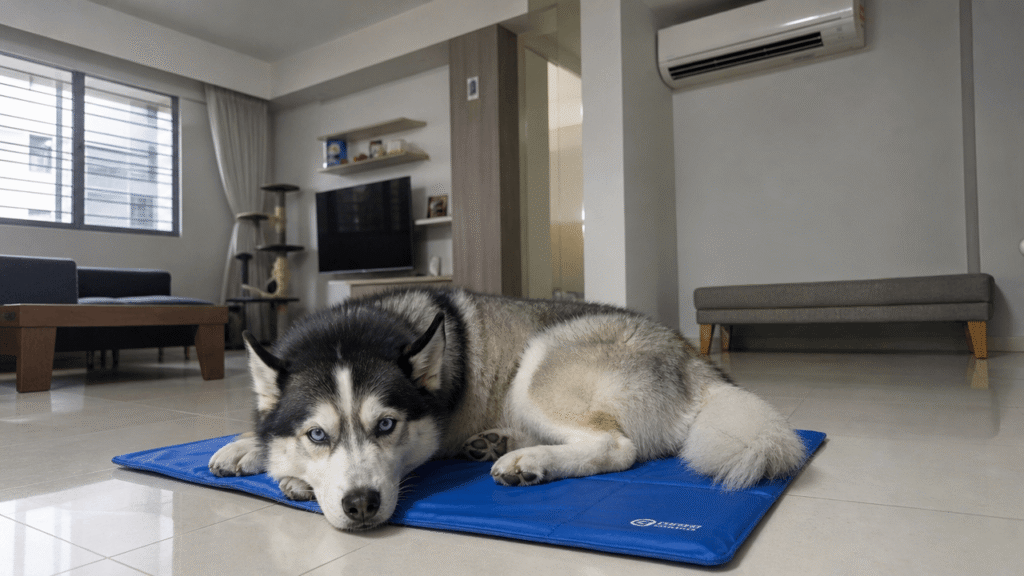
Huskies, Samoyeds, and Alaskan Malamutes are not on the HDB-approved breed list, and forum threads about keeping them here explain exactly why.
Their double coat is built to trap heat for survival in sub-zero conditions — the same coat that makes Singapore’s climate genuinely hard on them, not just uncomfortable.
This isn’t theoretical. In September 2025, Mothership reported on a husky-type dog confined to the service yard of a Toa Payoh HDB unit, with neighbours hearing it howling in distress for hours at a time over several weeks.
AVS officers visited the flat, confirmed the dog was being kept in cramped, unsafe conditions, and seized it that same evening — later identifying the breed as an Alaskan Malamute. The dog was later listed for foster adoption by a chained-dog welfare group.
The case is a clean illustration of why these breeds aren’t HDB-approved in the first place: the heat and space mismatch becomes a welfare issue that authorities do act on, especially once neighbours report it.
If you already have one, or inherited one: keep them indoors with air-conditioning during peak heat, never shave the coat (it insulates against heat as well as cold — removing it backfires), walk only in early morning or late evening, and never leave them on an exposed balcony or service yard for extended periods. Invest in cooling mats helps alot or refer to our blog for future cooling technology to help furkids of such breed
If you’re still deciding, this is a breed where “I’ll manage” usually isn’t enough. Arctic breeds belong in cooler climates or, at minimum, private property with real climate control — not a short-term HDB experiment.
2. The Barking Problem: Corgis, Shelties, and the Herding Instinct Nobody Warns You About
Here’s a detail that surprises a lot of new owners: the Shetland Sheepdog is genuinely on the HDB-approved list. The Corgi is not, and never has been — a dedicated breed guide from Pawrenthood published as recently as March 2026 explicitly warns owners not to count on an “exception letter,” because HDB treats it as a clear non-approved breed, not a borderline case.
Both, however, share the same underlying problem people get blindsided by: they’re herding breeds. As one Singapore-focused dog breed guide puts it, breeds like these are genetically hardwired to bark to direct movement — bred for generations to control the movement of livestock using bark and motion, that instinct doesn’t switch off in a flat.
A Sheltie or a Corgi-cross will often bark sharply at moving objects — a vacuum cleaner, a person entering the room, a delivery rider passing the corridor window. Owners who pick these breeds purely for their looks are frequently the ones blindsided by 6am barking at the cleaner emptying the rubbish chute.
The fix isn’t training the bark away entirely — it’s giving the instinct somewhere to go. That means 1–2 hours of genuinely vigorous outdoor exercise daily, not just a 15-minute corridor walk, plus structured “settle” training so the dog has a default behaviour for movement and noise other than vocalizing. A tired herding dog with a job (even a fake one — fetch, scent games, obstacle courses) barks dramatically less than a bored one.
3. Small Dog Syndrome: Why Chihuahuas and Toy Poodles Get Blamed Most
Search any Singapore pet forum or Reddit thread about problem barking, and Chihuahuas and Toy Poodles come up constantly — not because they’re inherently badly behaved, but because of a pattern trainers call “Small Dog Syndrome.” Because they’re small and undeniably cute, owners often skip the structured training and socialisation a larger breed would get by default — picked up, carried everywhere, treated more like an accessory than a dog with real behavioural needs.
The result, reported again and again by owners and neighbours alike: a dog that’s hyper-reactive, yapping at the slightest sound in the corridor, and never taught that being startled doesn’t require an alarm response.
The fix is uncomfortable but simple: train a small dog exactly as you would a large one. Basic obedience, leash manners, and exposure to corridor noise from puppyhood — not just cuddles. If you’ve already got an adult dog with this pattern, a force-free trainer can still make real progress; it’s a training gap, not a fixed trait of the breed.
4. The Open Door Mistake
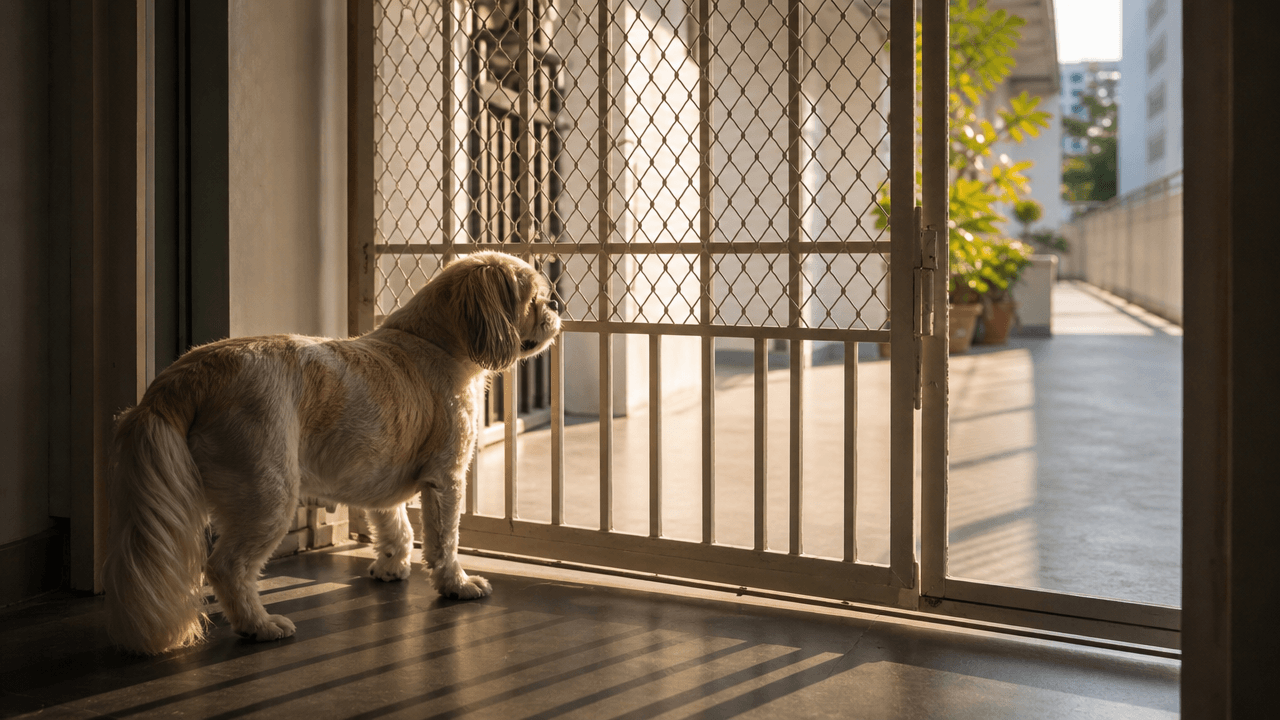
This is a specific, real scenario that shows up repeatedly in complaint threads: an owner leaves the front gate or door open, believing it’s kind to let the dog watch the corridor and “see outside” while they’re home. The dog, predictably, barks at everyone who walks within a few metres.
A Quora thread on exactly this situation pointed the asker toward Singapore’s Miscellaneous Offences (Public Order and Nuisance) Act as the relevant legal angle — meaning this isn’t just an annoyance, it’s something with real legal weight behind a complaint.
The fix: close the gate. If the dog genuinely benefits from visual stimulation, a baby gate with mesh, a window perch facing outdoors, or scheduled supervised time in common areas all give the same enrichment without turning every passer-by into a trigger. This is one of the rare HDB pet problems with an almost zero-cost, same-day fix.
5. Off-Leash Walking: The $5,000 Mistake
Walking a dog off-leash in Singapore isn’t a minor technicality — it’s an offence under the Animals and Birds Rules, carrying a fine of up to S$5,000 (~US$3,650). If your dog runs at a person, vehicle, or cyclist while off-leash, that’s a separate fine of up to S$1,000 (~US$730), and if it actually injures someone, the fine climbs to S$5,000 plus up to S$2,000 in compensation to the injured party.
Owners commonly assume “he’s friendly” or “he always comes back” is a defence. It isn’t, legally or practically — a startled stranger or a sudden motorbike doesn’t know your dog’s temperament, and a single bad interaction during off-leash time is what tends to trigger formal complaints, not just a verbal warning.
The fix: leash in every public space, full stop — corridors, void decks, lift lobbies, parks, even at 6am when the area looks empty. If your dog needs off-leash time to burn energy, look specifically for AVS-recognised dog runs, which have published etiquette guidelines precisely because shared off-leash space requires more structure, not less.
6. Puppy Separation Anxiety: The Howling Nobody Hears Until a Neighbour Does
Many owners have no idea their dog has separation anxiety until a neighbour tells them about the barking or howling — the behaviour often only happens once the owner is actually gone, which is exactly why it goes unnoticed for so long.
Separation anxiety isn’t bad behaviour — it’s genuine distress, and it shows up as persistent barking or howling, destructive chewing near doors and windows, house-soiling in an otherwise toilet-trained dog, or frantic escape attempts. It’s especially common in puppies suddenly left alone for the first time without any gradual buildup.
The fix is gradual, not immediate. Start with separations of just 5–30 seconds and build up slowly over weeks, not days. Leave a stuffed chew toy or puzzle feeder to redirect nervous energy. Set up an IP / wifi camera with voice control function the first few times you leave so you actually know what’s happening rather than guessing & talk to them to help ease your dog anxiety when your away.
If progress stalls after a few weeks of consistent effort, a certified separation-anxiety trainer (several operate in Singapore specifically, using structured desensitisation programmes) is worth the investment before the behaviour hardens into a long-term pattern — and before it becomes the thing your neighbours associate with your flat.
7. Confinement and Boredom: Is Your Dog Actually Depressed?
Veterinary sources are consistent on this: dogs left in solitary confinement for long stretches, with limited mental or physical stimulation, can genuinely develop something that looks like depression — lethargy, loss of interest in favourite activities, appetite changes, withdrawal. It’s not anthropomorphising to take this seriously; it’s a documented behavioural and welfare concern.
In a small flat specifically, the risk factors stack up: less space to move, often no balcony or yard, and an owner working long hours. None of that is automatically a dealbreaker, but it does mean enrichment isn’t optional the way it might be for a dog with a garden.
The fix: treat mental stimulation as seriously as physical exercise. Puzzle feeders, scent-based games (scattering kibble for a “find it” task), rotating toys weekly instead of leaving everything out permanently, and a predictable daily routine all measurably help. If withdrawal persists despite this, rule out a medical cause with a vet before assuming it’s purely behavioural — pain and depression can look identical from the outside.
8. Cats in HDB: Falls, Smell, and the 30-Cat Wake-Up Call
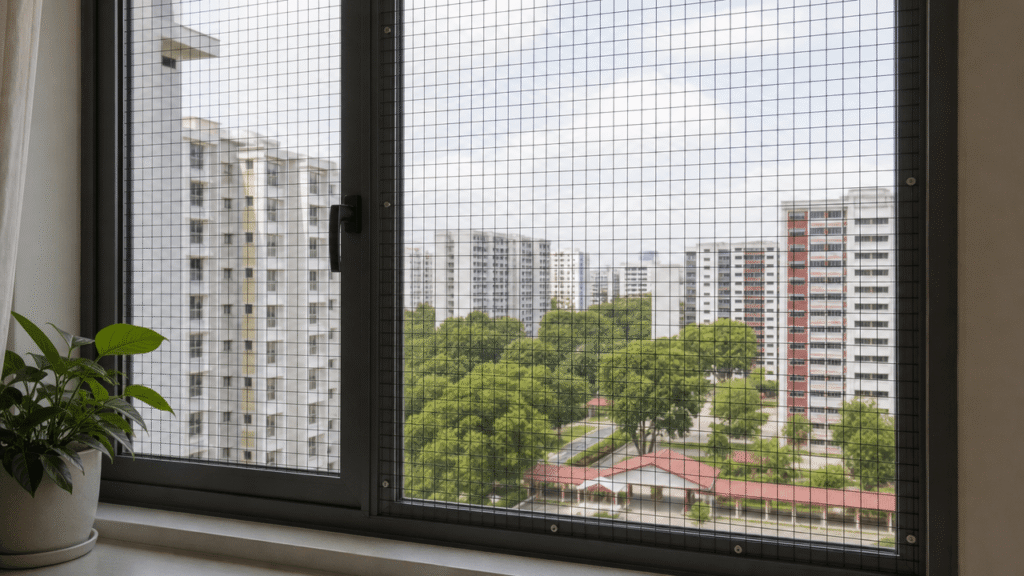
Cat ownership in HDB is genuinely new — legal only since September 2024 — and the two real-world risks that come up again and again are falls and smell.
Falls (“high-rise syndrome”): SPCA Singapore recorded 134 high-rise fall cases involving 141 animals in 2024 alone, the overwhelming majority of them cats. A recurring pattern in these cases: owners assumed they didn’t need mesh because they “usually kept the windows closed” — until once, they didn’t. Cats don’t need much of a gap to squeeze through, and the instinct to chase, balance, or investigate doesn’t pause for height.
The fix: secure mesh or grilles on every window and the gate, not just the ones you think the cat uses. Singapore-based installers commonly charge anywhere from roughly S$400 for an invisible grille panel up to S$3,000+ for a full-flat custom job, with simpler DIY mesh kits available for less — genuinely cheap next to a fall-related emergency vet bill, which commonly runs S$2,000–5,000 (~US$1,460–3,650) or more.
Smell and hygiene is the other recurring issue, and it has a real, extreme cautionary example: in January 2025, Mothership reported on roughly 30 cats found in a single HDB flat in Choa Chu Kang, with neighbours saying the owners hadn’t been seen for days.
SPCA inspectors counted around 30 cats sharing what appeared to be a single litter box, with a foul stench reaching the corridor. Tellingly, inspectors couldn’t even enter the unit on their first attempt — SPCA confirmed it has no legal authority to enter private premises without the owner’s consent, which is exactly why these situations can spiral for days before anyone in authority can intervene directly.
The fix, well short of that extreme: one litter box per cat plus one spare is the standard welfare guideline, scooped at least daily, with a full litter change on a regular schedule rather than “topping up.” Keep litter boxes away from shared walls where odour can transfer, and ensure the flat has genuine airflow — a closed-up flat with no ventilation concentrates smell fast, even with just one or two cats. Sterilisation also measurably reduces territorial spraying and roaming-related odour, beyond the licensing-fee incentive to do it anyway.
9. The Complaint Ladder: What Actually Happens When You’re Reported
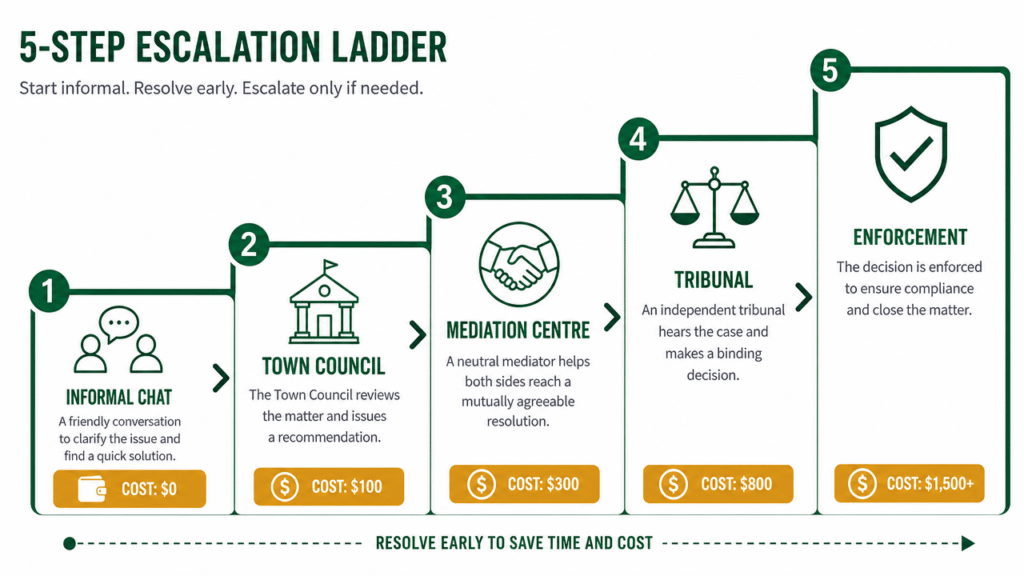
This is the part most coverage of real life with pets in an HDB flat skips entirely, and it matters because the actual process is far less catastrophic than the fear of it.
| Stage | What Happens | Typical Cost |
|---|---|---|
| 1. Informal | Neighbour knocks, messages, or leaves a note | Free |
| 2. RC / Town Council | Mediated conversation, often with a written reminder | Free |
| 3. Community Mediation Centre (CMC) | Neutral third-party mediation session | ~S$5 (~US$3.65) |
| 4. Community Disputes Resolution Tribunal (CDRT) | Formal tribunal hearing, legally binding outcome | ~S$150 (~US$110) |
| 5. HDB Enforcement | Direct enforcement action, including possible licence revocation | Fine up to S$4,000 (~US$2,920) |
The overwhelming majority of complaints never make it past stage 1 or 2. Reaching stage 5 — where HDB actually revokes approval and requires rehoming — is rare, and it’s almost always the result of a sustained pattern of complaints with no visible effort to address them, not a single bad night of barking.
A calm, good-faith response at the very first informal contact — acknowledging the issue and showing you’re taking action — defuses the overwhelming majority of these situations before they ever reach a tribunal. Defensiveness at stage 1 is what tends to push things to stage 4.
If it does reach CDRT, the tribunal’s own legal clinic offers free consultation, and bringing a documented timeline of training efforts, vet consultations, or behavioural changes genuinely affects the outcome.
10. Can You Appeal? Getting a Non-Approved Breed or a Second Dog Approved
This is real, documented, and works in some cases — but not all, and the breed matters enormously.
Real example that worked: one HDB owner wanted a Shiba Inu — not on the approved list — and wrote directly to HDB via their online e-feedback form months before bringing the dog home, explaining the situation. HDB responded with written approval, noting the breed, while technically non-approved, was assessed as a smaller breed temperamentally suitable for flat living. The dog was approved to live in that specific flat.
Real example where it doesn’t work: Corgis. Despite being a similar size to several approved breeds, current guidance is explicit that owners should not plan around getting an exception letter for a Corgi specifically — treat that path as closed, not as a maybe.
The pattern that emerges: appeals tend to succeed for breeds that are borderline on size and temperament (Shiba Inu, certain spitz-types) and tend to fail for breeds HDB has already specifically and repeatedly declined (Corgi, Husky, larger working breeds). There’s no published guarantee either way — every appeal is assessed case by case — but writing in before committing to a specific dog, not after, is the only way to know where you stand without risking a fine or forced rehoming.
If Corgi appeals don’t work, why do so many people already have one in their flat? Enforcement here is complaint and tip-off driven, not proactive — there’s no routine door-to-door check of every flat’s dog against the breed list. A quiet, well-behaved Corgi that never triggers a noise complaint can simply go unchecked for years.
Some existing Corgi owners may also have gotten written approval years ago, when practice was looser than it is now — older accounts of the appeal process list Corgi among the breeds people successfully wrote in for, while current guidance explicitly closes that door. Neither situation means a non-approved dog is actually safe long-term: a future complaint, a licence renewal check, or even a curious new neighbour can surface it at any time, with the same fine and rehoming risk as day one.
For a second dog or extra cats beyond the standard limit: AVS does accept written applications to keep more than the standard number of pets in a private (non-HDB) premises, evaluated case by case against criteria including adequate space, full licensing and microchipping, and no history of nuisance complaints. This route does not exist for HDB flats — the one-dog, two-cat limit there is fixed regardless of appeal, with the sole exception of pre-existing cats grandfathered in under the 2024–2026 transition period.
11. Real Life With Pets in an HDB Flat: How to Be a Considerate Owner
A recurring theme across forum threads, news stories, and even HDB’s own guidance: most pet-related disputes don’t start with the pet. They start with a neighbour feeling like their concerns were never considered in the first place.
For dogs:
- A brief, friendly heads-up to immediate neighbours before a new dog moves in goes further than almost anything else on this list
- Keep the door and gate closed — see section 4
- Leash in every shared space, every time, without exception
- Clean up immediately, every time — fines for not doing so run up to S$1,000
- If you know your dog reacts to a specific trigger (the rubbish chute, the lift door), manage that proactively rather than waiting for a complaint
For cats:
- Mesh every window before move-in day, not after a scare
- One litter box per cat plus one spare, scooped daily
- Sterilise — it reduces spraying, roaming, and caterwauling simultaneously
- If you’re genuinely struggling to keep a cat population manageable, contact an AVS-approved welfare group early — the Teck Whye case escalated specifically because nobody intervened until the situation was already extreme
For both: document your own efforts if a complaint ever happens — dates, what you changed, any training or vet input. It’s not about building a legal case; it’s about being able to show, calmly, that you’re an owner taking the issue seriously rather than one ignoring it.
12. The Verdict
The breed list and the licence fee are the easy part of pet ownership in an HDB flat. The hard part is everything covered here — the instinct you didn’t account for, the door left open out of kindness, the howling you can’t hear because you’re not home to hear it.
None of these problems are unique to Singapore. But the density of HDB living means they surface faster and get noticed sooner than almost anywhere else.
That’s the honest summary of real life with pets in an HDB flat: almost none of it ends in disaster if it’s addressed early. The dogs and cats that get reported aren’t usually owned by bad people — they’re owned by people who didn’t know the fix existed yet.