
Paralysis Tick Prevention for Dogs and Cats in Australia — The Honest Guide (2026)
Written for Australian dog and cat owners on the east coast
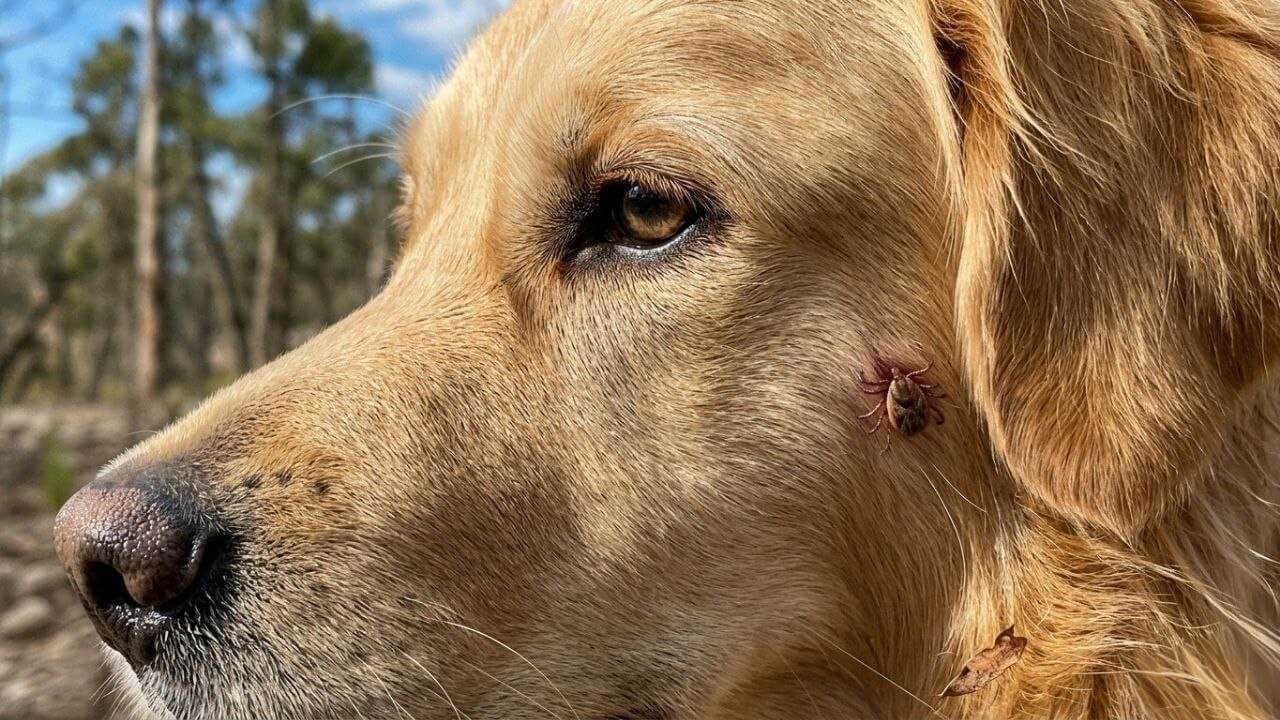
There’s a creature living in the bush around Sydney’s Northern Beaches, the Gold Coast hinterland, and virtually the entire eastern seaboard of Australia that can kill your dog or cat in less than 72 hours. It’s smaller than your fingernail. And it doesn’t care that your pet is on “tick prevention.”
It’s estimated that over 10,000 dogs and cats are paralyzed by paralysis ticks in Australia every year — and unfortunately, many die. This isn’t a fringe risk. If you live anywhere between North Queensland and Northern Victoria and your pet spends time outdoors, paralysis tick prevention isn’t optional.
This guide covers everything you actually need to know — which prevention products work, which ones don’t, what the real-world side effects are, and what to do if your pet gets a tick despite being on prevention.
Quick Answer Box
| Situation | Best Option |
|---|---|
| Dog, no seizure history | NexGard Spectra or Simparica Trio (monthly) |
| Dog, 3-month convenience | Bravecto chews (12 weeks coverage) |
| Cat, east coast Australia | Bravecto Spot-On for Cats (12 weeks coverage) & Bravecto Plus (8 weeks coverage) |
| Dog with seizure history | Avoid isoxazolines — ask your vet about Seresto collar |
| Small dog under 2kg | Consult your vet before using any isoxazoline |
| Indoor-only cat in tick area | Still needs prevention — ticks ride in on clothes |
Table of Contents
What Is the Paralysis Tick and Why Is It Only in Australia?
The paralysis tick (Ixodes holocyclus) is unique to Australia. Although ticks are found all over the world, the paralysis tick is only found in Australia — restricted to the humid east coast from North Queensland to Northern Victoria.
What makes it particularly dangerous isn’t just the fact it feeds on blood. It’s what it injects while it does so. The paralysis tick injects holocyclic toxin into the animal’s bloodstream, affecting the neuromuscular junctions essential for muscle function. This toxin causes muscle weakness and paralysis — typically affecting the hindlegs first, then progressing to the forelegs, and eventually the digestive and respiratory muscles.
That progression — from wobbly back legs to respiratory failure — can happen in under 72 hours from attachment. And a tick can start injecting toxin before it’s even visible to you.
Where Are Paralysis Ticks Found?
The short answer: anywhere along the east coast where there’s humidity, native bush, and wildlife.
In the northern parts of Australia, paralysis ticks may be found all year round. In the southern areas, the season begins in spring and finishes in late autumn. That means Sydney, Brisbane, and the Gold Coast are in the high-risk zone for the better part of the year.
Possums and bandicoots are the natural hosts of the paralysis tick and are usually unaffected by the toxin. So, if your neighborhood has native wildlife — and most suburban backyards do — ticks will follow.
The assumption that ticks only live in dense bush is one of the most dangerous myths in Australian pet ownership. Ticks turn up in suburban backyards, on walking tracks, and an emergency vet has pointed out that ticks can even be brought inside on clothing — which is why tick prevention is recommended even for indoor animals.
Signs of Tick Paralysis — What to Watch For
Early signs include weakness, struggling to walk, vomiting or retching, changes in breathing, and excess salivation. The tricky part is that these signs often look like something else — a stomach upset, a sore leg from running, tiredness after a walk.
You may not see all of these symptoms and often dogs initially present to the vet just with weakness of the hind legs or just retching.
Other warning signs that should prompt an immediate vet visit:
- Wobbly or weak back legs, especially when the front legs seem fine
- A strange change in the sound of their bark or meow
- Laboured breathing or open-mouth breathing in cats
- Gagging or regurgitating food without being able to vomit properly
- Dilated pupils that don’t respond normally to light
- Sudden inability to blink properly
If you’re seeing any of these, don’t wait to see if it resolves. Call your vet immediately. Every hour matters with tick toxin.
Paralysis Tick Prevention: The Products That Actually Work
Let’s be direct here. Not all tick prevention products are created equal, and some that are still sold in Australian pet stores offer genuinely inadequate protection against paralysis ticks.
The Products That Work — Isoxazolines
The modern standard in paralysis tick prevention is the isoxazoline class of drugs — oral tablets or spot-ons that work systemically throughout your pet’s body. When a tick attaches and feeds, it ingests the drug and dies before it can inject a paralysing dose of toxin.
Since Australian vets started recommending NexGard, cases of tick paralysis at some clinics have dropped from 2–3 per week to 2–3 per year. That’s the real-world impact these products have had.
The four main isoxazolines available in Australia for dogs are:
- NexGard / NexGard Spectra — monthly chewable tablet
- Bravecto — chewable tablet lasting 3 months
- Simparica / Simparica Trio — monthly chewable tablet
- Credelio — monthly chewable tablet
The Products That Don’t — Topical Spot-Ons and Collars
Products that rely on being applied to the outside of the animal — Frontline, Advantix, and Seresto — aren’t considered by most vets to be reliable enough for paralysis tick prevention and are easily disturbed by bathing.
Frontline in particular has been largely abandoned by Australian vets for tick paralysis prevention. If your pet is still on Frontline as its primary tick prevention and you live on the east coast, talk to your vet.
NexGard vs Bravecto vs Simparica — The Honest Comparison
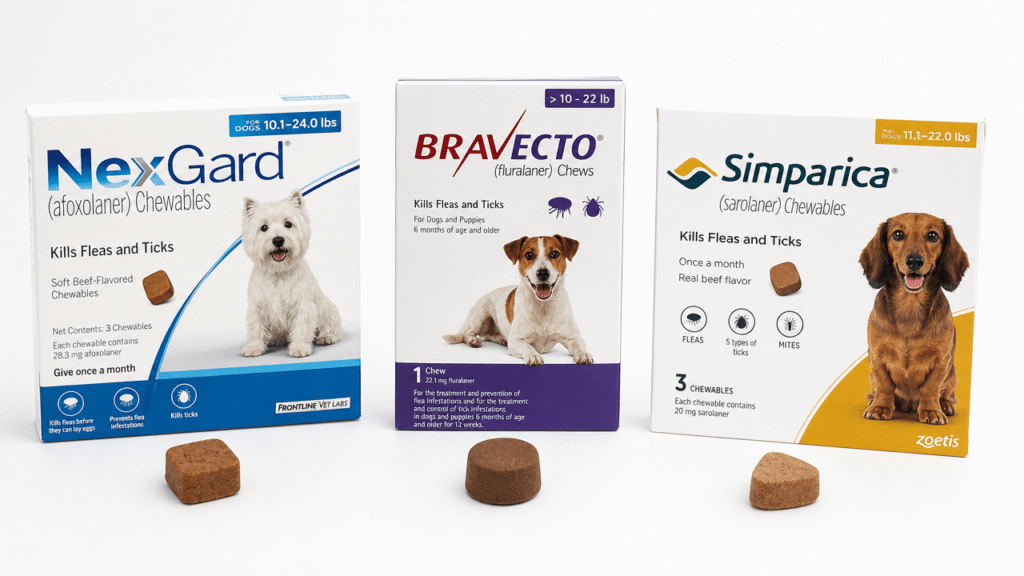
Here’s where it gets interesting. All four isoxazolines are highly effective — but they’re not identical.
| Product | Active Ingredient | Duration | Also Covers |
|---|---|---|---|
| NexGard Spectra | Afoxolaner + Milbemycin | Monthly | Fleas, heartworm, intestinal worms |
| Bravecto Chews | Fluralaner | 3 months | Fleas |
| Simparica Trio | Sarolaner + Moxidectin + Pyrantel | Monthly | Fleas, heartworm, intestinal worms |
| Credelio | Lotilaner | Monthly | Fleas |
NexGard Spectra is the most popular in Australia — largely because it was the first modern isoxazoline on the market here, and because its combination formula covers heartworm, worms, fleas, and paralysis ticks in one monthly chew. For most Aussie dog owners, it’s the most convenient all-in-one option.
Here are the five standard weight ranges (and their color-coded boxes) available for dogs: NexGard
- Orange – Very Small (XS) 2 to 3.5 kg(or 1.35–3.5kg in some regions)
- Yellow – Small (S) 3.6 to 7.5 kg
- Green – Medium (M) 7.6 to 15 kg
- Purple – Large (L) 15.1 to 30 kg
- Red – Extra Large (XL) 30.1 to 60 kg
Important Things to Remember:
- Age & Weight Limits: It can be safely given to puppies from 8 weeks of age, provided they meet the minimum weight requirement (usually at least 2 kg).
- For Giant Dogs (Over 60 kg): If a dog weighs more than 60 kg, veterinarians recommend combining two tablets to match the exact weight (e.g., a 75 kg dog would take one Red XL chew and one Green Medium chew together).
- The 30-Day Rule: For heartworm and tick protection to remain effective, it must be given every 30 days without gaps. It’s easiest to pick the same calendar date every month.
Bravecto’s appeal is the 3-month duration — one chew covers your dog through the peak of tick season. Bravecto starts killing fleas within 2 hours of administration, faster than either Simparica or NexGard. However, Bravecto does not cover heartworm or intestinal worms, so you’d need separate prevention for those.
Just like NexGard, Bravecto relies on strict weight bands to ensure safe, accurate dosing. It comes in 5 color-coded boxes: www.bravecto.com.au
- Yellow – Very Small 2 to 4.5 kg 112.5 mg
- Orange – Small 4.6 to 10 kg 250 mg
- Green – Medium 10.1 to 20 kg 500 mg
- Blue – Large 20.1 to 40 kg 1,000 mg
- Pink – Very Large / XL 40.1 to 56 kg 1,400 mg
Important Things to Remember:
- Minimum Age: Safe for puppies from 8 weeks of age and older
- Minimum Weight: The puppy must weigh at least 2 kg to safely process the lowest dose.
- Giant Dogs (Over 56 kg): Just like NexGard’s 60 kg limit, if a dog weighs more than 56 kg, owners must mix and match a combination of two tablets to accurately hit the dog’s body weight
- Breeding Safety: Unlike some competitors, Bravecto is explicitly approved as safe for use in breeding, pregnant, and lactating dogs.
Simparica Trio is the newer combination product and arguably the most comprehensive single tablet available — covering paralysis ticks, fleas, heartworm, hookworm, roundworm, and whipworm in one monthly chew. Studies have shown Simparica Trio provides efficacy of 99%+ against Ixodes holocyclus at the 72-hour timepoint.
Here are the international weight bands (measured in kilograms) and their color-coded boxes: Zoetis
- Yellow – Puppy 1.25 to 2.5 kg
- Purple – Very Small (XS) 2.6 to 5.0 kg
- Orange – Small (S) 5.1 to 10 kg
- Blue – Medium (M) 10.1 to 20 kg
- Green – Large (L) 20.1 to 40 kg
- Red – Extra Large (XL) 40.1 to 60 kg
Important Things to Remember:
- Minimum Age: Safe to use on puppies from 8 weeks of age
- Minimum Weight: Because of that Yellow Puppy box, it is suitable for tiny dogs starting at just 1.25 kg (compared to NexGard Spectra’s 2 kg minimum limit).
- The Heartworm Gap Warning: Because it contains heartworm prevention, if a dog has missed doses or is switching from a basic flea/tick product (like standard Bravecto), they must get a negative heartworm test from the vet before starting Simparica Trio.
- Over 60 kg: Just like NexGard, if a giant dog weighs more than 60 kg, owners must combine two full tablets to correctly match the dog’s exact body weight.
Credelio is the least common of the four and primarily covers ticks and fleas — no heartworm or worm coverage.
What About Cats?
Cat owners on the east coast often feel left out of the tick prevention conversation — and historically they were, because most of the effective isoxazoline products were dog-only.
The current best option for cats is Bravecto Spot-On for Cats, a topical treatment applied to the back of the neck that provides 3 months {12 weeks) of flea and paralysis tick protection. It’s the only product with good published efficacy data specifically against Ixodes holocyclus in cats. However, you may still see Bravecto plus for Cats which gives 2 months (8 weeks) of continuous protection against fleas, ticks, and heartworms, while clearing out active intestinal hookworm and roundworm infections.
Think of standard Bravecto as external-only defense, while Bravecto Plus is an all-in-one “internal + external” coverage.
Which one should you choose?
- Choose Standard Bravecto Spot-On if your cat is strictly an indoor pet with minimal exposure to mosquitoes (which carry heartworm), or if you already use a separate, dedicated deworming tablet for intestinal parasites and just want a long-lasting (3-month) shield against fleas.
- Choose Bravecto Plus if you want an easy, comprehensive “all-in-one” option. It is highly recommended if your cat goes outdoors, hunts mice/birds (a common source of roundworms), or if you live in an area with a high mosquito population where heartworm is a risk.
. Active Ingredients
- Bravecto Spot-On: Contains only Fluralaner. This ingredient targets the nervous system of external parasites like fleas and ticks.
- Bravecto Plus: Contains Fluralaner plus an added ingredient called Moxidectin. The addition of moxidectin is what allows the medication to absorb into the bloodstream and target internal worms.
Think of standard Bravecto as external-only defense, while Bravecto Plus is an all-in-one “internal + external” coverage.
Bravecto Spot-On for Cats is available in three sizes:
- Small cats 1.2–2.8kg
- Medium cats 2.8–6.25kg— covers most adult cats
- Large cats 6.25–12.5kg
Bravecto plus for Cats is available in three sizes:
- Small cats 1.2–2.8kg
- Medium cats 2.8–6.25kg— covers most adult cats
- Large cats 6.25–12.5kg
A study found that even infestation of cats with a single Australian paralysis tick can be fatal, particularly if tick removal and treatment is not initiated soon after the onset of paralysis.
Simparica is not registered for use in cats in Australia. Do not use dog tick prevention on cats — some formulations, particularly those containing permethrin, are acutely toxic to cats and can be fatal.
The Side Effects Nobody Wants to Talk About
Here’s the part most product sites gloss over — and you deserve the full picture.
The isoxazolines are the most effective paralysis tick prevention available. They are also associated with a real, documented risk of neurological side effects in some animals.
It does appear that the risk of seizures increases when using NexGard, Bravecto, and Simparica. The key question is by how much — and the answer depends heavily on your individual dog.
The evidence-based guidance from Australian vets is:
Dogs with no history of seizures: Use isoxazolines. The risk and consequences of tick paralysis are much higher than the risk of side effects from the medication.
Dogs with a history of seizures: Think carefully. The seizure risk from isoxazolines in dogs already prone to them is real, and the decision needs to be made with your vet based on how high the tick risk is in your specific area.
Bravecto’s reputation: Bravecto was the subject of a significant online scare campaign a few years ago. The scare campaign seriously dented Bravecto’s success globally — though many vets believe the campaign was unfair and not proportionate to the actual evidence. The product remains registered and widely used in Australia.
Real Owner Experiences — What Aussies Are Saying
The most consistent themes from Australian pet owner forums and vet comment sections:
“My dog got a tick despite being on NexGard.” This happens. An emergency vet explained that NexGard Spectra doesn’t always provide a full month’s coverage in areas with a very high density of ticks, especially for larger dogs. The product kills ticks — but in extremely high-burden areas, a tick can still attach and inject some toxin before dying. Prevention reduces the risk dramatically; it doesn’t eliminate it entirely.
“The vet bill was $1,700.” This is not unusual. Emergency tick paralysis treatment — serum, hospitalisation, IV fluids, oxygen support — regularly runs into four figures. One NSW owner whose dog was on NexGard Spectra still faced a $1,700 vet bill after her dog was paralysed by a tick near its tail. This is the argument for pet insurance if you live in a high-risk area.
“I’d never noticed the tick.” University of Queensland research involving over 10,000 tick envenomation cases found that paralysis ticks were found on the head, neck or ears in 73% of dog patients and 63% of cats. If you’re doing a daily tick check — and you should be — start there.

Tick Prevention Doesn’t Mean Tick Checking Is Optional
This is the single biggest misconception among Aussie pet owners on prevention medication.
Isoxazolines kill ticks — they don’t repel them. A tick will still attach to your pet; it just dies before it can inject a full paralysing dose of toxin. But in high-risk areas, daily checking is still strongly recommended.
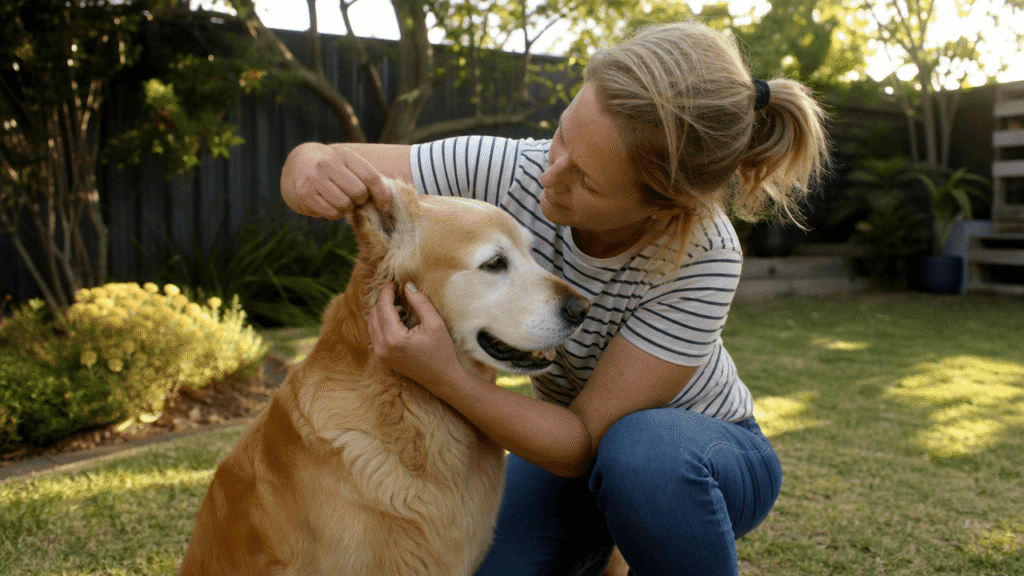
The most effective way to check is to systematically run your fingers along your pet’s skin until you’ve checked their entire body — you’re more likely to feel a tick than see one. Don’t stop searching if you find one, as many pets will have a second.
Start at the head and work toward the tail. Pay particular attention to:
- Around the ears and inside ear flaps
- Under the collar
- Between the toes
- Armpits and groin area
- Around the tail base
What to Do If You Find a Tick
Remove it immediately. Don’t put anything on it first — no Vaseline, no burning, no freezing. These old methods are dangerous and can cause the tick to inject more toxin.
Use fine-tipped tweezers or a tick removal tool. Grip as close to the skin as possible and pull straight out with steady, even pressure. Don’t twist.
Then watch your pet closely for 24–48 hours for any signs of weakness, wobbliness, or changes in breathing. If you see anything, call your vet immediately — even if the tick was tiny.
How Much Does Tick Paralysis Treatment Cost in Australia?
Tick paralysis treatment is not cheap. Here’s a realistic breakdown:
| Treatment | Estimated Cost |
|---|---|
| Emergency vet consultation | $200–$400 |
| Tick antiserum | $500–$1,500 depending on severity |
| Hospitalisation (per day) | $300–$600 |
| IV fluids, oxygen, monitoring | $200–$500 |
| Total (mild case) | $800–$1,500 |
| Total (severe case) | $2,000–$5,000+ |
The cost of annual tick prevention medication? Around $150–$250 per year depending on the product and your dog’s size. The maths aren’t complicated.
If you live on the east coast and don’t have pet insurance, this is the moment to reconsider it.
The Bottom Line
Paralysis tick prevention for Australian dogs and cats isn’t a nice-to-have. On the east coast, it’s one of the most important health decisions you make as a pet owner every year.
The isoxazoline tablets — NexGard Spectra, Bravecto, Simparica Trio — represent a genuine leap forward in protection compared to the old topical products. Since their introduction, tick paralysis cases at many Australian vet clinics have dropped dramatically. But they’re not foolproof, and daily tick checking remains essential in high-risk areas.
Talk to your vet, pick the product that suits your dog or cat’s individual health situation, and start it before tick season — not during.
Where to Buy
Good news here: NexGard, NexGard Spectra, Bravecto, and Simparica Trio are all classified as over-the-counter veterinary products in Australia under APVMA (Australian Pesticides and Veterinary Medicines Authority) regulation — you do not need a vet prescription to buy any of them. That’s actually the opposite of the US, where the same products require an FDA prescription because of their heartworm-prevention component.
That said, a vet’s input is still genuinely worth getting before starting a new product, especially for a dog with any seizure history (see the side effects section above) or a small dog under 2kg. “No prescription required” doesn’t mean “skip the vet conversation entirely” — it just means the choice is legally yours to make.
Available through:
- Your local vet clinic
- Online pet pharmacies and retailers, no prescription needed
- Amazon.com.au stocks some formulations — always verify the product is registered for Australian use
Have questions about paralysis tick prevention? Drop them in the comments or contact us here.




One Comment