
The New Pet Owner’s Starter Guide: Everything You Need Before Your Pet Comes Home
Written for new dog and cat owners in the United States
So you’ve decided to get a pet. Maybe you’ve already picked a name. Maybe you’ve been sneaking looks at adoption listings for weeks, telling yourself you’re “just browsing.” Either way — congratulations. Your life is about to get a whole lot more chaotic, and honestly, so much better.
But here’s the thing nobody really tells you upfront: the days before your pet arrives matter just as much as the days after. A little preparation goes a long way toward making the whole transition smoother — for your new dog or cat, and for your own sanity.
This new pet checklist covers everything you actually need, from the basics like food bowls and collars all the way to the smart tech that modern pet owners swear by — GPS trackers, health monitors, and yes, self-cleaning litter boxes. We’ll also talk about pet anxiety, because it’s way more common than people expect, and most new owners aren’t prepared for it at all.
Let’s get into it.
Before Your Pet Comes Home — The Preparation Phase
The number one mistake new pet owners make is doing all their shopping after their pet has already arrived. You’re in a state of overwhelm, your new dog is crying in the corner, and you’re desperately Googling “what do puppies eat” at 11pm. Don’t be that person.
Set everything up at least a few days before pickup day. Walk through each room of your home and think like a curious, chew-happy creature with no sense of danger. Electrical cords? Tuck them away or cover them. Toxic plants? Check the ASPCA’s list and remove anything that shows up on it — lilies are especially dangerous for cats, and xylitol (found in some peanut butters and sugar-free products) can be fatal for dogs. Trash cans? Get ones with lids.
This process is called pet-proofing, and it takes maybe an hour but saves you a small fortune in vet bills later.
Preparing for Your Pet’s First Seasons
Your prep list doesn’t end once your pet settles in. The season you bring them home in — and the ones that follow — bring their own challenges.
If you’re bringing your pet home in winter: Cold tolerance varies enormously by breed and size. Small dogs, short-haired breeds, and puppies struggle with cold much faster than larger or double-coated breeds. A dog sweater or coat isn’t vanity — it’s necessary for many breeds below 40°F. Watch paws for ice and salt irritation; paw balm helps. Cats should be kept indoors during extreme cold regardless of how independent they seem.
If you’re bringing your pet home in summer: Heatstroke is a genuine emergency risk, especially for flat-faced breeds like Bulldogs and Pugs. Never leave a pet in a parked car — even briefly, even with windows cracked. Walk dogs early morning or evening when pavement has cooled; hot asphalt burns paw pads faster than most owners realise.
Spring and fall transitions: This is peak flea, tick, and allergy season in most of the US. Pollen allergies in pets present as itchy skin and paw-licking, not sneezing the way they do in humans. Keep up with whatever flea and tick prevention your vet recommended — parasite activity ramps up fast as temperatures rise.
Year-round regardless of season: What works as flea, tick, and heartworm prevention in Florida is different from what’s needed in Minnesota — talk to your vet about your specific region’s risks, not a generic national recommendation.
The New Pet Owner Guide Starter Pack — What You Actually Need
There’s a lot of noise online about what’s “essential.” Here’s the honest breakdown, split by what you genuinely need on day one versus what can wait.
Your New Pet Checklist for Day One
Food and water bowls Go for stainless steel or ceramic — they’re easier to clean, don’t harbour bacteria the way plastic does, and they last years. Get non-slip bases if you can, especially for enthusiastic eaters. Budget around $20–$40 for a decent set.
Food Ask the breeder, shelter, or previous owner what your pet has been eating and stick with that brand for at least the first week. Switching food too quickly causes stomach upsets, and you really don’t want to be cleaning that up on day one. Once your pet has settled in, you can slowly transition to a different food if you prefer.
A bed or crate Dogs are den animals — they genuinely love having a dedicated space that’s theirs. A crate isn’t cruel; it’s comforting, especially during the adjustment period. Line it with something that smells like you — an old t-shirt works perfectly. For cats, a cosy bed in a quiet corner of the room does the job.
Collar and ID tag This is non-negotiable. In most US states, an ID tag is your pet’s best legal protection if they get lost. Put your mobile number on it — not your address. Get this sorted before your pet’s first walk outside.
Leash (for dogs) Start with a standard fixed-length lead around 4 to 6 feet. Avoid retractable leads for puppies — they make training inconsistent and can snap unexpectedly.
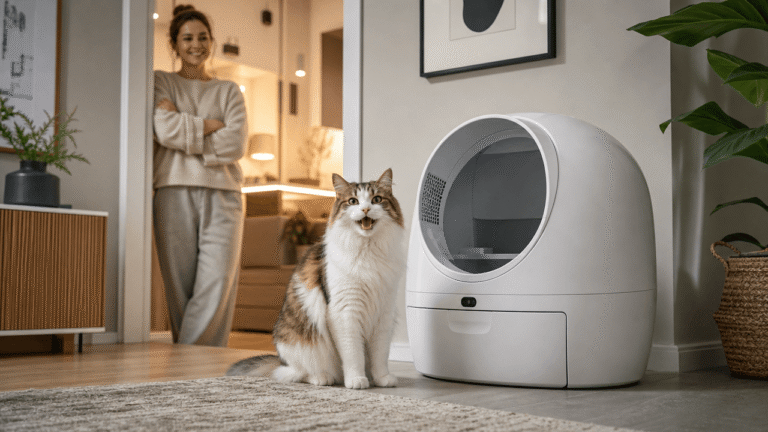
Litter box and litter (for cats) Rule of thumb: one litter box per cat, plus one extra. So if you have one cat, get two boxes. Place them in quiet, low-traffic areas — cats won’t use a box that feels exposed or stressful. More on upgrading to a self-cleaning box in a moment.
Toys A few goes a long way. Rotating toys keeps things fresh and prevents boredom. For dogs, a chew toy, a rope toy, and a squeaky toy cover most bases. For cats, anything that mimics prey — feather wands, crinkle balls, laser pointers — will keep them busy.
What to Get in the First Week
Vet appointment Book this within 48 to 72 hours of bringing your pet home. Even if they seem perfectly healthy, a baseline health check catches things that aren’t visible to the eye. Your vet will also advise on vaccination schedules, parasite prevention, and spaying or neutering timing if that’s relevant.
Flea, tick, and heartworm prevention In many parts of the US, fleas, ticks, and heartworm are serious year-round concerns. Talk to your vet about the right prevention plan for your region — what works in Florida is different from what’s needed in Minnesota. Don’t skip this or delay it.
Grooming basics Even short-haired pets need occasional brushing, nail trims, and baths. Start early so your pet gets used to being handled — it makes every future groom dramatically easier. Pick up a soft brush, pet-safe shampoo (never use human products), and nail clippers made for pets.
Stain and odour remover Accidents will happen. An enzyme-based cleaner breaks down the proteins in pet waste so the smell is properly gone rather than just masked. If your pet can still smell where they went before, they’ll go in the same spot again. Invest in a good one.
The Smart Upgrade — Pet Tech Worth Having
This is where things get genuinely exciting, and also where a lot of new pet owners leave money on the table by not knowing these products exist.
GPS Trackers — Because Curiosity Has No Boundaries
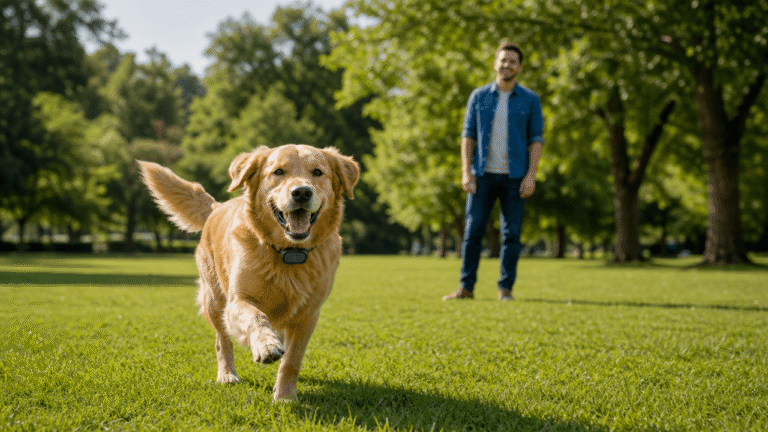
Dogs bolt. Cats disappear for three days and then stroll back in like nothing happened. A GPS tracker changes the anxiety of a missing pet from a full-blown panic into a quick phone check.
The Tractive GPS tracker is the one that comes up again and again, and for good reason. It gives you live location updates every few seconds — not once a minute like some cheaper trackers. It’s waterproof, works across all 50 states, and has a cat-specific version that’s lighter and includes territory mapping so you can see where your cat actually goes when she’s out exploring. Battery life sits at up to 14 days depending on usage, and there’s a monthly subscription fee for the live tracking service — think of it like a data plan for your pet. Completely worth it for the peace of mind alone.
Our honest take on GPS trackers: Tractive is the most reliable, most widely used GPS tracker for both dogs and cats. If your pet goes outdoors at all, this is the one to start with.
Health & Activity Monitors — Know What’s Going On Inside
GPS tells you where your pet is. A health monitor tells you how they’re actually doing — and that’s a completely different kind of peace of mind.
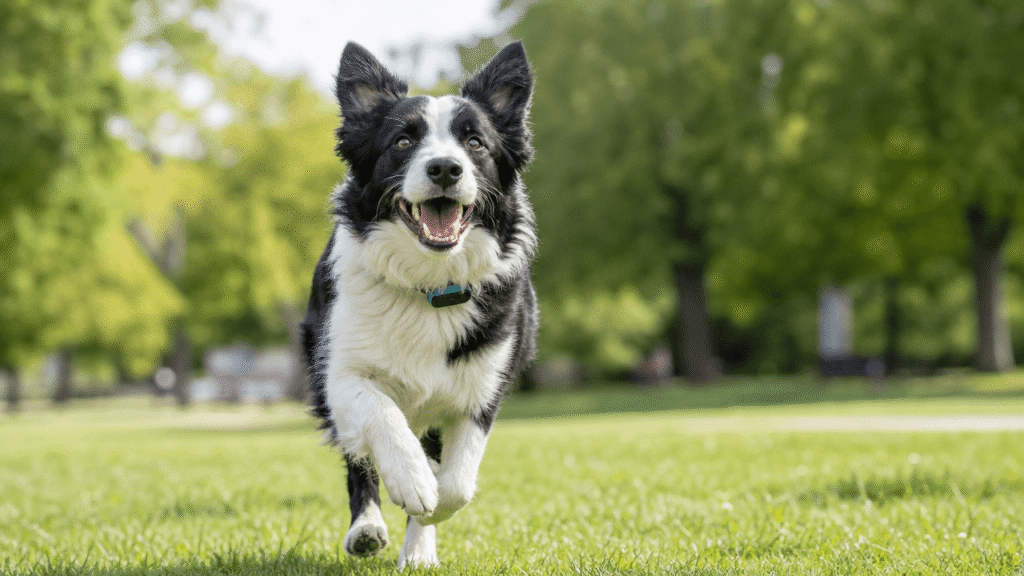
The Invoxia Minitailz is the standout choice here and one of the most impressive pet tech products we’ve come across. It’s a small, lightweight device that clips to your dog’s collar and monitors heart rate, respiratory rate, activity levels, sleep quality, and GPS location — all in one unit. It won the CES 2024 Best Innovation Award in the AI category, which tells you this isn’t just another gimmick. The app uses AI to translate the health data into plain English, so instead of seeing a number it tells you “his heart rate averaged 65 beats per minute, which is completely normal.” That’s genuinely useful for a new pet owner who has no baseline to compare against.
It requires a subscription starting at $9.60 per month, but given that it replaces both a GPS tracker and a health monitor, the cost is very reasonable.
The Tractive GPS also includes basic health monitoring — activity levels, sleep tracking, and heart rate monitoring — making it a solid all-in-one option if you want to keep things simple with just one device.
Our honest take on health monitors: If you want to go beyond location tracking and actually monitor your dog’s wellbeing, the Invoxia Minitailz is the most sophisticated option available right now. For most new dog owners, starting with Tractive and upgrading later is a perfectly sensible approach.
Self-Cleaning Litter Boxes — The Cat Owner’s Best Friend
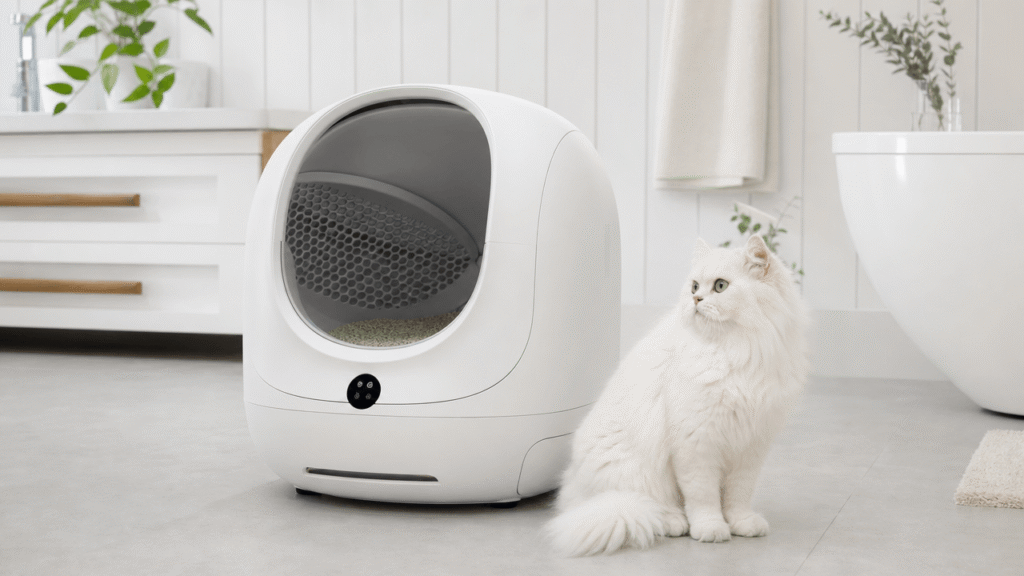
Let’s be real. Scooping litter is the part of cat ownership nobody mentions when they’re telling you how wonderful it is to have a cat. An automatic self-cleaning litter box handles this for you — it detects when your cat has used the box, waits a few minutes, then automatically rakes or rotates the waste into a sealed compartment.
We’ve done the research so you don’t have to. After looking at every major model tested in 2026, here’s the honest breakdown:
The best overall: Litter-Robot 4 by Whisker This is the one that keeps coming out on top in every independent test, and it’s not particularly close. The Litter-Robot 4 is quieter than its competitors, more thorough at removing small clumps that other models miss, and the app is genuinely intuitive. It tracks your cat’s usage patterns and weight over time — which is actually a useful early warning system for urinary health issues. If your cat starts using the box more or less frequently than usual, or if their weight changes, you’ll know about it before your vet does.
It’s expensive — around $699 — but it’s built to last years and comes with a one-year warranty. For a single-cat or multi-cat household, it handles everything without complaint.
The best mid-range option: PETKIT PuraMax 2 If the Litter-Robot’s price is a stretch, the PETKIT PuraMax 2 is a very capable alternative at around $299. It has a smaller footprint which makes it ideal for apartments and smaller spaces, and the app is solid. It doesn’t quite match the Litter-Robot’s cleaning thoroughness, but for most cats and most homes it does the job very well.
The best budget option: Ellenpent Automatic Litter Box At around $199, the Ellenpent is the best value self-cleaning litter box on the market right now. It has app control, decent safety sensors, and handles waste well for one to two cats. If you’re just dipping your toes into automatic litter boxes and don’t want to commit $700 upfront, this is a completely reasonable starting point.
One thing to know about all self-cleaning litter boxes: Introduce it slowly. Put the new box next to your existing one and let your cat explore it at their own pace before removing the manual box. Some cats take to it immediately. Others need a week or two. Patience here pays off.

Pet Anxiety — The Thing Nobody Warns You About
Here’s something that surprises almost every first-time pet owner: animals get anxious, and they get anxious a lot. The transition to a new home is genuinely stressful for them — new smells, new sounds, new people, and no familiar environment. For rescue animals especially, there may be layers of past trauma on top of that.
Signs of anxiety in dogs include excessive barking or whining (especially when left alone), destructive chewing, accidents in the house despite being trained, and restlessness at night. In cats, watch for hiding, over-grooming, changes in appetite, or avoiding the litter box.
The good news is that most new-pet anxiety is temporary and very manageable with the right approach.
What actually helps:
Establish a routine immediately. Meals at the same time, walks at the same time, bedtime at the same time. Predictability is genuinely calming for animals — it tells them the world is safe and under control.
Don’t overwhelm them on day one. Keep the household calm for the first few days. Resist the urge to invite everyone over to meet the new pet. Give them time to decompress and settle in at their own pace.
Use a calming aid during the transition period. Adaptil (for dogs) and Feliway (for cats) are pheromone-based diffusers and sprays that mimic the natural calming signals animals produce. They’re not sedatives — they work more like a reassuring signal that tells your pet the environment is safe. Many vets recommend them for the first few weeks in a new home. Both are widely available on Amazon.
Consider a calming supplement. Products containing L-theanine or melatonin can take the edge off for anxious pets. Always check with your vet before starting anything new.
Give them a safe space. Don’t force interaction. Let your pet retreat to their bed or crate when they feel overwhelmed, and resist the urge to follow them in. That space needs to feel like a guaranteed, undisturbed sanctuary.
Separation anxiety is common and trainable. If your dog panics every time you leave — and many do, especially in the first few weeks — the solution is gradual desensitisation. Start by leaving for just two minutes, returning calmly without making a fuss, then slowly building up the duration over days and weeks. Petco offers both in-person and virtual training classes with certified trainers who specialise in separation anxiety specifically.
The First 24 Hours — A Simple Timeline
Before you bring them home: Set up the crate or bed, fill the water bowl, have food ready, remove hazards from each room, and get the collar and ID tag fitted.
The car ride home: Keep it calm and quiet. For dogs, have someone else drive so you can sit in the back and offer reassurance. For cats, use a secure carrier and cover it with a light cloth — reducing visual stimulation significantly reduces travel stress.
First hour at home: Let them explore at their own pace. Resist the urge to pick them up constantly. Sit on the floor and let them come to you. For cats, consider confining them to one room initially so the whole house isn’t overwhelming all at once.
That evening: Feed them on schedule, take the dog out for a short toilet break, and keep the household calm and quiet. Expect some whining or meowing at night — this is completely normal and typically settles within a few days.
Day two: Book the vet if you haven’t already. Start establishing your daily routine. Keep all interactions positive, calm, and unhurried.

Your Day One Checklist
Feeding
- Age-appropriate food — same brand as what they were eating before
- Stainless steel or ceramic food and water bowls
Safety and ID
- Collar with ID tag — your phone number, not your home address
- Leash (dogs)
- Carrier (cats)
Comfort
- Bed or crate lined with familiar-smelling bedding
- 2–3 toys to start
Hygiene
- Litter box and litter (cats — remember, one per cat plus one extra)
- Poop bags (dogs)
- Enzyme-based stain and odour remover
Health
- Vet appointment booked within 48–72 hours
- Flea, tick, and heartworm prevention discussed with vet
- Microchip your pet and register it — strongly recommended in all US states
Smart Tech (optional but genuinely useful)
- GPS tracker — Tractive (dogs and outdoor cats)
- Health & GPS monitor — Invoxia Minitailz (dogs)
- Self-cleaning litter box — Litter-Robot 4 (premium) or PETKIT PuraMax 2 (mid-range) or Ellenpent (budget)
- Calming aid — Adaptil diffuser (dogs) or Feliway diffuser (cats)
Final Thought
Bringing a pet home is one of those things that sounds simple and turns out to be genuinely life-changing — in the best way possible. There’s a learning curve. There will be moments where you wonder what you were thinking. There will also be moments, probably within the first week, where you look at this small creature who has completely upended your routine and feel something that is very close to absurd, overwhelming love.
Get the basics right with this new pet checklist, give them time to settle. And don’t underestimate what a GPS tracker and a self-cleaning litter box will do for your quality of life.
Welcome to pet parenthood.
Check our Starter Guides hub for more new pet owner resources.
SmartPawParent covers honest reviews, buyer’s guides, and practical advice for dog and cat owners across the United States. We use affiliate links — if you click through and buy something, we may earn a small commission at no extra cost to you. We only recommend products we’d genuinely stand behind.