
AirTag on Dog Collar Safety Guide: Real Risks, 2026
A dog owner named Colin Mortimer noticed his AirTag was missing from his dog’s collar, opened the Find My app, and hit play on the sound. It was coming from inside his dog’s stomach. That’s not a hypothetical warning — it’s a documented case, and it’s exactly why this question keeps coming up.
Apple’s own guidance is direct: AirTags aren’t designed or intended for tracking pets. This airtag on dog collar safety guide covers why that warning exists, what’s actually happened to real dogs, and — since a lot of owners are going to use one anyway given the price gap versus a dedicated GPS collar — how to meaningfully reduce the risk if you do.
Quick Answer
| Question | Short Answer |
|---|---|
| Is it officially recommended? | No — Apple explicitly does not design or market AirTags for pet tracking |
| What’s the real risk? | Choking/ingestion, and battery chemical burns if the casing is chewed and the CR2032 cell is exposed |
| Has this actually happened to real dogs? | Yes, documented multiple times — including surgery cases and one dog that later vomited the AirTag up on its own |
| Does a secure holder fix the problem? | It meaningfully reduces it, but doesn’t eliminate it — supervision still matters |
| Is an AirTag a real GPS tracker substitute? | No — it relies on nearby Apple devices via the Find My network, not real-time cellular GPS |
| Are Tile/SmartTag/Chipolo safer substitutes? | No — same battery and housing risk, just a different brand; longer Bluetooth range but still not real GPS |
Table of Contents
- Why Apple Says Not To
- What’s Actually Happened to Real Dogs
- The Battery Risk Specifically
- How to Actually Reduce the Risk, If You Do This
- What AirTag Can and Can’t Do Instead of a Real GPS Tracker
- Are Tile, SmartTag, or Chipolo Any Safer?
- Safer Alternatives Worth Comparing
- What People Get Wrong
- US / Australia / Singapore Notes
- If Your Dog Has Already Swallowed One
- The Bottom Line
Why Apple Says Not To
Apple has been clear that AirTags aren’t designed or marketed as pet trackers, and the reasoning comes down to two separate risks stacked on top of each other: the physical size makes ingestion possible for a curious or bored dog, and the coin-cell battery inside turns that ingestion from an inconvenience into a potential medical emergency.
There’s a functional reason too, separate from safety. AirTags rely on Apple’s Find My network — nearby iPhones and iPads silently relay the AirTag’s location — which works well in populated areas but degrades fast in rural or low-Apple-device-density areas. If your dog gets out of a low-traffic area, an AirTag may simply have nothing nearby to relay its position, unlike a cellular GPS tracker.
What’s Actually Happened to Real Dogs
These aren’t hypothetical warnings. One widely-reported case involved a dog named Luna, who swallowed an AirTag off her collar; an animal hospital attempted surgery but couldn’t locate it during the procedure, and Luna eventually vomited it up on her own six weeks later. A separate case involved a dog named Rose, who chewed through an AirTag and ingested fragments of metal and plastic while her owners were out — fortunately without ingesting the battery itself.
Colin Mortimer’s case is the one that captures the risk most vividly: he used the Find My app’s sound feature to locate what he assumed was a missing AirTag, only to discover the sound was coming from his dog’s stomach. These cases share a pattern — smaller dogs and puppies with a habit of chewing collar attachments are disproportionately represented, though any dog with access to a loose or hanging AirTag is at some level of risk.
The Battery Risk Specifically
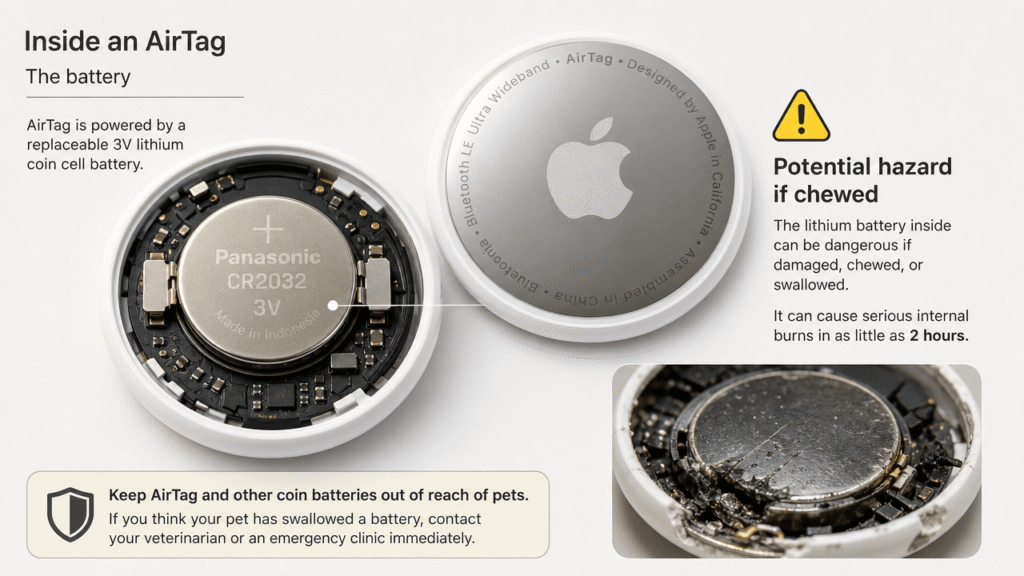
The AirTag’s CR2032 battery is the part that turns a choking hazard into something worse. If the casing is damaged by chewing and the battery is exposed, it can leak and cause chemical burns to the mouth, esophagus, or stomach lining — and the risk compounds the longer the battery sits inside the body.
This isn’t a pet-specific problem — the same battery-ingestion hazard led the US federal government to pass Reese’s Law in August 2022, mandating child-resistant packaging and secure battery compartments for consumer products, after the CPSC recorded 27 deaths and roughly 54,300 emergency room visits tied to button and coin battery ingestion in children over a decade. Worth being precise here: Reese’s Law specifically protects children age six and under, not pets — but the underlying chemistry that makes these batteries dangerous when swallowed doesn’t distinguish between a toddler’s digestive system and a dog’s.
How to Actually Reduce the Risk, If You Do This
Given how many owners will use an AirTag anyway, purely because of the price gap against a subscription-based GPS collar, the more useful conversation is harm reduction rather than a flat refusal. A few things matter more than others here.
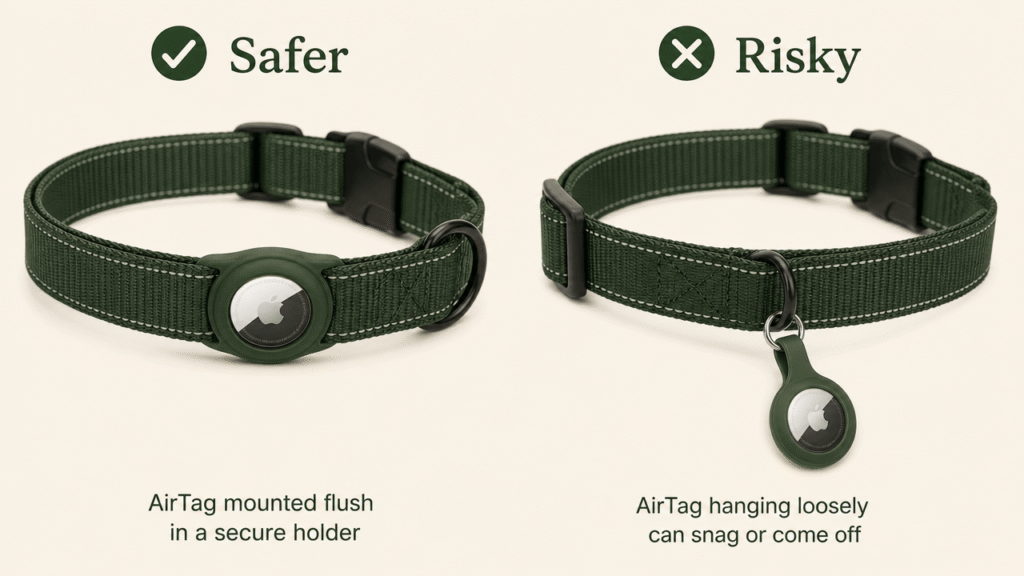
Skip any holder that lets the AirTag hang or dangle from the collar. A dangling AirTag is both easier to grab in the mouth and easier for another dog to grab during play. Vets specifically recommend a holder that mounts the AirTag flush against the collar, with no hanging component a dog can reach or chew through.
Check the holder and casing regularly for cracks, not just at setup. Battery casing damage from chewing often happens gradually, not in one obvious incident, which means a quick weekly check of the AirTag’s housing is a genuinely useful habit rather than an overcautious one. This matters more for dogs with any known history of chewing collar attachments, tags, or toys — a dog with zero chewing history carries meaningfully less risk than one that’s shown the behavior before.
What AirTag Can and Can’t Do Instead of a Real GPS Tracker
An AirTag can reasonably serve as a low-cost backup layer — useful for an indoor cat that rarely leaves the house, or as a way to test whether tracking technology is even something you’ll use consistently before committing to a subscription. It genuinely cannot serve as a primary safety tool for a dog that actually gets loose in unfamiliar or low-traffic territory, since it depends entirely on other Apple devices being nearby to relay location — no cellular network, no independent GPS.
That distinction is worth being blunt about: a real-time GPS tracker with cellular coverage will find your dog whether or not a stranger’s iPhone happens to walk by. An AirTag will not, and treating it as equivalent creates a false sense of security in exactly the scenario — a genuinely lost dog in an unfamiliar area — where accurate tracking matters most.
Are Tile, SmartTag, or Chipolo Any Safer?
Worth addressing directly, since it’s a natural next question: no, not meaningfully. Tile, Samsung’s Galaxy SmartTag, and Chipolo are all Bluetooth item-finders built around the same fundamental design — small housing, a coin-cell battery, and a network of nearby phones relaying location rather than independent GPS. Swap the brand name and the physical hazard profile stays essentially the same: any of these can be chewed through, and any of them contain a battery that poses the same ingestion risk as an AirTag’s.
Where they do differ in practical, non-safety terms: Tile and SmartTag offer a longer Bluetooth range (250–400 feet, versus roughly 30 feet for AirTag) and Tile specifically works across both iOS and Android, which matters if your household isn’t in Apple’s ecosystem. One direct comparison summed up the actual limitation plainly: Bluetooth tags depend on nearby phones, while GPS trackers depend on satellites and cellular networks — and most dogs go missing outdoors, exactly where Bluetooth tags perform worst.
So the honest answer: if you’re choosing between AirTag and a different Bluetooth tag specifically, pick based on which phone ecosystem you’re in and whether you want a longer range — not based on safety, since none of them meaningfully improve on that front. If safety and reliable outdoor tracking are both the priority, the answer isn’t a different Bluetooth tag, it’s a real GPS tracker.
Safer Alternatives Worth Comparing
Purpose-built GPS trackers solve both problems at once: they’re built with pet-safe housings designed to resist chewing, and they use actual cellular GPS rather than depending on nearby phones. We’ve covered the trade-offs between two of the most popular options in our Fi vs Tractive comparison, including battery life, cost over time, and documented reliability issues for both.
Microchipping remains the most failure-resistant identification method precisely because it can’t be chewed off, fall off, or run out of battery — though it doesn’t provide live location the way a GPS device does. The two aren’t really competing solutions; a microchip plus a properly-secured tracking device covers more scenarios than either alone.
What People Get Wrong
The most common mistake is treating “many owners use AirTags on dogs without incident” as evidence the risk isn’t real. Most dogs don’t chew at collar attachments, which is exactly why the documented incidents involve a specific, identifiable pattern (chewing-prone dogs, hanging or loosely-secured AirTags) rather than being random or universal. Low incident rate isn’t the same as low severity — when it does go wrong, the outcome ranges from a vet bill to emergency surgery.
The second mistake is assuming a secure holder fully solves the problem. A flush-mount holder meaningfully reduces the chewing-access risk, but it doesn’t address the network-dependency limitation, and it doesn’t eliminate risk entirely for a genuinely determined chewer — it lowers probability, not certainty.
AirTag on Dog Collar Safety Guide: US / Australia / Singapore Notes
United States: Find My network density is generally strong in populated areas; rural and remote regions will see meaningfully worse performance, consistent with the network-dependency limitation above.
Australia: Apple device density is lower outside major cities, and — as covered in our Fi vs Tractive piece — actual cellular coverage across the Australian outback and regional areas is a separate, well-documented gap that affects any tracking technology, AirTag included. An AirTag is a weaker choice specifically for rural Australian properties.
Singapore: Dense urban Apple device coverage makes Find My network performance strong here, which is the one regional factor that works in an AirTag’s favor rather than against it — though the physical safety risks (chewing, battery ingestion) are identical regardless of location.
If Your Dog Has Already Swallowed One
Call your vet or an emergency animal hospital immediately rather than waiting to see if symptoms appear — button battery ingestion is treated as time-sensitive precisely because internal damage can begin quickly. Don’t attempt to induce vomiting at home without direct veterinary guidance, since bringing a leaking battery back up through the esophagus can cause additional injury on the way. Bring the AirTag’s model information if you have it, since this helps the vet team understand exactly what they’re dealing with.
The Bottom Line
Apple’s warning against AirTag pet tracking is grounded in real, documented incidents, not overcaution. If cost is genuinely the barrier to a proper GPS collar, an AirTag can work as a low-stakes backup layer for a low-risk situation — an indoor cat, a dog with no chewing history — provided it’s mounted flush with no hanging component and checked regularly. For a dog that actually roams, escapes, or chews at its own gear, the risk profile and the network-dependency limitation both point toward a purpose-built tracker instead.
If you like this post, you might like our gadgets section => New Gadgets
Sources Referenced
Editorial and community sources (linked):
CPSC — Reese’s Law Federal Safety Standard Press Release
AppleInsider — Here’s Why You Don’t Put an AirTag on Your Dog’s Collar
AppleInsider Forums — Discussion Thread
Tech Times — Dog Swallows AirTag: CR2032 Battery Could Poison Pet If Chewed
Waggle — Is an AirTag Dangerous to Your Dog?
Flowery Branch Animal Hospital — Using an Apple AirTag on Your Dog’s Collar? Safety First
Abbycart — Is an AirTag Safe for Dogs? Pros, Cons & Real Use Cases