Dog Dryer by Coat Type: The Brutal 2026 Guide
Dog Dryer by Coat Type: The Brutal 2026 Guide
A Husky owner and a Poodle owner can read the exact same “best dog dryer” roundup and both walk away with the wrong machine. That’s the actual problem with most of these lists — they rank dryers like there’s one universal winner, when a double coat and a continuously-growing curly coat need almost opposite things from the airflow. One needs raw CFM to blast an undercoat out from the skin. The other needs controllable heat and a stand-mounted, hands-free setup to stretch hair straight while it dries.
So this isn’t a single “best dog dryer” pick. Below is a dog dryer by coat type breakdown, sorted by what your dog’s coat is actually doing to you in the bathroom — shedding, matting, curling, or just being small and easily startled by a machine that sounds like a shop vac crossed with a leaf blower.
Quick Answer: Dog Dryer by Coat Type
| Coat Type | Best Pick | Why |
|---|---|---|
| Double-coat / heavy shedder (Husky, GSD, Golden) | MetroVac Air Force Commander | All-steel body, blows undercoat out at the root, 220-240V version exists for AU/SG |
| Curly / continuous-growth (Poodle, Doodle, Bichon) | XPOWER B-16 Pro Finisher | Hands-free stand, variable heat for stretch-drying, built for fluff finishing |
| Large or multi-dog household, heavy daily use | XPOWER B-24 Thermal Ace | 3HP canister, dual heat settings, handles back-to-back dogs without overheating |
| Noise-sensitive or anxious dogs | GustyAir Pro II (paired with a Happy Hoodie) | Dual-motor design distributes load for a lower-pitched, less startling sound |
| Budget / occasional home use | Shelandy 3.2HP | Real owner reports of blowing out husky and Great Pyrenees undercoats at low cost |
Table of Contents
- What “High-Velocity” Actually Means (and What CFM/FPM Numbers Tell You)
- Why Coat Type Changes the Answer
- Best for Double Coats and Heavy Shedders
- Best for Curly and Continuous-Growth Coats
- Best for Large Households and Daily Use
- Best for Noise-Sensitive Dogs
- Best Budget Option
- Comparison Table
- The Good, The Bad, and The Verdict
- What People Get Wrong
- The Amazon Clone Problem in This Category
- US / Australia / Singapore Notes
- Maintenance and Accessories
- The Verdict: Choosing a Dog Dryer by Coat Type
What “High-Velocity” Actually Means (and What CFM/FPM Numbers Tell You)
Every listing in this category throws numbers at you — CFM, FPM, HP, amps — and most owners have no idea which one actually matters. Groomers care about two: CFM (cubic feet per minute, how much air volume moves) and FPM (feet per minute, how fast that air is moving when it leaves the nozzle). General buying guidance in this category recommends at least 100 CFM and 1,400–1,800 watts as a baseline for adjustable, breed-appropriate airflow.
A dryer needs both volume and speed: high volume with low speed just pushes warm air around; high speed with low volume can’t move enough air to force water off a dense coat. The Flying Pig High Velocity dryer is commonly listed at a 12.72-amp, 1400-watt motor delivering roughly 240 CFM at 28,000 FPM, which is a fairly typical spec profile for this mid-tier of the category.
Amperage matters for a different reason: household circuits. comparable full-size dryers in this class, like the MetroVac Air Force Commander, draw around 11.25 amps at 1,350 watts. A standard US 15-amp circuit can run one of these dryers comfortably on its own, but running one on a shared circuit with other grooming tools (clippers, vacuums, space heaters in a garage setup) is a real way to trip a breaker mid-dry. If you’re setting up a home grooming station, give the dryer its own outlet run if you can.
Why Coat Type Changes the Answer
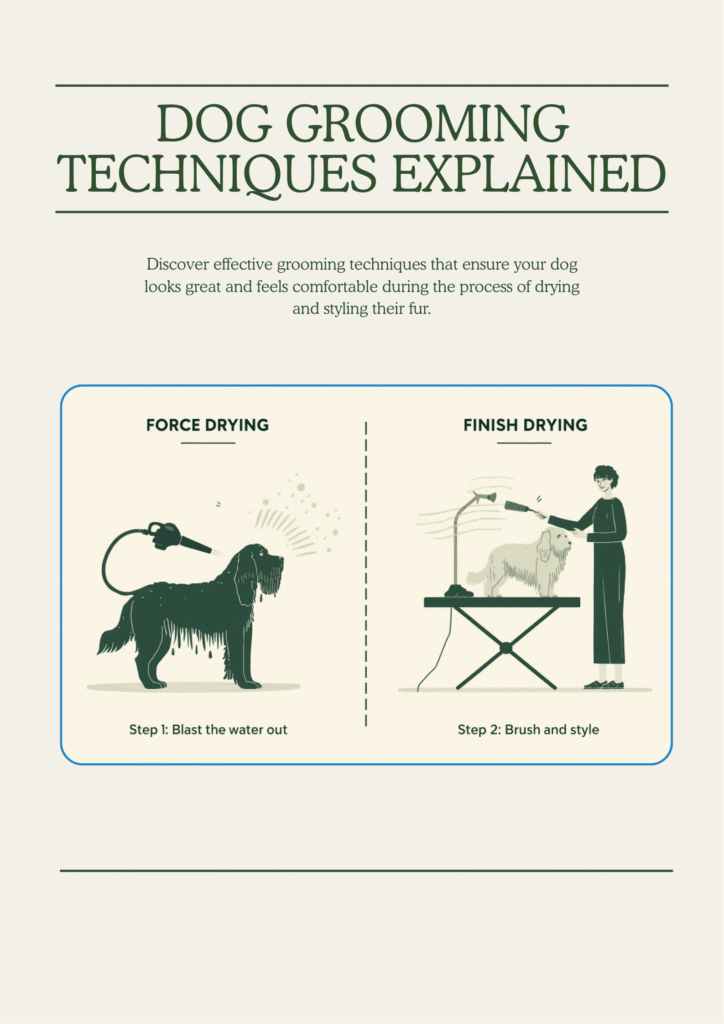
Almost every generic “best dog dryers” list online skips this step entirely and just ranks by horsepower, rather than picking a dog dryer by coat type. A double-coated dog’s undercoat is dense and packed close to the skin — the job is physically forcing water and loose fur out from underneath, which is why heavy-shedding-breed owners consistently favor higher-CFM canister and stand units over lighter handhelds. A curly or continuous-growth coat (Poodles, most Doodles, Bichons) doesn’t shed the same way — the goal shifts to stretching the hair straight while drying so it doesn’t dry into a fuzzy, uneven texture that’s harder to scissor cleanly. That’s a fluff-drying job, and it’s why finishing stand dryers with adjustable heat exist as a separate category from raw-power force dryers.
Best for Double Coats and Heavy Shedders: MetroVac Air Force Commander
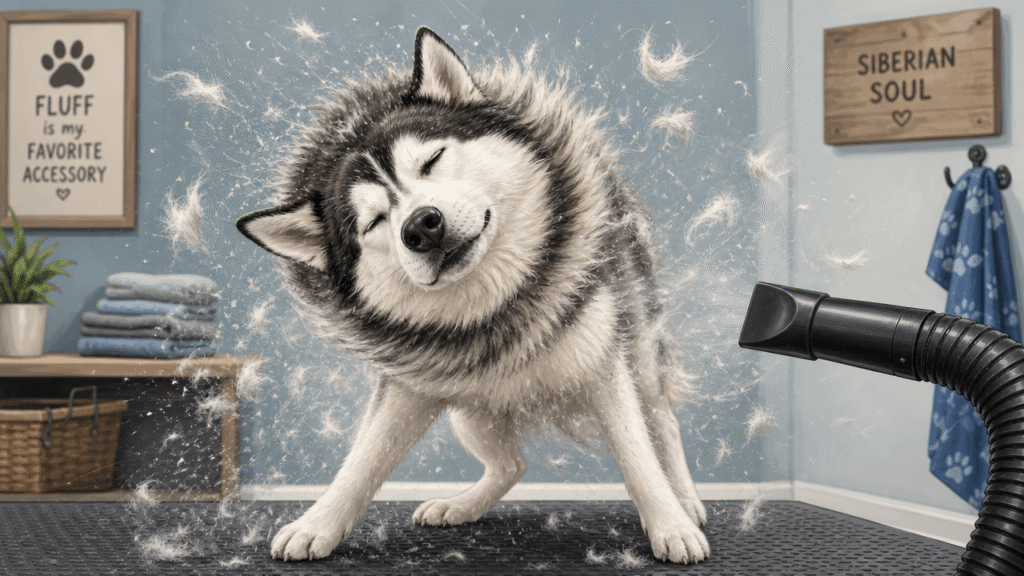
the MetroVac Air Force Commander has been sold for over 30 years and is built with an all-steel body, which matters because these motors run hot and long on thick-coated dogs. it includes a 6-foot hose with airflow control, an easy-change filter, a groomer rake, an air flare, and an air concentrator nozzle, and MetroVac also sells the Air Force Blaster and Master Blaster for higher-volume commercial use if the Commander isn’t enough dryer. One long-term owner in a product review said their unit, purchased in 1990, is “still going strong 35 years later” — which says more about steel-body durability than any spec sheet does.
Best for Curly and Continuous-Growth Coats: XPOWER B-16 Pro Finisher
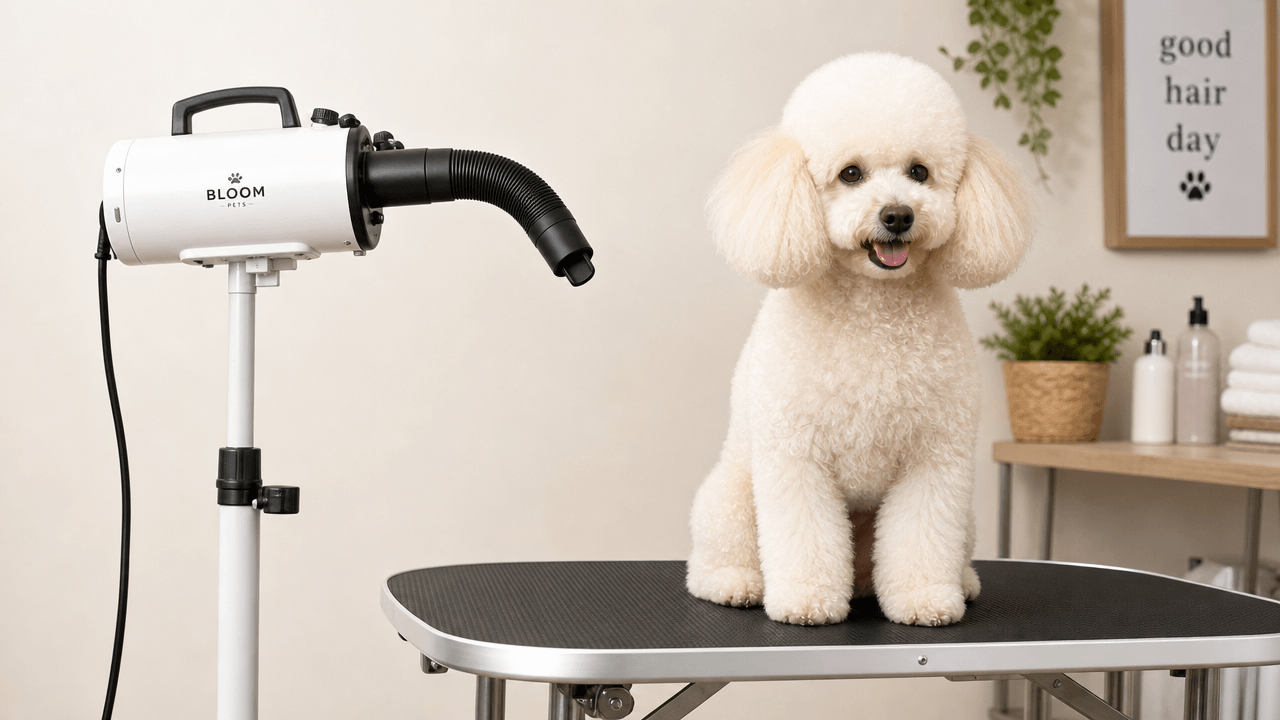
This is a stand-mounted, hands-free dryer built for the fluff-and-finish stage, not the initial water-blasting stage. It runs a 1/4 HP brushless DC motor rated up to 5,200 RPM with dual heat control and anion anti-static technology, drawing a low 12 amps at max with roughly 300 CFM of airflow. Groomers on the Poodle Forum have mixed but mostly positive experiences with it: one owner reported no problems with their B-16 since buying it, while another had heard secondhand that a grooming shop had ongoing trouble with theirs early on.
A more detailed owner review posted alongside the product summed up the honest trade-off for anyone weighing this dog dryer by coat type: it’s a strong stand dryer for forced air, but the reviewer felt 12 amps wasn’t quite enough heat for fluff-drying dense poodle coats compared to a dedicated forced-air/heat combo unit. Translation: it’s excellent as a finishing tool paired with a separate bath-side force dryer, not necessarily a total one-machine replacement for a full poodle groom.
Best for Large Households and Daily Use: XPOWER B-24 Thermal Ace
the B-24 runs a 3 HP motor at 31,000 RPM with variable speed control and dual heat settings, and its ABS housing and washable filter system are built to protect the motor across repeated back-to-back dries. If you’re running three or four dogs through a wash-and-dry routine on a Saturday, this is the tier built to not overheat halfway through dog number three.
Best for Noise-Sensitive Dogs: GustyAir Pro II + Happy Hoodie
Noise level is one of the most common concerns pet owners raise before buying any high-velocity dryer, and it matters even more for dogs that are already anxious. The GustyAir Pro II runs dual 6 HP Ametek turbine motors, delivering 65,000 FPM and 130 CFM from each motor (260 CFM total) at 19 amps on its highest setting — a dual-motor split like this tends to run at a lower, steadier pitch than a single motor pushed to its limit, which some anxious dogs tolerate better.
Pair it with ear protection: independent testing found the Happy Hoodie provides real attenuation starting around 3150 Hz and up to 17 decibels at higher frequencies, though that same testing noted the bigger benefit is probably the swaddling/compression effect calming the dog, not pure noise blocking at the low frequencies dryers are loudest at. Worth having in the kit regardless — it’s a genuinely useful accessory, not just a marketing add-on, for any dog that flinches at force-drying.
Best Budget Option: Shelandy 3.2HP
For anyone picking a dog dryer by coat type on a tighter budget, the strongest evidence for this one isn’t a spec sheet, it’s a real owner report. One editorial comparison measured the Shelandy Groomer Partner at roughly 84.7 CFM against a premium canister dryer’s 240 CFM — meaningfully less raw power, but a Shelandy buyer who groomed a husky/shepherd mix and two Great Pyrenees/shepherd mixes said it blew out their undercoats with ease and wasn’t held back by having a single motor, adding they didn’t even need the heat function because the airflow alone ran warm enough. That’s a specific, verifiable use case (multiple heavy-coated large dogs) holding up under real conditions, not a templated “game-changer” claim.
Comparison Table: Dog Dryer by Coat Type, Side by Side
| Model | Motor / Power | Airflow | Amps | Best For | Tier |
|---|---|---|---|---|---|
| MetroVac Air Force Commander | 4 HP (multi-speed) | Not independently CFM-rated by Metrovac; ~28,000 FPM | 11.25A | Double coats, heavy shedders | Mid-Premium |
| XPOWER B-16 Pro Finisher | 1/4 HP brushless DC, 5,200 RPM | 300 CFM | 12A | Curly/continuous-growth finishing | Premium (stand) |
| XPOWER B-24 Thermal Ace | 3 HP, 31,000 RPM | Not separately CFM-rated | 12A | Multi-dog households | Mid-Premium |
| GustyAir Pro II | Dual 6 HP Ametek turbine | 260 CFM total | 19A (high) | Noise-sensitive dogs | Premium |
| Shelandy 3.2HP | 3.2 HP single motor | Manufacturer-stated, not independently verified | Variable | Budget, occasional use | Budget |
The Good, The Bad, and The Verdict
A quick side-by-side on each dog dryer by coat type pick, so you can weigh the trade-offs before buying:
MetroVac Air Force Commander
The Good: Steel construction that owners report lasting decades; no heating element to accidentally overheat sensitive skin; includes a groomer rake attachment.
The Bad: No digital heat control — it’s airflow-only on the base Commander, which some fluff-drying breeds will still need a second tool for.
The Verdict: The safe, durable default for anyone with a heavy-coated shedding breed who wants one dryer that will still work in ten years.
XPOWER B-16 Pro Finisher
The Good: Hands-free stand frees up both hands for brushing while drying; anion technology cuts static during that brushing.
The Bad: Groomers report the amp-limited heat isn’t quite enough for a full professional fluff-dry on dense curly coats — it’s a finishing tool, not a standalone force dryer.
The Verdict: Buy it to pair with a force dryer, not to replace one, if you’re doing full grooms on curly-coated breeds.
XPOWER B-24 Thermal Ace
The Good: Dual heat settings and a washable filter system built for repeated daily use without overheating.
The Bad: At 3 HP and higher amperage, it’s a bigger, louder tool than a casual single-dog household needs.
The Verdict: Right-sized for multi-dog homes or anyone drying more than one animal per session.
GustyAir Pro II
The Good: Dual-motor design keeps the pitch lower and steadier than a single motor pushed to its limit, which matters more to anxious dogs than raw amp draw does.
The Bad: At 19 amps on its highest setting, it draws more power than the MetroVac or XPOWER options here — check your circuit before running it alongside other tools.
The Verdict: The right call for anxious dogs specifically — pair it with ear protection and expect a calmer session, not necessarily the fastest one.
Shelandy 3.2HP
The Good: Real multi-dog, heavy-coat owner reports back it up at a fraction of the premium-tier price.
The Bad: Manufacturer specs on budget-tier dryers like this are harder to independently verify than established brands like MetroVac or XPOWER.
The Verdict: A legitimate budget pick, but go in knowing the spec sheet deserves more skepticism than the premium options.
What People Get Wrong
When picking a dog dryer by coat type, the most common mistake is buying on horsepower or wattage alone and ignoring how the air is actually delivered. A Poodle Forum discussion thread captured the real-world unpredictability of this category well — one poster described a friend’s grooming shop having ongoing trouble with a stand dryer, while another owner in the same thread, running the identical model for months, simply “wonder[ed] why both of your friends had trouble”. Same model, two very different outcomes, which is exactly why individual owner reports matter more than any single glowing spec sheet.
The second mistake is assuming “quiet” and “gentle” are marketing fluff rather than something to actually verify — anxious dogs genuinely respond differently to motor pitch, not just volume, which is part of why dual-motor designs get singled out by owners of nervous dogs specifically.
The Amazon Clone Problem in This Category
Anyone shopping for a dog dryer by coat type on marketplaces will run into this fast: budget high-velocity dryers are one of the worst offenders for the white-label problem SmartPawParent has flagged before in grooming tools. Searching for generic “5.2HP/3800W” high-velocity dryers turns up the identical spec sheet — same horsepower figure, same wattage, same 4-nozzles-plus-comb bundle — sold under completely different, unrelated-sounding names (TJOUL, and separately as unbranded “High Velocity Dog Hair Dryer” listings from different sellers entirely) at nearly identical price points. That’s the signature of one factory hardware line getting relabeled and resold under whatever storefront name is running that week.
This doesn’t mean every budget dryer is a clone — Shelandy, for instance, has enough of a distinct owner-review history to stand on its own reputation. But treat any dryer brand name you don’t recognize from professional grooming circles (MetroVac, XPOWER, Flying Pig) as a weak signal of accountability, not a strong one, until you’ve checked whether the exact spec combination shows up under other names too.
Dog Dryer by Coat Type: US / Australia / Singapore Notes
United States: Standard 120V household current. the MetroVac Air Force Commander’s standard version draws about 11.25 amps, comfortable on a dedicated 15-amp circuit, but avoid daisy-chaining it with other high-draw grooming tools on the same breaker.
Australia: MetroVac sells a dedicated 220/240V version of the Air Force Commander built for markets running that voltage standard, which Australia uses — don’t buy the US 120V version and run it through a step-down converter long-term; a proper voltage-matched unit is safer and won’t strain the motor.
Singapore: Also runs 220-240V, so the same MetroVac 220/240V unit applies. Singapore’s humidity is worth planning around specifically — heavy coats take longer to fully dry in ambient humid air even with a strong dryer, so budget more drying time than a US or AU owner would expect from the same machine, and make sure the coat is genuinely dry at the skin (not just surface-dry) before crating, since damp undercoat in humid conditions is a hot-spot and skin-fold irritation risk.
Maintenance and Accessories
Whichever dog dryer by coat type you land on, filters need regular cleaning on every model in this list — MetroVac’s easy-change filter system exists specifically because hair and debris buildup restricts airflow and strains the motor over time. Check and clean it after every few uses, more often with heavy shedders. On stand dryers like the B-16, groomers report the adjustable arm can loosen over months of daily use, so check the tension on any joint or hinge periodically rather than waiting for it to fail mid-groom.
For anxious dogs, a Happy Hoodie is the accessory worth adding to any of these dryers — it’s designed to reduce noise and provide a swaddling effect that calms dogs during force drying specifically, and it costs a fraction of the dryer itself.
The Verdict: Choosing a Dog Dryer by Coat Type
Out of every dryer we looked at for this dog dryer by coat type roundup, one rule holds: match the tool to the coat, not to the horsepower number that sounds most impressive. A Husky owner buying a finishing stand dryer built for fluff-drying Poodles will be disappointed, and a Poodle owner buying a raw-power canister dryer built for blasting undercoat will find themselves fighting a hose that’s way more machine than their dog’s coat needs. MetroVac and XPOWER both earn their reputations here for different, specific reasons — pick based on what your dog’s coat is actually doing, not what’s cheapest or loudest on paper.ill find themselves fighting a hose that’s way more machine than their dog’s coat needs. MetroVac and XPOWER both earn their reputations here for different, specific reasons — pick based on what your dog’s coat is actually doing, not what’s cheapest or loudest on paper.
If you like this post, you might like our gadgets section => New Gadgets
Sources Referenced
Editorial and community sources (linked):