Robotic Dog Wash Machine Review: Smart Tech or $10,000 White Elephant?
A machine that washes, rinses and blow-dries your dog with zero scrubbing on your part costs $10,000. That’s the price of a decent used car, for an appliance that bathes your dog instead of driving you to work.
This robotic dog wash machine review pulls the real specs, the real prices, and what long-term users in the US, Australia and Singapore actually say once the CES hype wears off — so you can tell whether it’s actually worth it, or just the pet-tech equivalent of a treadmill that turns into a clothes rack.
Quick Answer — Who Should Actually Buy What:
| Your Situation | Best Option | Why |
|---|---|---|
| You bathe one dog occasionally | Self-serve wash station near you | Cheapest per-use, already mature tech, no upfront cost |
| You have a back injury or mobility issue | Self-serve station with raised bay | Designed to eliminate bending/lifting |
| You’re curious about the $10K home robot | Wait | No 6+ month consumer track record exists yet |
| You want a budget DIY setup at home | Portable washer + raised tub | Under $300, no installation |
| You own a cat | Skip this category entirely | Built for dogs; cats show real distress even in purpose-built units |
| You live in an HDB flat / apartment in SG | Self-serve station (already common) | No plumbing changes needed, pay-per-use |
Prices throughout this article are listed in USD for comparison purposes. Actual prices vary by retailer, region, import duties and currency conversion at time of purchase.
Table of Contents
- Robotic Dog Wash Machine Review: What It Actually Costs
- Robot Wash vs. Self-Serve Station: The Mix-Up That Wastes Your Money
- Robotic Dog Wash Machine Review: Full Spec Breakdown
- US vs Australia vs Singapore: What’s Actually Confirmed Available
- The 6-Month Mark: What Long-Term Self-Serve Users Actually Report
- Self-Serve Stations: What’s Actually Included, and a Real Groomer’s Wash Sequence
- What Self-Serve Users Get Wrong, According to This Review’s Research
- Is Your Dog Even a Candidate? Breed and Size Red Flags
- Can You Wash a Cat in One of These? (Short Answer: Be Careful)
- Where to Verify a Machine Meets Safety Standards in Your Country
- Robotic Dog Wash Machine Review: The Verdict — Smart Investment or White Elephant?
1. Robotic Dog Wash Machine Review: What It Actually Costs
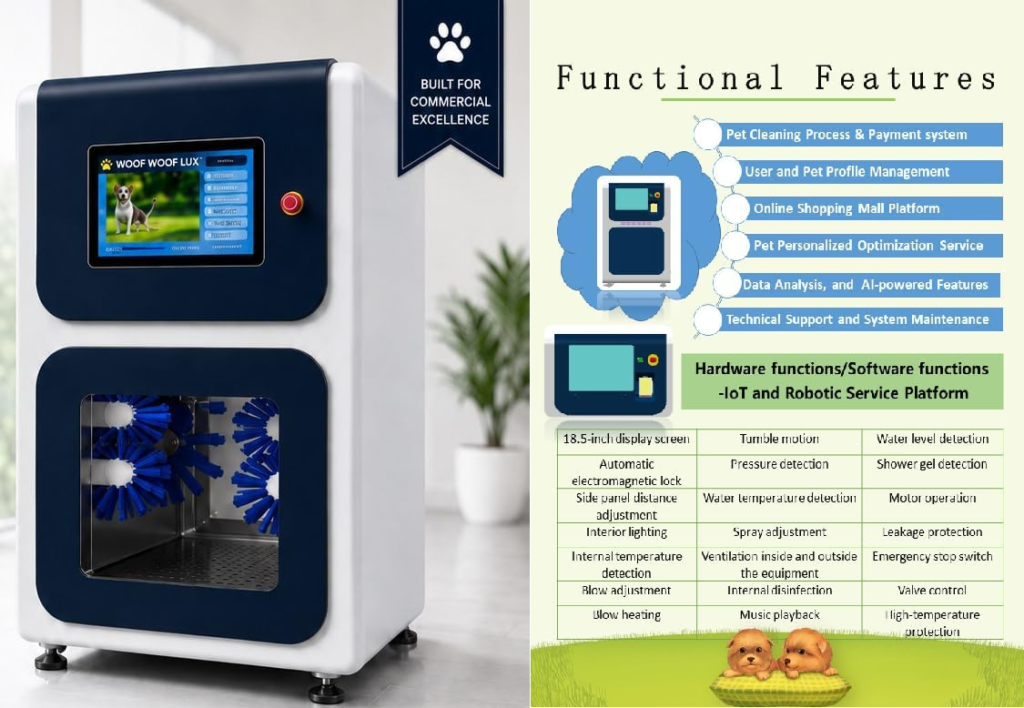
Here’s the number that matters most in this robotic dog wash machine review. The flagship “fully autonomous” home unit — currently sold under the name WoofWoof Lux, which unveiled the product at CES 2025 and has since installed real units at locations like a dog gym in Phoenix, Arizona — runs about $10,000 for the indoor/outdoor version.
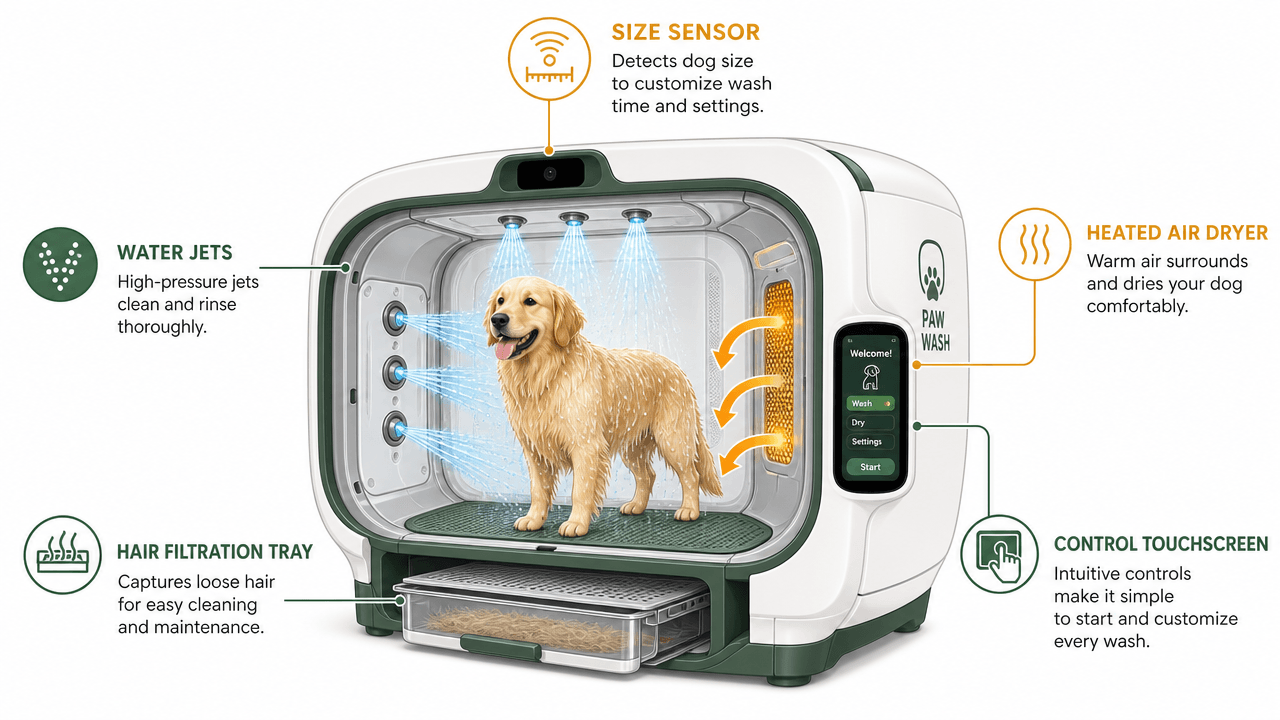
It senses your dog’s size automatically, runs a roughly 20-minute wash cycle, then spends another 5 to 10 minutes self-cleaning before the next dog. A real, purchasable listing exists on Amazon, though stock and shipping availability shift, so treat that link as a way to verify the product is real rather than a guaranteed current price.
That price tag isn’t a typo, and it isn’t a one-off. Commercial-grade self-serve stations (the kind you’ve probably already seen at a pet store or car wash) run anywhere from $4,000 on the budget end up to $30,000 for premium installations. The difference between those and the $10K home robot is enormous, and it’s the single most confusing part of this entire category.
2. Robot Wash vs. Self-Serve Station: The Mix-Up That Wastes Your Money
This is the part nobody explains clearly, and it’s why so many people end up disappointed.
There are two completely different products being sold under almost identical names.
Type 1: The genuine robotic dog wash machine. You put your dog in. It does everything — wash, rinse, dry. You don’t touch a sprayer. This is the $10,000 category, and it’s genuinely new. It’s not common yet, and it’s not something you’ll casually find at your local pet store.
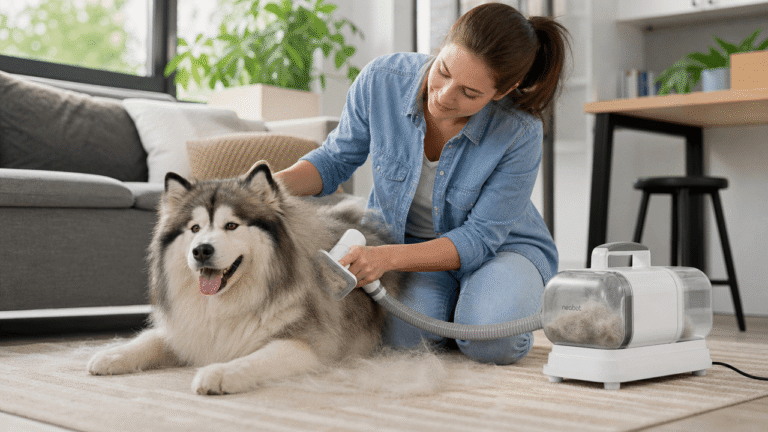
Type 2: The self-serve station. You still do the scrubbing. The machine just hands you a sprayer, a heated dryer, and a contained, splash-free bay so you’re not flooding your bathroom. This is the version that’s actually everywhere — Tractor Supply, PetSmart, independent pet wash businesses, and most of what you’ll find searching “automatic dog wash near me.”
If you search “automatic dog wash machine” expecting a hands-off robot and walk into a self-serve station, you will be scrubbing your own dog. That’s not a malfunction. That’s just what the product is.
3. Robotic Dog Wash Machine Review: Full Spec Breakdown
| Product / Type | Format | Price (USD) | Wash Cycle | Dry Cycle | Size Handling | Built For |
|---|---|---|---|---|---|---|
| Home AI robot (flagship unit) | Fully autonomous | ~$10,000 | ~20 min | Heated, auto-adjusted, built into same cycle | Auto-senses dog size and adjusts settings | Home or small commercial/B2B |
| Premium self-serve station | Self-serve, owner-operated | $8,900–$9,900 | Owner-paced, minutes per wash | Built-in high-airflow dryer | Designed for most dog sizes in an enclosed bay | Pet wash businesses, retail |
| Standard commercial station | Self-serve, owner-operated | $20,000–$30,000 | Owner-paced | Owner-operated dryer | Large bay, multiple size settings | Retail chains, vet clinics |
| Budget commercial station | Self-serve, owner-operated | $4,000–$5,500 | Owner-paced | Owner-operated | Bath only — not built for matting or styling | Smaller operators, startups |
| Portable home washer | Manual/semi-automated, collapsible | Budget consumer range (verify current pricing before publishing) | A few minutes | Limited — mainly spray/rinse, not full dry | Fits in a standard bathtub | Home use |
| Small-pet/cat wash cabin | Enclosed automatic cabin | Commercial-grade (price not publicly confirmed — verify) | 15–30 min, programmable | Built-in, temperature-monitored, auto shut-off on variance | Small to medium pets, including cats | Vet clinics, groomers |
Key spec nobody advertises clearly: the heated dry cycle is the part to watch closely if your dog is flat-faced (think bulldogs, pugs) — heat regulation in short-snouted breeds is already harder for them, and an unattended heated cycle is a real risk factor, not a theoretical one.
4. US vs Australia vs Singapore: What’s Actually Confirmed Available
This robotic dog wash machine review would be incomplete without the regional picture — and the honest finding here is that the robot itself has almost no confirmed presence in any of these three countries yet. What’s actually mature and locally available everywhere is the self-serve station, not WoofWoof Lux or anything like it.
| Country | Dominant Local Format | True Home-Robot Availability | Electrical Safety Standard | Real Local Examples |
|---|---|---|---|---|
| United States | Self-serve stations are everywhere; home robot is brand new | Limited — sold mostly direct, not mainstream retail | UL listing (voluntary) + National Electrical Code (NEC) | Tractor Supply pet wash stations, K9000, SHELANDY, Evolution Dog Wash |
| Australia | Self-serve / DIY wash culture in pet retail (thinner sourcing — treat as a research gap, not a confirmed market map) | No confirmed import of the true robotic home unit found | SAA / RCM (Regulatory Compliance Mark) | Limited public data |
| Singapore | Self-serve stations are well established, including government-run installations at public parks | No confirmed import of the true robotic home unit found | Safety Mark (CPSRR scheme) via Enterprise Singapore | SoapyPaws, GoGoWash, K9000 Singapore, NParks dog wash stations |
The honest takeaway: if you live in any of these three countries and want a true robotic dog wash machine that does everything for you right now, you’re early. What’s actually available and mature in all three markets is the self-serve station — and Singapore in particular already has a strong, established self-serve scene, including free or low-cost government installations at parks.
5. The 6-Month Mark: What Long-Term Self-Serve Users Actually Report
Important caveat before this section, and central to any honest robotic dog wash machine review: genuine 6-month-plus reviews exist for self-serve stations, which have been around for years. The $10,000 home robot category is too new — most units only launched at CES 2025 and 2026 — for any honest long-term consumer data to exist yet. Anyone claiming a year of home-robot ownership right now should be read with real skepticism.
Here’s what long-term self-serve users actually say:
Long-term owners — including owners of poodles and other low-shedding breeds — report that wash cycles often don’t leave enough time to fully rinse shampoo out of the coat, which has led to skin irritation. Several said this pushed them back to bathing at home or paying a professional groomer instead.
A recurring complaint at lower-quality or heavily shared stations, documented in an operator’s own troubleshooting thread: weak dryers and over-diluted shampoo. These machines are built for a bath, not a trim — they’re not a substitute for a groomer if your dog has matting or needs styling.
Hygiene is a real hesitation for repeat users. Shared facilities used by other people’s dogs raise legitimate concerns, and several long-term users specifically wanted a private, lockable space — especially for emergency situations like a skunk encounter, where you need access any time of day or night.
And one warning that has nothing to do with dog wash machines specifically, but shows up constantly in confused searches:
Never put a pet in a household clothes washing machine. Veterinary case reports document severe, real injuries — drowning risk, chemical exposure, head trauma — from pets accidentally trapped in front-loading laundry machines. That is an entirely different appliance and a genuine emergency, not a grooming product of any kind. I really do not know what’s going on in their minds when they do that.
On the business side, for context: self-serve station operators report machine costs of roughly $4,000–$5,500 with $1,000–$3,000+ in monthly revenue, and payback in 6 to 12 months. A $9,500 machine financed over 12 months runs about $850 a month — covered by just two to three washes a day.
6. Self-Serve Stations: What’s Actually Included, and a Real Groomer’s Wash Sequence
Everything in this section is specifically about self-serve stations, not the $10,000 robotic dog wash machine — there simply isn’t enough real-world data on the robot yet to write this kind of detail about it honestly.
Self-serve stations are remarkably consistent on what they provide, confirmed across multiple chains (Tractor Supply, Petco, EarthWise Pet, and several independent operators): waterproof aprons, rubber gloves, elevated waist-high tubs with ramps for larger dogs, a leash tie-down hook, shampoo and conditioner, brushes and combs, towels, and a high-velocity dryer to finish.
Pricing varies more than the equipment does — Tractor Supply runs under $10 per wash, while Petco’s self-serve stations run around $20, and several independent operators bill by the minute instead of a flat rate.
A real, specific technique sequence, credited to a professional dog groomer’s published advice, is worth following in order rather than improvising:
- Blow out loose hair before getting your dog wet, using the station’s force dryer on the dry coat first — this catches hair you missed brushing and makes the actual wash more effective.
- Wet from the bottom and rear, working up, rather than starting at the head.
- Brush shampoo through the coat rather than just lathering by hand — more shampoo doesn’t mean cleaner, the agitation and the ingredients do the actual work, not the volume.
- Match your tool to the coat type: a rubber curry for slick-coated breeds (Labs, Pit Bulls), a slicker brush for double-coated or low-shedding breeds.
- Skip conditioner if drying time matters to you. It genuinely helps with tangles and static, but it works by retaining moisture — which means a longer dry afterward, not a shorter one.
One easy-to-miss step that applies regardless of which station or machine you use: remove your dog’s regular collar before washing and drying. A wet collar left against skin is a real, documented cause of skin irritation — dry it separately and put it back on once your dog is fully dry.
If you’re drying afterward with your own equipment rather than the station’s, our high-velocity pet dryer review and pet dryer box review cover the two main options in depth, including the safety considerations specific to each.
7. What Self-Serve Users Get Wrong, According to This Review’s Research
Pricing structure catches a lot of repeat users off guard. One real Chicago-area complaint described expecting a familiar flat-rate setup — historically $7 for ten minutes, $10 for fifteen — only to find the same location had switched to a strict $1-per-minute structure with no grace period. The customer arrived with $14 and left with a dog that was clean but not fully dried, simply because the math changed underneath them between visits.
The lesson: confirm the current pricing structure at your specific location before each visit, especially if it’s been a while since your last one — these stations adjust pricing more often than the signage gets updated.
Long or medium-haired dogs can develop tangles during the wash itself, not just from skipping a post-bath brush. One detailed Manhattan review specifically described knots forming around the ears and legs during the wash cycle of a medium-haired dog, with staff stopping mid-session to work them out by hand.
The fix is the same one groomers recommend before any bath: brush your dog out completely beforehand, not just after, so wet fur isn’t tangling on top of fur that was already matted going in.
Several long-term reviewers across different cities independently noted that “self-serve” doesn’t always mean “unsupervised and unstaffed” — many locations have staff nearby who’ll step in to help, especially for a first-time user who looks unsure how to work the controls. This cuts against the common assumption that a self-serve station means you’re entirely on your own if something goes wrong.
8. Is Your Dog Even a Candidate? Breed and Size Red Flags
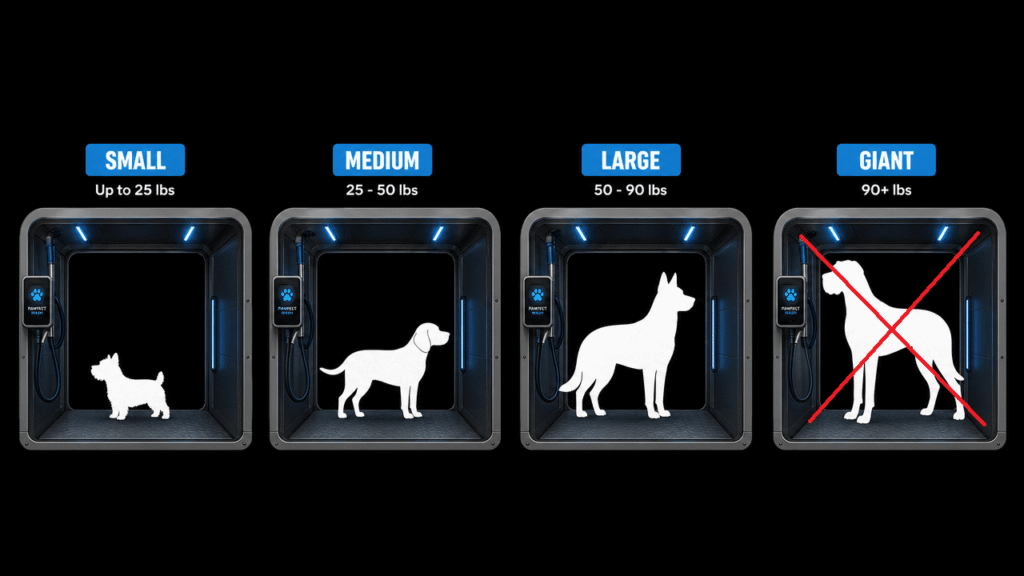
These two apply specifically to the $10,000 fully autonomous robot — the actual “robotic” half of this robotic dog wash machine review — not the self-serve stations you’ll actually find nearby:
- Very young puppies: the robot’s sensors are calibrated to detect a dog’s presence and size reliably before running an unattended cycle — very small or very young puppies can fall outside that calibration range. This isn’t a concern at a self-serve station, since you’re physically present and controlling everything by hand.
- First-time users of any size: even the companies building these autonomous robots openly acknowledge dogs are commonly anxious on their first encounter with a fully enclosed, unattended format. A self-serve bay carries far less of this risk specifically because you’re standing right there with your dog the whole time, not because the bay itself is calmer.
These apply to any enclosed bay or cabin, robot or self-serve alike:
- Flat-faced breeds (bulldogs, pugs, Boston terriers): a heated dry cycle is a genuine heat-stress risk for these breeds regardless of who’s controlling the dryer. If you’re at a self-serve station, watch your dog closely and use the lowest heat setting; on the robot, this risk is harder to monitor in real time since nobody’s standing over the cycle.
- Giant breeds: most bays and cabins, self-serve or robotic, are sized around small-to-large dogs, not giant ones. Check the published interior dimensions before assuming your Mastiff fits.
- Long or medium-haired breeds: brush thoroughly before the wash, not just after — see the tangle complaint above. A pre-wash brush-out takes a few minutes and avoids a mid-cycle detangling session either way.
9. Can You Wash a Cat in One of These? (Short Answer: Be Careful)
Mostly, no — this is a dog category. Purpose-built small-pet wash cabins for cats do exist commercially, with hair traps, monitored water and air temperature, and an auto shut-off if conditions vary — genuinely automated in how they regulate the cycle.
It’s worth being honest that I don’t have clear confirmation either way on whether these specific cabins still require you to actively lather and rinse, the same trade-off that separates a true hands-free robot from a self-serve bay in the dog category above. Treat the “automated” label as applying to the monitoring and safety systems, not necessarily to full hands-off washing, until you’ve confirmed that detail on the specific model you’re considering.
Even the companies building these units are upfront that some pets show real discomfort or anxiety inside them, and recommend introducing the cabin while the pet is young if you intend to rely on it long-term.
If your cat already tolerates baths poorly, an automated wash cabin is not the fix. Skip it.
10. Where to Verify a Machine Meets Safety Standards in Your Country
This is the section of any robotic dog wash machine review that gets skipped most often, even though it directly affects whether a home unit is safe to plug in and plumb yourself.
This category doesn’t have a dedicated pet-import or travel authority the way pet relocation does — there’s no AVS- or APHIS-equivalent agency for dog wash machines specifically. What actually governs safety here is each country’s general consumer electrical product regulator. Worth checking before you buy, especially for a home unit you’re plugging in and plumbing yourself:
- United States — Check general product safety recalls and filings via the Consumer Product Safety Commission (CPSC)
- Australia — Check the Product Safety Australia recall register and confirm RCM compliance on the unit’s rating label
- Singapore — Check Safety Mark registration status via Enterprise Singapore
If a seller can’t tell you which safety mark or listing applies in your country, that’s a legitimate reason to walk away — particularly for the $10,000 home unit, which is new enough that not every market has clear import precedent yet.
11. Robotic Dog Wash Machine Review: The Verdict — Smart Investment or White Elephant?
Split answer, because this is actually two different products wearing the same marketing language.
The $10,000 home robot: White elephant, for now. Not because the engineering is fake — it’s real, and it works as described. But there’s no 6-month track record, no resale market, no repair infrastructure yet, and a $10,000 price tag for something a $40 self-serve station visit already solves. Wait for the second or third generation and an actual used market before you commit.
The self-serve station: Genuinely worth it, especially if you’re in Singapore or a US city where they’re already common. Cheap per visit, mature technology, real ROI data behind it. The skin-irritation, rinse-time, and pricing-structure complaints are real, but they’re solvable by simply taking your time, brushing thoroughly beforehand, and confirming current pricing at your specific location — not a fundamental flaw in the category.
For most readers: skip both extremes. A $30 portable washer attachment and a $50 raised tub will get you 80% of the benefit for under $100, with none of the installation, none of the plumbing, and nothing to resell when the novelty wears off.
If you like this post, you might like our gadgets section => New Gadgets
Sources Referenced
- Dog Forum — “What do you think of Self-Service Dog Wash Machines?”, real owner thread on rinse time, skin irritation, and hygiene concerns
- Car Wash Forum — operator troubleshooting thread on diluted soap dispensing at self-serve dog wash stations
- Yelp — Chicago self-service dog wash reviews, including the flat-rate-to-per-minute pricing complaint
- Yelp — Manhattan self-serve dog wash reviews, including the mid-wash tangle/knot account