High Velocity Pet Dryer Review: The Safety Fact That Changes the Buying Decision
A dog’s skin is roughly a third as thick as a human’s — three to five cell layers compared to our ten to fifteen. That single anatomical fact is the entire reason vets keep repeating the same warning: never dry your dog with the hair dryer you use on yourself.
This high velocity pet dryer review starts there because it’s the most important thing to understand before spending money on this category. But there’s a second problem just as worth knowing before you shop: a meaningful share of the listings you’ll see on Amazon for this exact product type are dropshipped clones sharing identical hardware under wildly different brand names, with horsepower claims that don’t hold up to basic electrical math. Here’s both problems solved properly.
Quick Answer:
| Your Situation | What to Know |
|---|---|
| You’re currently using a human hair dryer on your dog | Stop — read the safety section below first |
| Thick or double-coated breed (Husky, Newfoundland) | Prioritize real CFM and dual-motor builds, not just a horsepower number |
| Shopping on Amazon | Check whether the same plastic shell appears under 5+ different brand names — that’s a clone, not a unique product |
| Sound-sensitive dog | Look for a true stepless variable speed dial, not a Low/High toggle |
| You also own a cat | High-velocity is usually the wrong tool for cats — see our dryer box review instead |
| Just washed your dog in a robotic wash station | Check our robotic dog wash machine review for the full wash-to-dry routine |
Table of Contents
- High Velocity Pet Dryer Review: Why a Human Hair Dryer Is Genuinely Dangerous for a Dog
- What “High Velocity” Actually Means: CFM, Not Just a Horsepower Number
- The Amazon Clone Problem, Verified
- A Groomer-Sourced Desensitization Protocol
- Comparison Table
- The Good, The Bad, and The Verdict — By Model
- What People Get Wrong, According to This High Velocity Pet Dryer Review’s Research
- Should You Use One on a Cat?
- US vs. Australia vs. Singapore: What Changes
- High Velocity Pet Dryer Review: The Verdict
1. High Velocity Pet Dryer Review: Why a Human Hair Dryer Is Genuinely Dangerous for a Dog
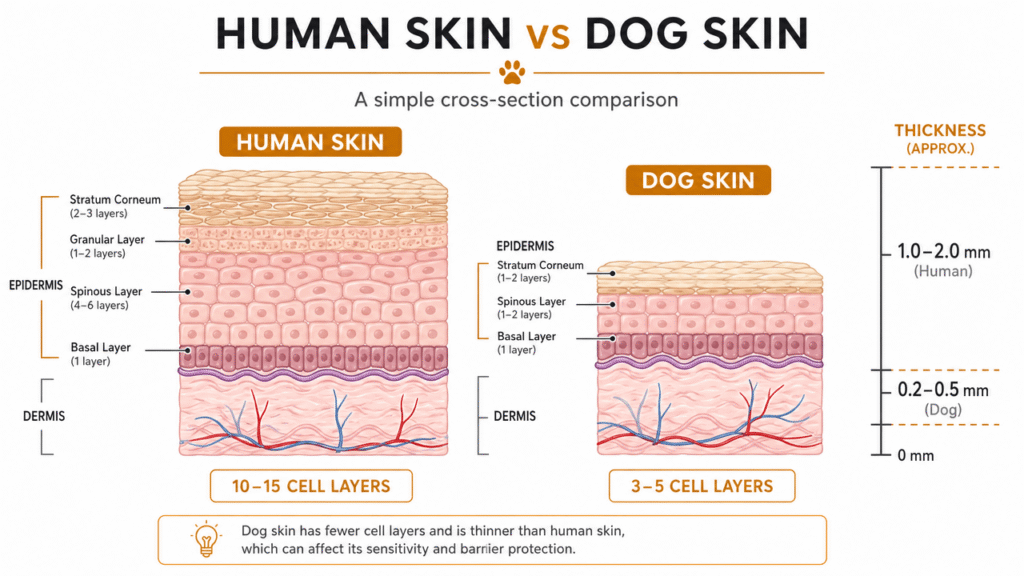
This isn’t a marketing exaggeration designed to sell a more expensive product. Multiple independent sources — a professional dryer manufacturer’s own safety FAQ, veterinary-sourced pet product guidance, and general pet care outlets — converge on the same finding: a human hair dryer’s “low” setting, comfortable on human skin and hair, can cause real thermal injury to a dog.
The mechanism is straightforward once you know the anatomy. Human hair dryers are built around a heating coil — heat does the actual work of evaporating water, with airflow as a secondary factor. Dog skin has far less insulation and far less ability to dissipate that heat than human skin does, which is exactly why a setting you’d find pleasantly warm on your own scalp can sit at a genuinely risky temperature against a dog’s skin.
A high-velocity pet dryer flips the entire approach: airflow, not heat, does almost all the work. The motor functions closer to a mechanical squeegee — forcing water physically off the coat — with any heating element present mainly to keep the air slightly above room temperature for comfort, not to bake the coat dry the way a human dryer does.
2. What “High Velocity” Actually Means: CFM, Not Just a Horsepower Number
The category name causes real confusion, and any honest high velocity pet dryer review needs to clear it up with the actual spec professional groomers check first: CFM (cubic feet per minute) and FPM (feet per minute) — the volume and speed of air the motor actually moves — not the horsepower number printed in bold on the listing.
This distinction matters because horsepower, on its own, is the easiest spec to inflate without consequence. A genuine high-velocity dryer uses real air volume to separate hair strands and physically blast water droplets off the coat and skin, which is also why these dryers are so effective at blowing out loose undercoat during shedding season.
The trade-off is volume in the literal sense too: moving that much air, that fast, is mechanically loud almost by design — which is exactly why the noise-handling section further down matters as much as the power spec.
3. The Amazon Clone Problem, Verified
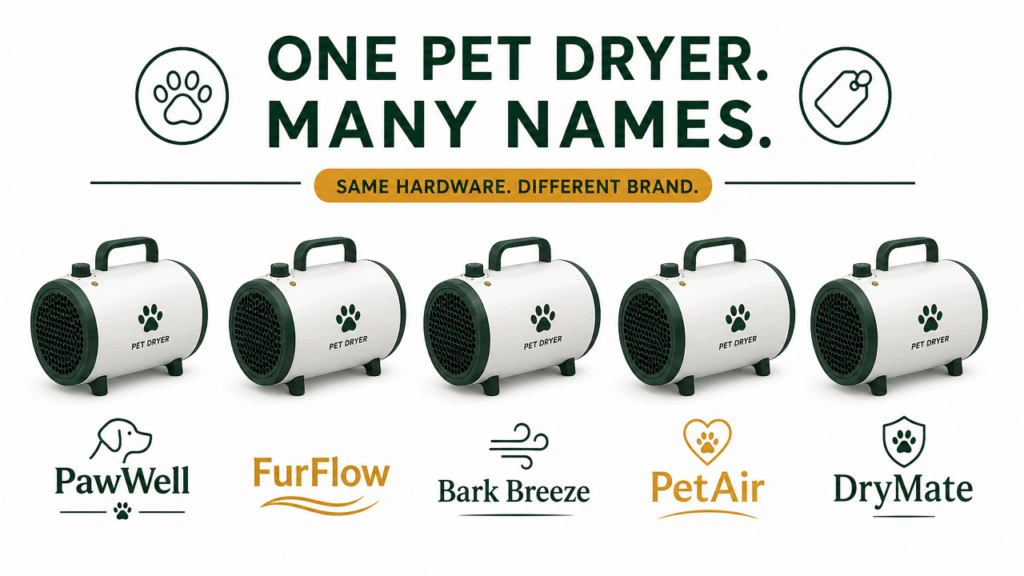
This is worth taking seriously before you buy anything in this category — and any thorough high velocity pet dryer review needs to check it directly, not just repeat the rumor.
Searching current Amazon listings for “5.2HP/3800W high velocity dog dryer” turns up the identical specification — down to the same product dimensions — sold under at least seven different brand names: Flying Pig, CHAOLUN, Blanlody, Hoqqf, Xapigo, GULUQI, and multiple generic unbranded listings. Several of these list the exact same casing dimensions to the decimal inch. That’s the clearest possible sign of the same factory hardware being relabeled and resold under whichever name a given seller account happens to use.
The “5.2HP” figure itself deserves real skepticism. It’s not necessarily a fabricated number — but a genuine continuous-duty 5.2-horsepower motor has no business running safely off a standard home wall outlet.
The more useful way to think about it: the 3800W rating on these listings draws roughly 32 amps on a 120V US circuit — meaningfully more than a standard 15-20A household circuit is rated to handle safely, especially if anything else is drawing power on the same circuit at the time.
The practical filter, the same one that applies to any white-labeled product: before buying, check whether the same casing shape and color options show up under multiple different brand names. If five sellers with unrelated names are moving the identical-looking unit, you’re not comparing five products — you’re comparing five name tags on one factory’s hardware, and the specific brand name tells you very little about quality control.
4. A Groomer-Sourced Desensitization Protocol
This is the part of a high velocity pet dryer review that matters most once you’ve actually got the unit home.
Even a genuinely quiet high-velocity motor registers as loud to a dog — hearing that extends to roughly 45,000-65,000 Hz, well past the human ceiling of about 20,000 Hz, means motor noise that’s merely “a bit loud” to you can trigger real fight-or-flight stress in your dog.
Professional groomer guidance, shared consistently enough across grooming communities to be treated as standard practice rather than one person’s opinion, breaks the introduction into deliberate steps:
- Power off, treats on. Place the unit in your grooming space completely off for a few days first, feeding high-value treats directly off the machine body so your dog associates it with something good before it ever makes a sound.
- Lowest setting, pointed away. When you do turn it on, use the lowest setting on a genuine stepless dial, and point the nozzle away from your dog entirely at first — reward calm behavior, don’t force proximity.
- Protect the ears. Pairing a high-velocity dryer with an ear-covering wrap (sometimes sold as a “Happy Hoodie“) muffles the noise around the ears and reduces the physical buffeting of air against the sensitive ear canal — a real, practical accessory most buying guides skip entirely.
- Never the face. Keep the airflow away from eyes, nose, and open ears at all times; finish the head area by hand or with the lowest possible setting rather than direct blasting.
Two more practical accessories worth knowing about, neither of which comes with the dryer itself:
A hose heat shield — sold as an add-on accessory by at least one professional dryer brand — slides over the hose and reduces both hose temperature and the heat reaching your own hand during longer sessions, since the motor genuinely does warm up the air and the hose itself over extended use.
Remove your dog’s regular collar before drying. This applies regardless of which dryer type you use, and it’s a step that’s easy to overlook entirely — a wet collar left against skin during or after drying is a documented, real cause of skin irritation. Dry the collar separately and put it back on once your dog is fully dry.
5. Comparison Table
Any high velocity pet dryer review worth reading needs real, verified models on the table — not just generic price tiers.
| Model | Motor Setup | Speed Control | Best For | Real-World Note |
|---|---|---|---|---|
| K-9 Dryers (Fluffer, Mini, III Variable Speed) | Single to dual motor depending on model | Variable, muffler-kit compatible | Giant breeds, heavy coats, professional use | American-made; the III Variable Speed is heavy and priced for serious/commercial use |
| Flying Pig One | Single motor, high output | Stepless turn dial + separate heat switch | Serious home groomers wanting commercial-adjacent control | Hose ships stiff and needs a warm-air session to fully loosen up |
| Shernbao Super Cyclone | Single motor, shielded | Stepless precision dial | Cats and noise-sensitive dogs specifically | Established brand (operating since 1999); proprietary nozzle fittings can be slow to source as replacements |
| Shelandy 3.2 HP | Single motor | Variable, 65-135 MPH | Home use across most dog sizes | Strong review base; hose connection point can run warm during long 30+ minute sessions |
| MetroVac Air Force Commander | Single motor | Fixed toggle, no stepless dial | Travel, mobile grooming setups | Rugged all-steel build; noticeably loud for its compact size |
| Generic “5.2HP/3800W” clones (Flying Pig knockoffs, CHAOLUN, Blanlody, etc.) | Single motor, inflated spec | Toggle, rarely true stepless | Budget shoppers who’ve checked for the clone pattern first | Identical casing dimensions repeat across multiple unrelated brand names — verify before buying |
6. The Good, The Bad, and The Verdict — By Model
This is where a high velocity pet dryer review actually earns its keep — matching real models to real situations, including the ones worth avoiding entirely.
K-9 Dryers (Fluffer, Mini, III Variable Speed) — The Good: a dedicated professional dryer brand with genuine American-made build quality and a stated design choice to use motor heat rather than a separate heating element. The Bad: the higher-end models are priced well above casual home budgets, and the largest units are heavy enough that moving them between rooms is a real chore. The Verdict: worth it specifically for giant or heavy-coated breeds and anyone drying multiple dogs regularly.
Flying Pig One — The Good: genuinely durable sheet-metal housing with a real adjustable speed dial and a separate heat switch, giving independent control over temperature and velocity rather than one combined setting. The Bad: the hose is noticeably stiff straight out of the box and needs a warm-air session before it loosens up properly. The Verdict: a strong mid-tier pick for serious home use without crossing into full commercial pricing.
Shernbao Super Cyclone — The Good: a legitimately established pet grooming brand (operating since 1999, not a recent dropship entrant), with a stepless dial that several reviewers single out as noticeably smoother than budget alternatives, and noise-dampening that measurably reduces the high-pitched turbine whine common to cheaper models.
The Bad: replacement nozzles use a proprietary slot-lock design that can be slower to source than a universal fitting. The Verdict: a strong choice specifically for cats and noise-sensitive dogs where dial precision matters more than raw power.
Generic “5.2HP/3800W” listings — The Good: genuinely the cheapest entry point into this category, and not automatically unsafe just for being a clone.
The Bad: the horsepower figure is marketing inflation rather than an honest spec, and quality control is unverifiable across sellers using the same hardware under different names.
Several of these listings also use a crude Low/High toggle instead of real variable speed — exactly the kind of switch that can startle a dog with a sudden full-force blast. The Verdict: acceptable only if you’ve confirmed which specific listing you’re buying isn’t just a relabeled duplicate of five others, and only with realistic expectations about the actual power output.
7. What People Get Wrong, According to This High Velocity Pet Dryer Review’s Research
The most common mistake isn’t choosing the wrong dryer — it’s trusting the horsepower number on the listing over the actual CFM/FPM spec, the noise profile, and whether the same housing shows up under other brand names. A bigger number on the box doesn’t mean a better or even a real motor behind it.
A second recurring mistake: judging a dryer purely on power without checking for a true stepless speed dial. A dog that’s never experienced a high-velocity dryer before can become genuinely fearful of bath time itself if the first experience is a sudden full-force toggle switch with no gradual introduction.
A third: assuming a “quiet” pet dryer is automatically the right tool for a cat. It generally isn’t — see the section below.
8. Should You Use One on a Cat?
This high velocity pet dryer review would be incomplete without a direct answer here: generally, no — and this is worth being direct about, because it’s a genuinely common assumption that doesn’t hold up. Experienced groomers describe the idea that cats specifically need a high-velocity dryer as an old assumption that doesn’t match real behavior: most cats become more stressed, not less, when faced with the speed and noise of a true high-velocity unit.
A stressed cat on a grooming table is a real safety risk for scratching and biting, not just an inconvenience. If you own a cat, the better-suited category is an enclosed dryer box, built around lower noise and gentler, indirect airflow specifically because cats tolerate that combination far better. We cover that category, including a working cat groomer’s real six-month account, in a separate review.
9. US vs. Australia vs. Singapore: What Changes
This high velocity pet dryer review’s core findings hold across all three markets — what shifts is voltage, certification, and how much climate matters.
United States: Dryers run on standard 110-120V residential circuits. A heavy dual-motor model pulling close to its full rated wattage on startup can be enough to trip a breaker if it’s sharing a circuit with another major appliance — worth checking which outlet and circuit you’re actually using, not just whether the plug fits.
Australia: Operating on a 230V/50Hz Type I grid generally runs these motors more efficiently than the US voltage does, but confirm any imported brand carries genuine Australian electrical certification before relying on it — an uncertified import running on the wrong assumptions about local voltage tolerance is a real fire-risk consideration, not just a compliance formality.
Singapore: Operating on 230V/50Hz with Type G plugs. Singapore’s consistently high humidity means natural air-drying takes meaningfully longer than in a drier climate, which makes a genuine high-velocity dryer’s deep-coat drying advantage more valuable here than elsewhere. One added maintenance point for this climate specifically: the rear intake foam filter collects dust and dander faster in humid air, and needs monthly washing with full air-drying before reinsertion to protect the motor.
10. High Velocity Pet Dryer Review: The Verdict
Two safety facts should drive this purchase more than any spec sheet: your dog’s skin genuinely cannot tolerate what your own hair dryer considers a gentle setting, and a meaningful share of the cheapest listings in this category are the same factory hardware wearing different name tags with inflated horsepower claims.
Check CFM and real speed control before horsepower, verify whether a tempting budget listing is a duplicated clone, and introduce any new dryer to your dog gradually rather than at full power on day one. For thick or double-coated breeds, a genuine model from an established brand earns its price back quickly in saved grooming visits; for a single small dog with a light coat, a mid-range model with disclosed, adjustable settings is plenty.
If you like this post, you might like our gadgets section => New Gadgets
Sources Referenced
- K-9 Dryers — Best Dog Hair Dryers in 2026, tested models and FAQ
- K-9 Dryers — Types of Pet Dryers Explained
- Bustle — The 4 Best Quiet Blow Dryers for Dogs, including the Shelandy hands-on review
- Groomer to Groomer — Cats & Dryers, a working groomer’s real account of high-velocity dryers on cats
- Beardpet — Can I Use a Regular Hairdryer for Cat Drying?
- Amazon — Shernbao High Velocity Professional Dog Dryer listing, confirming the brand’s 1999 founding and 20+ years in pet grooming
- Amazon — verified matching “5.2HP/3800W” specifications across multiple unrelated brand listings (Flying Pig, CHAOLUN, Blanlody)
- Jeffers Pet — K-9 Comfort Sleeve hose heat shield listing