Dog Anxiety Symptoms by Breed: Hidden Warning Signs
A dog that shreds the couch the moment you leave isn’t getting revenge. Most owners read destructive behavior, accidents, or nonstop barking as defiance, when the far more common explanation is fear. Getting that distinction wrong is the single biggest reason anxiety treatment plans fail before they start.
Dog anxiety symptoms by breed, age, and living situation all interact in ways that generic “10 signs your dog is anxious” lists tend to flatten. A senior Labrador pacing at 2 a.m. and a six-month-old Border Collie destroying a crate are both anxious, but for almost entirely different reasons, and they need different responses.
Quick Answer
| Question | Short Answer |
|---|---|
| Is my dog anxious or just badly behaved? | Check timing and body language, not just the mess — panic-driven behavior clusters around triggers (departures, storms, being alone), misbehavior doesn’t |
| Which breeds are most at risk? | Small/toy companion breeds and several working breeds, per veterinary behaviorist research — genetics load the dice, but any breed can develop it |
| Do puppies and senior dogs get anxious for the same reasons? | No — puppy anxiety usually traces to fear periods and under-socialization; senior anxiety is frequently linked to cognitive decline or physical pain |
| Do calming products actually work? | Some help meaningfully as one part of a plan; none replace training or a vet visit for anything beyond mild, situational stress |
| Does my dog need medication? | Only a vet or veterinary behaviorist can determine that — self-diagnosing and dosing is not safe or appropriate |
Table of Contents
- What Anxiety Actually Looks Like
- The Behaviors Owners Most Often Misread
- Breeds Most Prone to Anxiety
- When Breed and Environment Don’t Match
- Puppies vs. Senior Dogs: Different Anxiety, Different Causes
- Training Approaches That Actually Help
- Products That Can Help, and Their Real Limits
- Medication: What Vets Actually Prescribe
- What People Get Wrong
- US / Australia / Singapore Notes
- When to See a Vet or Behaviorist
- The Bottom Line
What Anxiety Actually Looks Like
The core symptom list is fairly consistent across sources: excessive barking or howling when alone, destructive chewing focused near doors and windows, house-soiling in a normally house-trained dog, pacing, trembling, excessive drooling, and attempts to escape a crate or room. Separation anxiety specifically tends to show up within minutes of an owner leaving, which is one of the clearest tells that distinguishes it from a dog that’s simply bored or under-exercised.
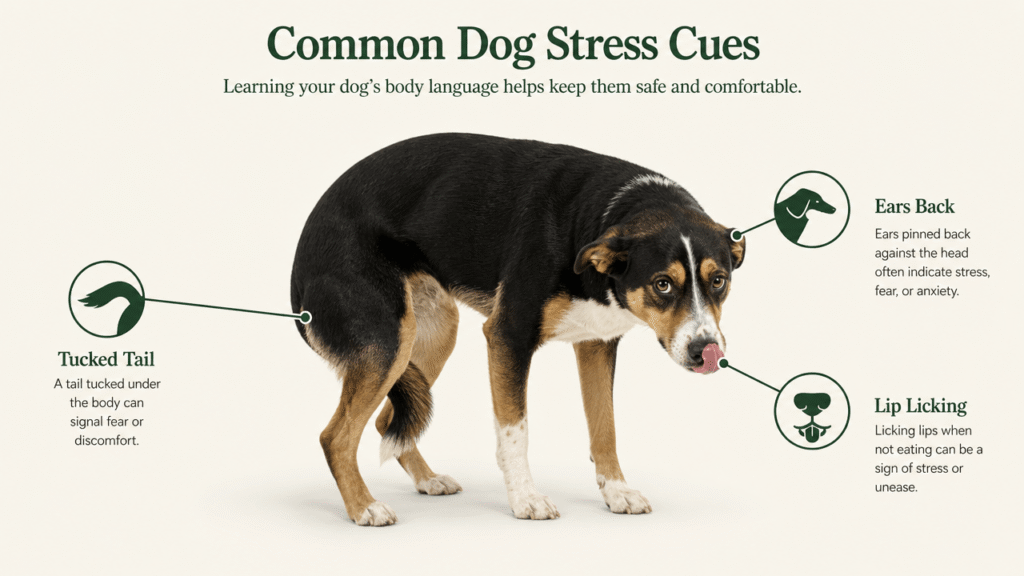
Body language matters as much as the mess left behind. A dog holding its ears back, tail tucked, lip-licking, or yawning outside of tiredness is often signaling stress in the moment, not after the fact. Veterinary telehealth service Dutch notes that anxious dogs may also excessively bark, tremble, or pace even in situations that don’t involve being left alone — thunderstorms, unfamiliar visitors, and car rides are common non-departure triggers.
The Behaviors Owners Most Often Misread
A dog that “acts guilty” when you come home to a mess is reading your body language and reacting to your tone, not confessing to a crime — dogs don’t connect punishment delivered minutes or hours later to the earlier behavior. Chewed doorframes and scratched windowsills usually mean a dog is trying to reach you or escape confinement, not “getting back at you” for leaving.
Recent adoption is its own risk factor, and somewhat counterintuitively, separation anxiety in newly adopted shelter dogs tends to emerge one to two months after coming home, not immediately — which catches a lot of new owners off guard right when they assumed the hard part was over.
Breeds Most Prone to Anxiety
Genetics load real risk, even though any individual dog of any breed can develop anxiety. A study by veterinary behaviorist Dr. Deborah Duffy found that the highest levels of fear and separation anxiety belong almost without exception to small or toy breeds, and that dwarf or miniature versions of a breed are typically more anxious than their standard-sized counterparts.
PetMD’s breed-specific rundown, reviewed with input from veterinary behaviorists, lists Siberian Huskies, Chihuahuas, German Shepherds, Greyhounds, American Staffordshire Terriers, and Border Collies as breeds with elevated anxiety risk — a mix of toy companion breeds and high-drive working breeds, for different underlying reasons in each case.
Working and herding breeds (German Shepherds, Border Collies, Australian Shepherds) tend toward anxiety rooted in insufficient mental and physical outlets rather than pure separation distress — Border Collies consistently rank as one of the most intelligent breeds, and become anxious specifically from a lack of stimulation, not just from being alone. Toy and companion breeds (Chihuahuas, Bichon Frises, Cavalier King Charles Spaniels) more often show classic separation distress tied to their strong attachment to a specific person.
When Breed and Environment Don’t Match
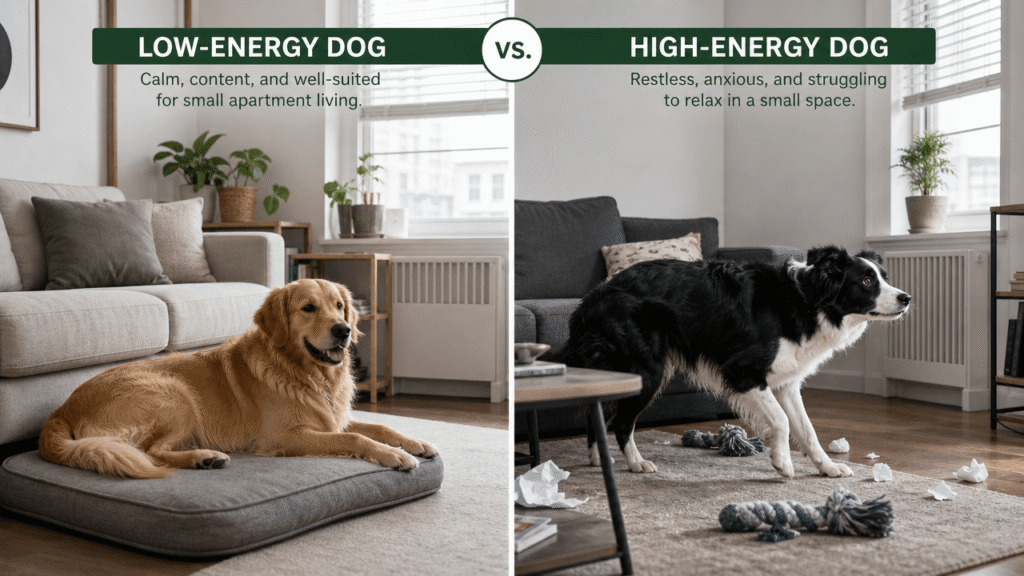
This is the piece most breed lists skip entirely: a breed doesn’t have to be “anxious” on paper to develop anxiety symptoms in the wrong living situation. High-drive working breeds like the Belgian Malinois can become frustrated and anxious in a confined space specifically because their strong prey drive and need for structure go unmet, regardless of whether that breed shows up on a typical “anxious breeds” list.
The same pattern shows up with Siberian Huskies, Weimaraners, and Australian Shepherds in apartments — these breeds are described as needing intense daily exercise and mental engagement that a small living space and a typical work schedule often can’t provide, which manifests as anxiety-adjacent destructive behavior even in dogs with no inherent predisposition to fear or separation distress.
On the other end, calmer, lower-energy breeds — French Bulldogs, Pugs, Bichon Frises, Basset Hounds, Boston Terriers — generally adapt well to apartment life and don’t need the same volume of physical outlet to stay settled. The takeaway isn’t “avoid working breeds,” it’s that a working breed’s environment needs to match its actual drive, or anxiety symptoms are a predictable outcome regardless of genetics.
Puppies vs. Senior Dogs: Different Anxiety, Different Causes
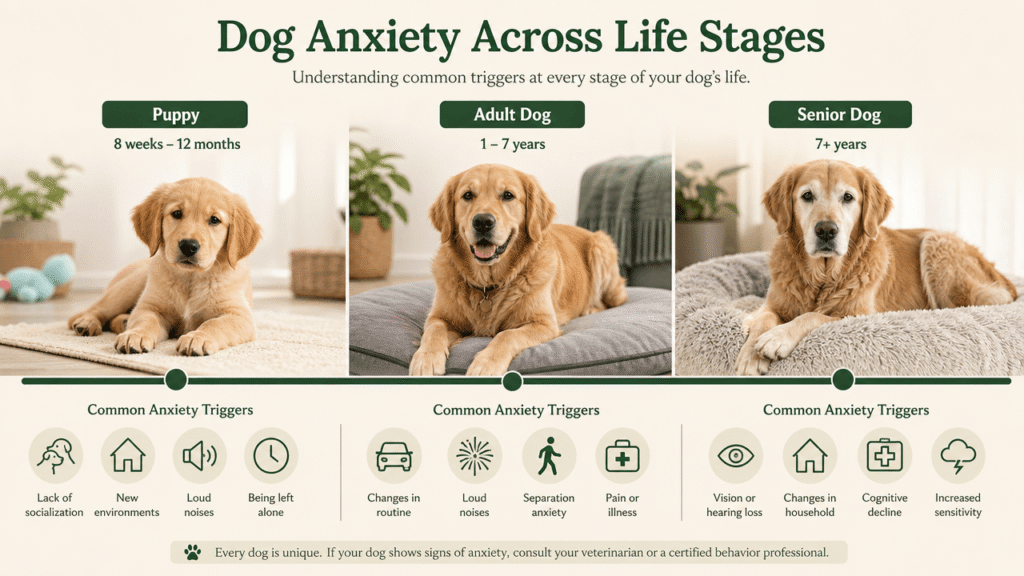
Puppy anxiety is heavily shaped by two developmental windows. The first fear period runs roughly 8 to 11 weeks, right as puppies typically move to a new home, and the second runs from about 6 to 14 months as adolescence begins — both are normal developmental stages, not signs something is wrong, but a scary experience during either window can create a lasting phobia.
A peer-reviewed study of 107 adopted dogs found that puppies adopted at one month of age or younger showed significantly higher fear, anxiety, and attachment-related behaviors as adults compared to puppies adopted slightly later, underscoring how much the 3-to-12-week socialization window matters for lifelong temperament.
Senior dogs are a different story almost entirely. Anxiety that develops or worsens in older dogs is frequently linked to canine cognitive dysfunction syndrome (CDS), a condition with strong parallels to Alzheimer’s in humans, alongside sensory decline (reduced hearing or vision making the world feel less predictable) and physical pain that keeps the nervous system on edge. One peer-reviewed study found CDS prevalence estimates ranging from roughly 14% in dogs over 10 to as high as 74% in dogs over 7, depending on how it was measured — likely underdiagnosed since owners often mistake early signs for normal aging.
A sudden behavior change in a senior dog — new separation anxiety that never existed before, increased vocalizing at night, or disorientation in a familiar home — warrants a vet visit before anything else. The ASPCA notes that a thorough medical evaluation combined with a full behavioral history is necessary to determine whether the cause is cognitive, medical, or genuinely behavioral, since the treatment differs depending on which it is.
Training Approaches That Actually Help
Desensitization and counterconditioning form the backbone of most legitimate treatment plans — exposing a dog to a trigger at an intensity low enough that it doesn’t react, then gradually increasing exposure while pairing it with something positive. This applies whether the trigger is departures, thunderstorms, or unfamiliar people, and it works the same way for puppies and senior dogs, just at different paces.
A few specific, well-supported tactics show up consistently across trainers and behaviorists. Downplay departures and returns rather than making a production of either. Exercise before a predictable stressful event, since a physically tired dog has less energy left to spend on panic. Certified trainer Renee Rhoades recommends giving an anxious dog “a secure sanctuary for times of stress” that stays peaceful and accessible on the dog’s own terms, not a space used for punishment.
Food puzzles and frozen stuffed toys reserved specifically for alone-time can help shift the emotional association with departures, though this only works for mild cases — a dog in genuine panic usually won’t eat. For anything beyond mild, situational stress, working with a certified trainer or veterinary behaviorist gets better results faster than guessing at home.
Products That Can Help, and Their Real Limits
Pheromone diffusers, calming beds, compression wraps, and calming chews are the most common category of product recommended for mild to moderate anxiety, and real owner and veterinary reporting suggests they help meaningfully for situational stress (thunderstorms, car rides, vet visits) more often than for severe separation anxiety. None of these products treat the underlying cause on their own — they’re best understood as one supporting piece alongside training, not a replacement for it.
We have covered specific pheromone and calming-aid products head to head in a dedicated comparison, since the claims and evidence quality vary meaningfully by brand and category. You can find the link here.
Medication: What Vets Actually Prescribe
Medication is a real, legitimate part of treatment for moderate to severe anxiety, but it’s a veterinary decision, not a self-directed one — this section is informational, not a substitute for a vet’s assessment of your specific dog. Fluoxetine (an SSRI) is typically used for long-term anxiety management and takes several weeks to reach full effect, while trazodone works within hours and is more often used for situational stress like thunderstorms, fireworks, or vet visits. The two are sometimes prescribed together, since they address different timeframes.
Clomipramine is FDA-approved specifically for separation anxiety in dogs, and selegiline is FDA-approved for canine cognitive dysfunction specifically — meaning the right medication genuinely depends on which underlying cause a vet identifies, not just “anxiety” as a single catch-all diagnosis. Abruptly stopping any of these medications can cause rebound anxiety, so any change in dose or discontinuation needs to happen under veterinary guidance, tapered gradually rather than stopped all at once.
What People Get Wrong
The most common mistake is treating anxiety as a training problem exclusively, when a meaningful share of cases — especially sudden-onset anxiety in adult or senior dogs — has a medical root that training alone won’t fix. Ruling out pain, thyroid issues, and cognitive decline before assuming “it’s just behavioral” saves months of frustration for both dog and owner.
The second mistake is assuming a calm-looking dog left alone all day in an apartment is fine simply because there’s no barking complaint from neighbors. Quiet distress (excessive drooling, self-soiling, destructive chewing that only happens near exits) is just as real as the loud kind, and it’s easier to miss specifically because it doesn’t generate complaints.
Dog Anxiety Symptoms by Breed: US / Australia / Singapore Notes
United States: Certified veterinary behaviorists (board-certified through the American College of Veterinary Behaviorists) are available in most major metro areas, though rural access is thinner — a regular vet can still prescribe first-line medications like trazodone while you’re on a waitlist for a specialist.
Australia: Veterinary behaviorist access is more concentrated in capital cities; regional and rural pet owners may need to rely more heavily on a general practice vet plus remote consultation with a behaviorist, which is increasingly offered via video call.
Singapore: Apartment living is the default here for the vast majority of dog owners, which makes the breed-environment mismatch section above especially relevant — a high-drive working breed in a typical Singapore apartment is a common, preventable setup for anxiety-driven behavior that has nothing to do with the breed being inherently “more anxious.”
When to See a Vet or Behaviorist
See a vet promptly if anxiety symptoms appear suddenly in a dog with no prior history, if a senior dog shows new disorientation or altered sleep-wake patterns, or if self-injury (chewing paws raw, breaking teeth on crate bars) is happening. These patterns are common enough reasons for a same-week vet visit rather than trying home remedies first, since an underlying medical cause changes the entire treatment approach.
The Bottom Line
Dog anxiety symptoms by breed give you a reasonable starting expectation, not a diagnosis — a Chihuahua and a Border Collie can both end up anxious for almost opposite reasons, and a low-risk breed in the wrong environment can develop the same symptoms as a genetically predisposed one.
Age matters as much as breed: a puppy in a fear period and a senior dog with early cognitive decline need completely different responses even when the visible symptoms look similar. Training addresses most mild-to-moderate cases; medication is a real, legitimate tool for the rest, but it’s a vet’s call to make, not a guess to run on your own.
If you like this post, you might like our other post regarding pet anxiety products => here
Sources Referenced
Editorial, veterinary, and reference sources (linked):
AOL — 5 Ways to Help Your Anxious Dog Become More Confident (Renee Rhoades)
Wikipedia — Separation Anxiety in Dogs
Dutch — Fluoxetine vs. Trazodone for Dogs
Small Door Veterinary — Managing Anxiety in Dogs
Petcube — Dog Breeds With Separation Anxiety
PetMD — 10 Dog Breeds Prone to Anxiety
PetsRadar — 32 Dog Breeds Most Likely to Have Separation Anxiety
iHeartDogs — Dog Breeds Not Ideal for Apartment Living
Yahoo Creators — 7 Dog Breeds That Struggle With Apartment Living
American Kennel Club — Puppy Fear Periods
NCBI/PMC — The Puppies’ Age at Adoption Time Influences Behavioral Responses of Adult Dogs
NCBI/PMC — Signs of Medical Conditions and Cognitive Decline in Senior Dogs
ASPCA — Behavior Problems in Older Dogs
Today’s Veterinary Practice — The Use of Medications in Canine Behavior Therapy