Fi vs Tractive Real Owner Reviews: Honest 2026 Take
A GPS collar has exactly one job that matters more than any other: telling you the moment your dog gets out. Both Fi and Tractive occasionally fail at that exact job — and real owners have the receipts to prove it.
Every spec-sheet comparison of these two will tell you the same thing: Tractive updates faster, Fi’s battery lasts longer. That’s true, and it’s also not the whole story. We dug into fi vs tractive real owner reviews across Trustpilot, Reddit, and long-term ownership blogs, and found complaint patterns on both sides that neither company’s marketing page mentions.
Quick Answer
| Category | Winner | Why |
|---|---|---|
| Overall pick for dogs (per our locked verdict) | Tractive | Faster live updates, broader international coverage, cheaper long-term |
| Battery life | Fi Series 3+ | 2-3 months standby vs Tractive’s 5-7 days |
| Subscription cost over 5 years | Tractive | Roughly $379 total vs Fi’s ~$965-1,930 depending on plan |
| Collar design | Fi | Integrated, can’t fall off or snag; Tractive clips onto an existing collar |
| Real-world reliability complaints | Both have them | Escape-alert delays and subscription-cancellation friction show up in reviews for both brands |
Table of Contents
- Speed and Accuracy: What the Numbers Actually Show
- Battery Life: The One Category Fi Dominates
- The Real Cost Over Time
- Health and Activity Monitoring
- What About Cats?
- What Owner Reviews Reveal That Spec Sheets Don’t
- Comparison Table
- The Good, The Bad, and The Verdict
- What People Get Wrong
- US / Australia / Singapore Notes
- Tips for Either Tracker
- The Verdict
Speed and Accuracy: What the Numbers Actually Show
In testing by multiple reviewers, Tractive consistently provided more accurate location data and triggered geofence alerts faster than Fi — when dogs left their safe zone, Tractive notified owners within seconds, while Fi sometimes took minutes. Tractive delivers live location updates every 2-3 seconds with consistent 5-8 meter outdoor positioning, while Fi’s occasional “Last seen 8+ minutes ago” messages are a documented trade-off of its aggressive WiFi-to-cellular battery-saving switching.
That gap matters most in the exact moment you need a tracker most. It’s the mechanical reason Tractive holds the “best overall” spot in our GPS tracker coverage — speed during an actual escape isn’t a minor spec, it’s the core function.
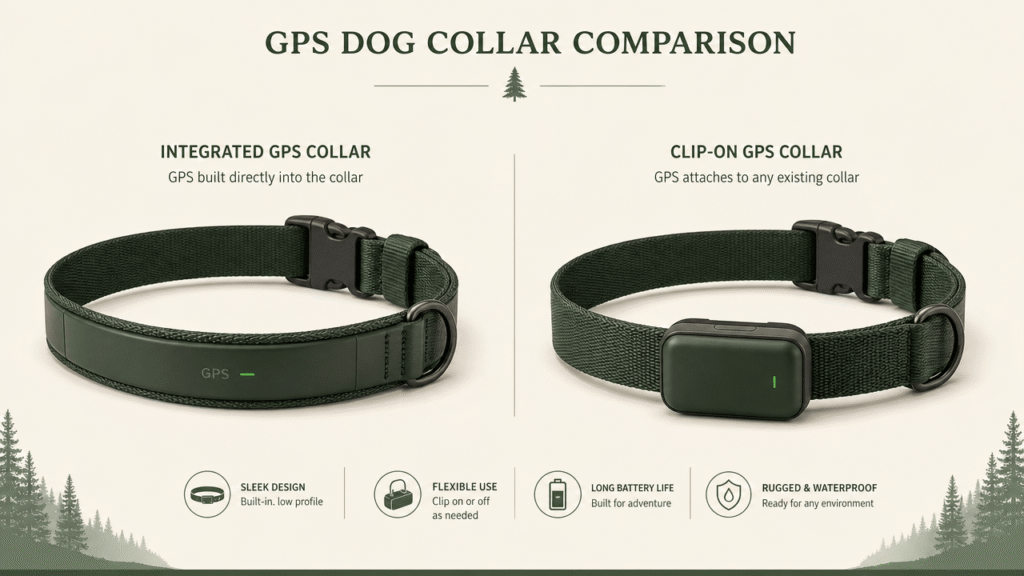
Setup experience differs too, and it’s worth factoring in if you’re not particularly technical. Fi’s collar is a single integrated unit, so setup is largely just charging it and pairing the app — there’s no separate device to attach. Tractive requires clipping its tracker onto an existing collar, which one long-term reviewer described as “a little cumbersome when compared to the Fi collar series,” though it does mean Tractive works with whatever collar your dog already wears comfortably rather than forcing a collar swap.
Battery Life: The One Category Fi Dominates
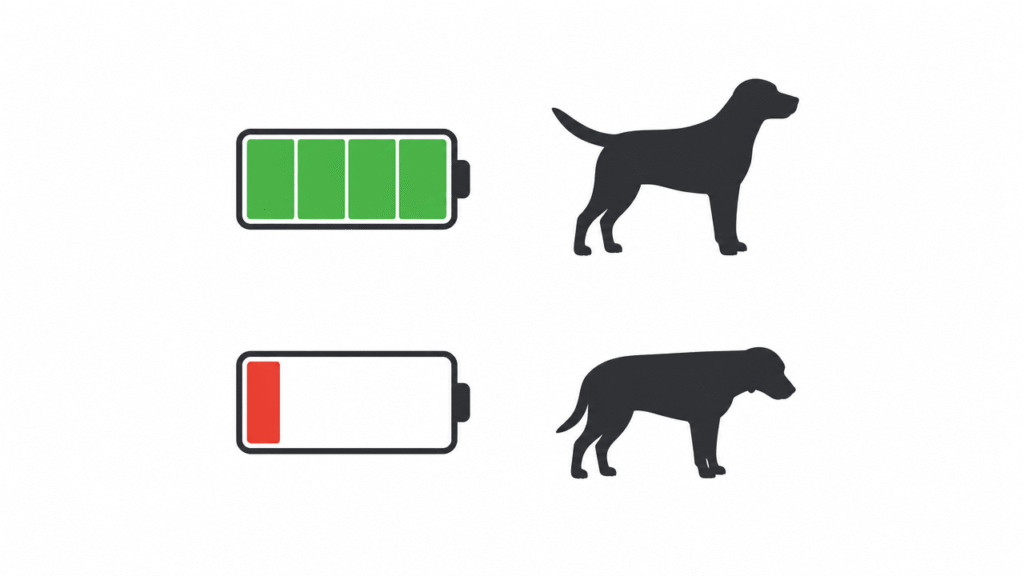
This isn’t close. The Series 3+ achieves up to 3 months of standby battery through intelligent WiFi/cellular switching, using WiFi when your dog is home and only activating cellular when they leave a known zone. Tractive’s battery lasts 5-7 days in standard mode and as little as 2 days with frequent live tracking — respectable for a clip-on device, but not in the same category.
For owners who’ve forgotten to charge a device before (most of us), that gap is the entire reason Fi holds its own “best for battery life” spot rather than losing outright to Tractive.
The Real Cost Over Time
Over three years, expect to spend roughly $235 on Tractive versus $567 on Fi under typical plans — a real gap that widens further on longer horizons. Fi offers only prepaid plans with no monthly option unless you commit to a 6-month minimum at $19/month, while Tractive’s multi-year prepay options bring the effective annual cost down significantly.
Health and Activity Monitoring

Both trackers have moved well past simple GPS pins. Tractive’s health tracking covers sleep, activity time, heart rate, respiratory rate, and barking, learning your dog’s normal patterns and flagging changes that might warrant a vet visit. Fi’s app takes a similar approach with AI-powered behavior detection, tracking daily activity against custom goals and surfacing changes over time rather than raw numbers alone.
Neither is a substitute for a vet, and both have documented false positives on health alerts — worth treating as a rough early-warning signal, not a diagnosis. If health tracking matters more to you than GPS accuracy specifically, the feature sets are close enough that battery life and cost are the more decisive factors.
What About Cats?
This is where the comparison gets lopsided. Fi’s product line is built for dogs — there’s no dedicated Fi cat tracker in the current lineup. Tractive, by contrast, has a purpose-built cat tracker with a lighter housing and a design suited to a cat’s smaller neck and different movement patterns. If you’re shopping for a cat specifically rather than a dog, this comparison mostly doesn’t apply — Tractive’s cat-specific model is the more relevant option to research on its own.
What Owner Reviews Reveal That Spec Sheets Don’t
Here’s what the roundups built from manufacturer spec sheets miss. On Trustpilot, real Fi owners describe a lost dog that “took off” while hunting, with Fi’s app giving “no signal, no location, no help” during the exact scenario the product is sold to solve. A more recent review describes a dog that escaped in May 2026: the alert “did not alert me until far too late,” and the dog ended up near a busy road before being found safe.
Cancellation friction is a recurring theme too. Multiple Fi reviewers describe subscriptions continuing to charge after a cancellation attempt, and one reviewer called the process “next to impossible” without changing their card number to force it to stop.
Tractive isn’t clean either. One owner’s dog went missing, and the tracker’s live location had a “massive delay” — the path only updated retroactively after the dog was found, three hours later, a serious failure of the exact live-tracking speed Tractive is supposed to win on. The BBB has also logged complaints about Tractive auto-renewing multi-year subscriptions and charging cards without prior notice.
Neither pattern is universal — both companies have thousands of satisfied owners — but both patterns are real and independently documented, which is more than most head-to-head roundups tell you.
Comparison Table
| Category | Fi Series 3+ | Tractive |
|---|---|---|
| Battery life | Up to 3 months standby | 5-7 days standard |
| Alert speed | Can lag minutes during network switching | Typically seconds |
| Design | Integrated collar, can’t fall off | Clip-on, fits existing collar |
| 3-year cost (typical plan) | ~$567 | ~$235 |
| Subscription flexibility | Prepaid only, or $19/mo with 6-month minimum | Monthly and multi-year prepay options |
| International coverage | US-focused, recent UK/EU expansion | 175+ countries |
| Documented complaint pattern | Escape-alert failures, cancellation friction | Live-tracking delays, unauthorized renewal charges |
The Good, The Bad, and The Verdict
Fi Series 3+
The integrated collar design and best-in-class battery life are real advantages, especially for owners who’ve been burned by a dead tracker before. Where it loses ground: alert speed can lag during network handoffs, and the subscription cancellation process has generated enough Trustpilot complaints that it’s worth reading your plan’s terms closely before signing up. If you want the tracker that survives forgetting to charge it for weeks, this is still the pick — just go in aware of both trade-offs.
Tractive — Good: faster alerts, broader coverage, and the cheapest long-term cost of the two. Bad: shorter battery life means weekly charging is a real commitment, and its own live-tracking delays and billing complaints show up often enough in reviews to take seriously. Verdict: still the stronger overall pick for most dogs, which is why it holds that spot in our broader GPS tracker coverage — but “most reliable” doesn’t mean “flawless.”
What People Get Wrong
The most common mistake is treating “GPS tracker” as a guarantee rather than a tool with real failure modes. Both Fi and Tractive work as advertised for the vast majority of owners, most of the time — but “most of the time” isn’t the same promise as “every time,” and the reviews where it mattered most are exactly the ones that get buried under thousands of routine five-star ratings.
The second mistake is skipping the subscription terms. Fi’s 6-month minimum on monthly plans and Tractive’s auto-renewal defaults have both generated real billing complaints — reading the cancellation policy before you buy takes five minutes and avoids most of these stories entirely.
Fi vs Tractive: US / Australia / Singapore Notes
United States: Both trackers are fully supported, with Fi running on AT&T’s LTE-M network and Tractive on its own multi-carrier infrastructure.
Australia: Tractive is the more practical choice on paper — it operates in 175+ countries with local carrier support, while Fi’s coverage remains US-focused with only a recent UK/EU expansion and no confirmed Australian rollout. But “supported” doesn’t mean “will work everywhere.” Australia’s three major mobile networks cover roughly 99% of the population, but that only translates to about 35% of the continent’s actual landmass — outback, regional, and remote areas are genuine cellular dead zones, government black-spot funding programs notwithstanding. A cellular GPS tracker is only as good as the network it rides on: if your dog roams property well outside a populated or coastal area, neither Fi nor Tractive will have signal to work with, regardless of which one wins the general coverage comparison. If you’re in or near a regional area, check current coverage maps for the specific carrier each tracker uses before buying, not just the country-level “we support Australia” marketing claim.
Singapore: Singapore’s dense urban coverage means the dead-zone problem above mostly doesn’t apply — but the same principle holds: confirm which carrier a tracker actually uses locally before buying, since coverage details change faster than review articles get updated, and Fi’s confirmed footprint still doesn’t extend to Singapore as of this writing.
Tips for Either Tracker
Register your warranty and read the cancellation policy the same week you buy, not the month you want to cancel — most of the billing complaints in owner reviews trace back to assuming the process would be easier than it turned out to be.
If you’re relying on a tracker for an escape-prone dog specifically, don’t treat the app notification as instant in every situation; both brands have documented delays, so pair the tracker with basic physical containment rather than treating it as a standalone safety net.
Test the tracker’s alert speed yourself in the first week, in a low-stakes situation — walk your dog to the edge of a virtual fence and time how long the notification actually takes to arrive on your phone. That real-world number, on your actual network coverage, is more useful than any manufacturer’s stated average.
The Verdict
Tractive remains the stronger overall pick for most dogs — faster alerts, broader coverage, and a real cost advantage over time. Fi earns its keep specifically on battery life, and the integrated collar design is a genuine advantage for dogs that are hard on clip-on hardware. Neither company’s marketing page will tell you about the reliability and billing complaints documented above, which is exactly why checking fi vs tractive real owner reviews before buying is worth the ten minutes it takes.
If you like this post, you might like our gadgets section => New Gadgets
Sources Referenced
Editorial and community sources (linked):
Simology — Australia eSIM Guide: Outback Coverage & 5G
PawTech Review — Fi vs Tractive GPS Dog Tracker
Life With Klee Kai — Fi Series 3+ vs Tractive Comparison
Smart Pet Gear Lab — Tractive vs Fi Series 3 Head-to-Head
Trustpilot — tryfi.com reviews
Trustpilot UK — tryfi.com reviews