
GPS Trackers for Australian Networks: Honest 2026 Guide
Some pet GPS trackers that worked fine in 2023 are completely dead in Australia now, and it has nothing to do with the device breaking. Vodafone closed its 3G network in January 2024, and Telstra and Optus followed on 28 October 2024 after two delays — today, 3G is completely dark across all of Australia, and any tracker that relied on it to transmit location data simply has no network left to connect to.
Finding GPS trackers for Australian networks isn’t just about picking a well-reviewed brand — it’s about confirming the specific device actually uses a network that still exists here, and that the Amazon listing you’re looking at is genuinely stocked for Australia rather than shipping from overseas.
Quick Answer
| Question | Short Answer |
|---|---|
| Is the 3G shutdown a real risk? | Yes — Vodafone shut down in Jan 2024, Telstra and Optus followed on 28 Oct 2024; any 3G-only tracker is now completely non-functional here |
| Does “listed on Amazon.com.au” mean it’s stocked locally? | Not always — some listings ship from Amazon UK or Amazon US, which affects delivery time and sometimes network compatibility |
| What 4G band matters most for regional coverage? | Band 28 (700MHz) — the backbone of Telstra and Optus regional coverage; cheap imports often lack it despite claiming “4G” |
| Do all trackers include their own SIM/subscription? | No — a real second category exists where you buy your own SIM (Telstra/Optus/Aldi/etc.) and pay no ongoing brand subscription |
| Which local SIM gets full Telstra coverage? | Only Boost Mobile — ALDI, Belong, and Woolworths Mobile all use the smaller Telstra Wholesale network instead |
| Are AirTags a real substitute for cellular GPS? | No — they rely on nearby phones to relay location and have no independent connectivity, a poor fit for the Australian bush specifically |
| Our existing top pick | Tractive remains our locked overall pick for dogs — this guide focuses on confirming genuine Australian availability and network support |
Table of Contents
- The 3G Shutdown Risk Most Buying Guides Miss
- Band 28: The Regional Coverage Detail Cheap Trackers Skip
- Amazon.com.au Listings: Local Stock vs. Cross-Border Shipping
- Two Different Tracker Categories: Bundled Subscription vs. Bring-Your-Own-SIM
- Which Local SIM Actually Gets You Full Telstra Coverage
- Why AirTags Aren’t a Substitute for Real GPS in the Bush
- What Actually Confirms Australian Network Support
- What People Get Wrong
- The Bottom Line
The 3G Shutdown Risk Most Buying Guides Miss
This is worth being direct about, since it’s an easy thing to miss if a review or buying guide hasn’t been updated recently. Vodafone completed its 3G shutdown in January 2024, while Telstra and Optus — after two separate delays originally planned for June and September 2024 — both shut down simultaneously on 28 October 2024. Today, 3G is completely dark nationwide, which directly affects any GPS tracker relying on that network to transmit location data.
A tracker bought secondhand, or a budget import that hasn’t been updated for years, may still be listed for sale with no indication that its underlying network no longer exists here.
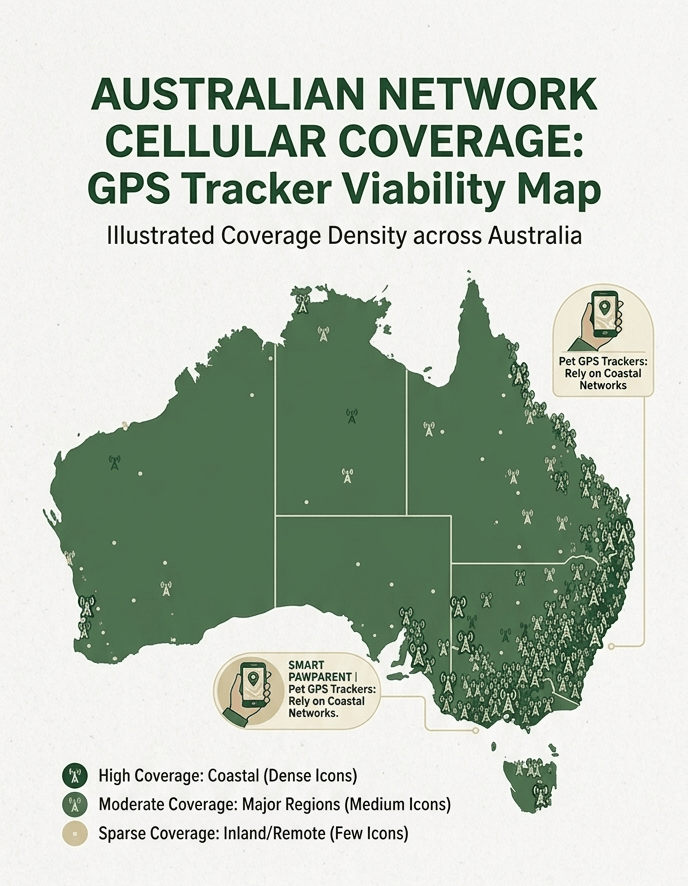
The practical check: confirm a tracker explicitly supports 4G (not just “cellular” as a vague spec), and be skeptical of very old listings or unusually cheap trackers that don’t specify a network generation at all. Almost all 4G GPS trackers sold in Australia support the LTE bands used here, but devices limited to 2G, 3G, LTE Cat-M1, or NB-IoT specifically need individual verification against current network support, not an assumption that “cellular” automatically means compatible.
Band 28: The Regional Coverage Detail Cheap Trackers Skip
This is a technical detail worth knowing if your pet spends time anywhere outside a capital city. Australia relies heavily on Band 28 (700MHz) as the backbone of long-range regional and outer-suburban 4G coverage for both Telstra and Optus — lower-frequency signals travel further and penetrate obstacles better than the higher bands used for dense urban capacity. A cheap imported “4G” tracker can genuinely support 4G in the generic sense while lacking Band 28 support specifically, and lose connection the moment your pet wanders past the suburban edge, even though the spec sheet technically says “4G.”
LTE-M (Cat-M1), the low-power network technology many pet trackers rely on specifically for extended battery life, also runs on Band 28 in Australia. If a tracker’s spec sheet doesn’t mention Band 28 or LTE-M/Cat-M1 by name, that’s worth a direct question to the seller before buying, especially for a semi-rural or regional property.
Amazon.com.au Listings: Local Stock vs. Cross-Border Shipping
This is a genuinely easy thing to miss, and it matters more than it looks. one Pawfit 3 listing on Amazon.com.au is explicitly marked “Ships from and sold by Amazon UK” — meaning the product shows up in an Australian search and can be bought with Australian currency, but it’s shipping across an international border, not from local Australian stock. This affects delivery time obviously, but it’s also worth checking whether a UK-shipped device’s bundled SIM or network configuration is genuinely set up for Australian carriers, rather than assuming a listing appearing on the .com.au domain guarantees local optimization.
Tractive, by contrast, has its own dedicated Amazon.com.au storefront listings that read as genuinely localized rather than cross-border. Before buying any tracker through Amazon specifically, check the listing’s shipping origin — it’s usually stated plainly, just easy to skim past.
Two Different Tracker Categories: Bundled Subscription vs. Bring-Your-Own-SIM
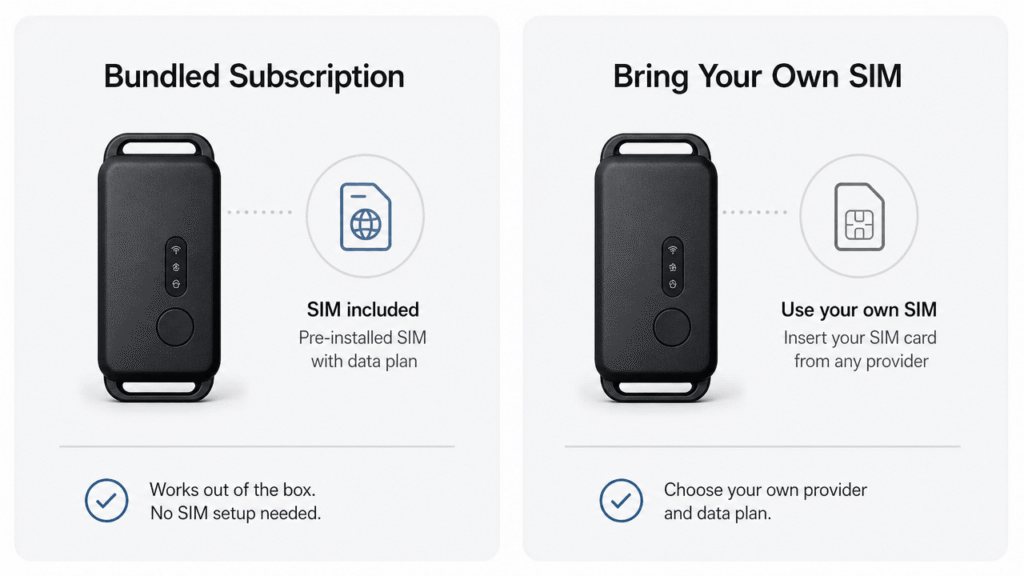
This is a distinction most tracker comparisons don’t draw clearly, and it’s a genuinely different buying decision, not just a pricing detail. Trackers like Tractive and Fi bundle their own subscription plan with the device — you pay the brand directly, and they manage the SIM and network relationship for you. A separate category of trackers sold in Australia are explicitly SIM-required, meaning you supply your own SIM card from a provider like Telstra, Optus, or Aldi and manage that relationship yourself, with no ongoing brand subscription fee at all beyond whatever your SIM plan costs.
Purpose-built multi-year pet tracker SIM cards exist specifically for this second category, letting you pay once for one to eight years of data rather than a recurring monthly subscription — a genuinely different cost structure than the bundled-subscription trackers this site has covered elsewhere. The trade-off: you’re responsible for confirming SIM compatibility and keeping the SIM active yourself, rather than the tracker brand handling that relationship for you.
Which Local SIM Actually Gets You Full Telstra Coverage
If you’re going the bring-your-own-SIM route specifically, which provider you pick matters more than it might seem. Boost Mobile is the only Telstra reseller (MVNO) with access to Telstra’s full retail network — every other Telstra-network reseller, including ALDI Mobile, Belong, Woolworths/Everyday Mobile, and Tangerine, runs on the smaller Telstra Wholesale network instead. The difference is real, not marketing: Telstra’s full retail network covers roughly 2.7 million square kilometres, about a million square kilometres more than the Telstra Wholesale network that ALDI and Belong operate on.
For a pet tracker specifically, that gap matters most in exactly the regional and outer-suburban areas where Band 28 coverage is already thinner — a genuinely different practical outcome than the same SIM decision would produce for a phone used mostly in a city.
Why AirTags Aren’t a Substitute for Real GPS in the Bush
Apple AirTags and Samsung Galaxy SmartTags are a genuinely tempting budget alternative to a subscription-based tracker, and worth addressing directly since they show up constantly in this category. These devices rely on nearby phones running the same ecosystem’s find-my network to relay location — they don’t have independent GPS or cellular connectivity of their own. In a populated Australian suburb with plenty of nearby phones, that can work reasonably well.
In Australian bush, regional parks, or anywhere genuinely low in foot traffic, there’s often nothing nearby to relay a location at all, which makes these devices fundamentally unsuited to the exact scenario — a pet lost somewhere unfamiliar and remote — where a real cellular GPS tracker is actually needed. We’ve covered the physical safety risks of this category of device in more detail in our AirTag on dog collar safety guide.
What Actually Confirms Australian Network Support
Three things are worth checking directly rather than trusting general marketing copy. First, confirm the specific network generation (4G, not just “cellular”). Second, if the tracker requires its own SIM, confirm the SIM options explicitly list Telstra and Optus — Australia’s two largest networks — rather than a generic “works worldwide” claim that doesn’t specify which local carriers are actually supported.
Third, if you’re in a regional or remote area specifically, check carrier coverage maps directly for your property, since coverage in remote and outback regions varies meaningfully by location regardless of which carrier or tracker you choose — a point we’ve covered in more depth in our Fi vs Tractive comparison.
A practical way to actually check this before buying: look at the product’s technical specification section rather than the marketing headline. A listing that specifically names “4G LTE” or lists compatible carriers by name is giving you something verifiable; a listing that just says “works anywhere” or “global coverage” without naming a network generation is a vaguer claim worth following up on directly with the seller before purchasing, especially for a device you’re relying on for genuine safety rather than convenience tracking.
What People Get Wrong
The most common mistake is assuming any tracker sold on an Australian retail site or Amazon.com.au listing has been verified to work here. Some listings are shipped cross-border from a UK or US warehouse, and older or budget devices may still rely on the now-defunct 3G network without the listing mentioning it at all.
The second mistake is not realizing bring-your-own-SIM trackers exist as a genuine alternative to subscription-bundled brands. If the ongoing monthly cost of a bundled subscription is the main barrier, a multi-year prepaid SIM paired with a compatible tracker is a real, functioning alternative — not just a workaround.
The Bottom Line
GPS trackers for Australian networks need two things verified before purchase that most buying guides skip: confirmed 4G (not legacy 3G) network support, and genuine local availability rather than an Amazon listing that happens to show up on the .com.au domain while shipping from overseas. Tractive remains the strongest overall pick for most dog owners, with a genuinely localized Amazon.com.au presence to match. If subscription cost is the deciding factor, a bring-your-own-SIM tracker paired with a multi-year prepaid Telstra/Optus SIM is a legitimate, verified alternative worth knowing exists.
If you like this post, you might like our gadgets section => New Gadgets
Sources Referenced
Editorial and retailer-neutral sources (linked):
Neerav Bhatt — Why Boost Coverage Is Massively Better Than Telstra Mobile Resellers
Finder — 3G Shutdown Australia: Dates & Networks
OzBroadbandReview — 4G Frequency Bands Used by Telstra, Optus, Vodafone
MySignalBoosters — Australian Mobile Network Frequencies
Reviews.org — Telstra Network Coverage: Telstra vs Boost, ALDI & More