

Furbo vs Petcube Real Reviews: Honest 2026 Take
Furbo sits at a 1.5 out of 5 “Bad” rating on Trustpilot across 100 reviews. Petcube’s review pattern is a genuine mix of praise and complaints — normal territory for a connected gadget. That gap alone should change how you read every “Furbo vs Petcube” comparison built purely from spec sheets, because it’s not close, and it’s not a fluke of a small sample.
Both cameras do the same basic job: watch your pet, talk to them, toss a treat, get an alert when they bark. Furbo vs Petcube real reviews tell a much messier story than that feature list suggests — and one company’s pattern of complaints is serious enough that it changes our recommendation entirely.
Quick Answer
| Category | Winner | Why |
|---|---|---|
| Overall reliability and trust | Petcube | Mixed but generally reasonable Trustpilot pattern; Furbo sits at a documented “Bad” 1.5/5 |
| Treat-tossing fun factor | Furbo | Simpler, more playful app experience when it works |
| Smart alerts (bark, meow, pet, human recognition) | Petcube | Four-microphone array, more granular alert categories |
| Cat compatibility | Petcube | Designed for cats and dogs equally; Furbo is dog-first |
| Price | Furbo | Roughly $30 cheaper at retail |
| Documented subscription complaints | Both, but Furbo’s are more severe | Furbo reviewers describe features marketed as free actually requiring a subscription |
Table of Contents
- What the Trustpilot Pattern Actually Shows
- Core Features: Where They’re Actually Similar
- Where They Genuinely Differ
- Video Storage and Subscription Tiers
- What Furbo Reviewers Keep Describing
- What Petcube Reviewers Keep Describing
- Comparison Table
- The Good, The Bad, and The Verdict
- What People Get Wrong
- US / Australia / Singapore Notes
- Tips Before You Buy Either
- The Verdict
What the Trustpilot Pattern Actually Shows

Furbo’s Trustpilot page shows a “Bad” 1.5 out of 5 TrustScore across 100 genuine customer reviews. Trustpilot’s own summary tool (which condenses a business’s reviews into a short overview, separate from the individual reviews themselves) describes most reviewers as “let down by their experience overall,” citing poor product quality, a subscription model reviewers “felt misled about,” a buggy and crash-prone app, and negative customer service interactions.
Reading through the individual reviews confirms the same specifics in customers’ own words: false bark notifications, hardware that stops connecting, and features pulled behind a paywall after purchase. This pattern repeats across regional Trustpilot pages in multiple languages — Canada, the UK, Portugal, Norway, and Finland all show the same core complaints, which rules out a regional fluke or a single bad batch of units.
Petcube’s Trustpilot presence tells a different story. Reviews range from genuinely satisfied owners praising picture quality and responsive support to real complaints about occasional connectivity issues and one specific concern about misleading marketing around its “emergency fund” feature — a normal spread for a connected gadget category, not the lopsided pattern Furbo shows.
There’s a smaller, easy-to-miss signal worth naming too: Furbo’s Trustpilot profile is marked as not having replied to negative reviews, while Petcube’s support team is visibly active in the review section, replying individually to both praise and complaints with specific troubleshooting steps rather than generic templates. That’s not proof of anything on its own, but it’s consistent with the broader pattern — a company engaging with its complaints tends to be a company at least trying to fix them.
Core Features: Where They’re Actually Similar
Both devices offer 1080p HD video streaming, two-way audio, night vision, and app-based treat dispensing, and both connect over home WiFi rather than a cellular network, so performance depends heavily on your router’s range and your home’s layout. Neither is a security camera repurposed for pets — both were built pet-first, which shows in details like treat-toss aim controls and bark-specific (rather than generic motion) alerts.
Where They Genuinely Differ
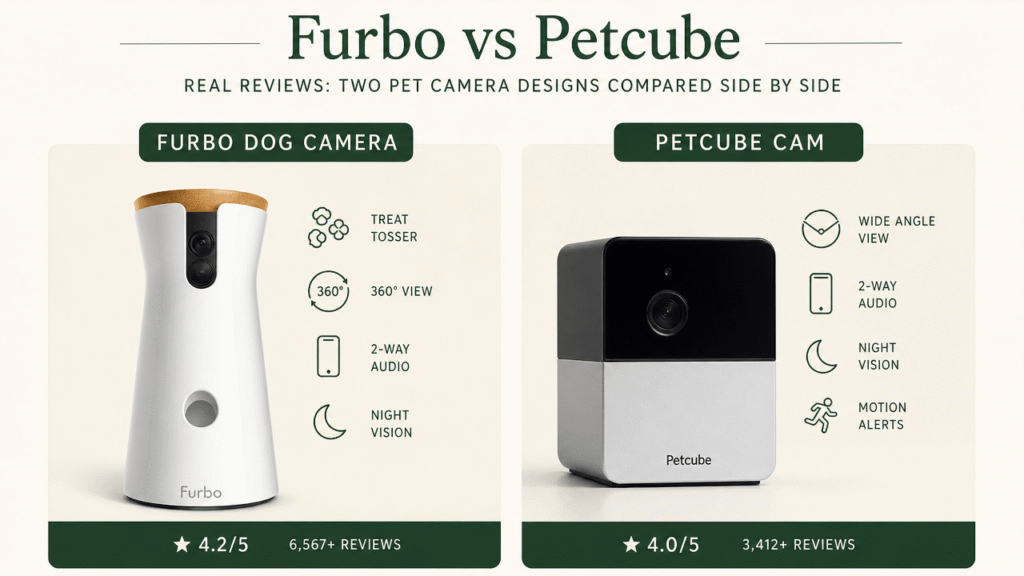
Furbo was built specifically for dogs, though some owners use it for cats too; Petcube’s Bites 2 was designed to work equally well for both species, which matters if you have both or are cat-only. Petcube’s four-microphone array and speaker bar are a genuine step up in audio quality over Furbo’s comparatively quiet mic, and its free-tier alerts cover more categories — Furbo’s free plan only alerts on barking, with richer recognition locked behind a paid tier.
On the flip side, Furbo’s treat-tossing mechanism and app are frequently described as more fun and simpler to use when the hardware is working properly, and it undercuts Petcube on price by roughly $30 at retail.
Video Storage and Subscription Tiers
Neither camera is fully usable long-term without paying something eventually, and this is exactly where Furbo’s reviews get sharpest. Multiple reviewers describe buying the camera under the impression, based on the product page, that core functionality was included — only to hit a paywall for things like viewing recorded clips or receiving detailed activity alerts once actually setting up the app. That gap between what the sales page implies and what the setup flow requires is the single most repeated complaint in Furbo’s review pattern.
Petcube’s tiered structure is more conventional: basic live viewing and two-way audio work without a subscription, while cloud video storage, extended history, and the smart-alert categories (as opposed to generic motion detection) sit behind a paid plan — a structure closer to most other connected camera brands, and one that draws fewer “I was misled” complaints as a result. Neither company publishes especially generous free tiers, but the difference in how clearly that limitation is communicated before purchase is the real distinction.
What Furbo Reviewers Keep Describing
The recurring themes are specific enough to be worth naming directly. Multiple reviewers describe buying the camera under the impression that core features were free, then discovering a subscription was required to access things like notification playback or extended recognition — one reviewer called it “a complete and utter scam” after false bark notifications spiked the day their free trial ended. Others describe hardware that stops connecting to WiFi after a period of non-use, with no warning that infrequent use would cause this. A separate complaint thread describes a software update that removed a previously-available video download feature without notice. However, Furbo recently has sold on amazon with no subscription required but at a bigger price tag here.
None of this means every Furbo owner has a bad experience — the same review page includes genuine five-star reviews praising the same features others complain about. But the volume and consistency of the negative pattern, across multiple countries and years of reviews, is not something a “which has more features” comparison will ever surface.
What Petcube Reviewers Keep Describing
Petcube’s complaints are real but different in character. The most specific recurring issue involves marketing around an “emergency fund” feature that reviewers describe as unclear about what actually qualifies — worth reading the fine print on before relying on it. A smaller number of reviewers describe billing continuing after a disconnection or cancellation attempt, similar in shape to complaints seen across this whole product category. Connectivity hiccups show up occasionally, generally described as intermittent rather than a persistent failure to connect at all.
Comparison Table
| Category | Furbo | Petcube |
|---|---|---|
| Trustpilot pattern | “Bad” 1.5/5, consistent negative themes | Mixed, roughly typical for the category |
| Species support | Dog-first, usable for cats | Built equally for cats and dogs |
| Free-tier alerts | Barking only | Multiple categories included free |
| Audio quality | Comparatively quiet mic | Four-microphone array |
| Price | Lower | Roughly $30 more |
| Fun factor | Simpler, more playful when working | More serious monitoring focus |
The Good, The Bad, and The Verdict
Furbo — Good: cheaper, simpler app, genuinely fun treat-tossing when the hardware cooperates. Bad: a well-documented, multi-year, multi-country pattern of subscription complaints, app bugs, and hardware that stops connecting after periods of light use. Verdict: the lower price doesn’t offset the reliability pattern here — go in with clear eyes about what you might be signing up for, or consider Petcube instead.
Petcube
The smarter alert system and better audio genuinely earn their higher price, and the Trustpilot pattern is what a normal, healthy product review spread looks like rather than a red flag. It isn’t perfect — the emergency fund marketing deserves a closer read before you rely on it, and a handful of billing complaints exist same as any subscription product. But nothing here rises to the scale of what Furbo’s reviews consistently describe. If you’re choosing primarily on trust and reliability rather than price, this is the stronger pick.
What People Get Wrong
The most common mistake is comparing these two purely on feature checklists, the way most “Furbo vs Petcube” roundups do. Feature lists don’t capture that one brand has a documented, years-long pattern of customers feeling misled about subscription requirements while the other doesn’t.
The second mistake is assuming a lower price has no trade-off attached. Furbo’s price advantage is real, but it’s worth weighing against a Trustpilot pattern this consistent — the “cheaper” option isn’t necessarily the better value if a meaningful share of buyers report the hardware becoming unreliable or the subscription model feeling deceptive.
Furbo vs Petcube: US / Australia / Singapore Notes
United States: Both cameras and their subscription plans are fully supported, with domestic shipping and US-priced plans.
Australia: Both devices ship internationally, but confirm the power adapter included is compatible with AU’s Type I plug standard before buying, or budget for a separate adapter — unlike a cellular device, WiFi performance here depends entirely on your home router, not carrier coverage, so router placement relative to where your pet spends time matters more than any spec on the box.
Singapore: Same logic applies — verify plug compatibility and check current local pricing for subscription plans, since both companies price plans in USD by default and currency conversion or availability can shift without the product pages being updated. But with Singapore homes, everyone has a wifi, its good to buy Furbo without the subscription plan.
Tips Before You Buy Either
Read the subscription terms before you unbox anything, not after — this is the single most common regret described in negative reviews for both brands, but especially Furbo’s. Place the camera within strong WiFi range specifically where your pet spends most of their time, not just anywhere convenient near an outlet; weak signal is the root cause behind a large share of the “won’t connect” complaints for both products.
If a feature is marketed as included, screenshot the product page before buying — several Furbo reviewers describe features being restricted to paid tiers after purchase in ways that contradicted what they saw when buying.
The Verdict
On pure features, this comparison is close — Furbo wins on fun and price, Petcube wins on smart alerts and audio. But furbo vs petcube real reviews aren’t close at all: Petcube’s review pattern looks like a normal connected-gadget product, and Furbo’s looks like a company with a genuine, sustained trust problem. Unless the price difference is a hard dealbreaker, that gap is significant enough to make Petcube the safer recommendation here.
If you like this post, you might like our gadgets section => New Gadgets
Sources Referenced
Editorial and community sources (linked):
Trustpilot — petcube.com reviews
SmartPickers — Furbo vs Petcube In-Depth Comparison