

Apartment Guide for Dogs and Cats: Small-Space Reality
In Singapore, roughly 80% of the population lives in HDB flats, where pet ownership isn’t a lifestyle choice made around a spare room — it’s a compact, tightly-regulated reality with real limits on how many pets you can even have. An apartment guide for dogs and cats needs to treat small-space living as the default case, not an exception tacked onto advice written for a house with a yard.
This guide covers three specific, verifiable problems that get harder — not just smaller in scale — the less space you have: fitting enough litter boxes in without a spare room to put them in, keeping air quality genuinely under control in an enclosed space, and managing the noise sensitivity that smart apartment tech can trigger without you even hearing it.
Quick Answer
| Challenge | The Real Constraint | Practical Solution |
|---|---|---|
| Litter box placement | N+1 boxes placed side-by-side count as one resource to cats | Split boxes across distinct rooms (bath + bedroom nook, not adjacent) |
| Litter box ammonia | Noticeable above 5 ppm, causes respiratory irritation above 25 ppm | Daily scooping, activated carbon, a nearby exhaust fan or window |
| Electronic noise | Dogs hear up to 45 kHz, cats up to 64 kHz — some chargers and adapters produce noise above human hearing but within animal range | Keep beds and sleeping areas away from chargers, routers, and smart plugs |
| Territory friction | Limited floor space increases multi-pet stress and conflict | Wall shelves, window perches, and tall cat trees add usable territory without using more floor space |
| HDB pet regulations | Hard limits: 1 approved dog, up to 2 licensed cats per flat | Microchip and license via AVS; grandfathering applies only if licensed by the deadline |
Table of Contents
- The N+1 Litter Box Rule in a Space That Doesn’t Have N+1 Rooms
- Litter Box Air Quality: The Numbers That Actually Matter
- The Noise Your Pet Hears That You Don’t
- Vertical Territory: The Small-Space Hack Most Guides Skip
- Singapore-Specific: HDB Pet Limits Are Real Constraints
- Matching Energy Level to Space, Not Just Breed Size
- What People Get Wrong
- The Bottom Line
The N+1 Litter Box Rule in a Space That Doesn’t Have N+1 Rooms
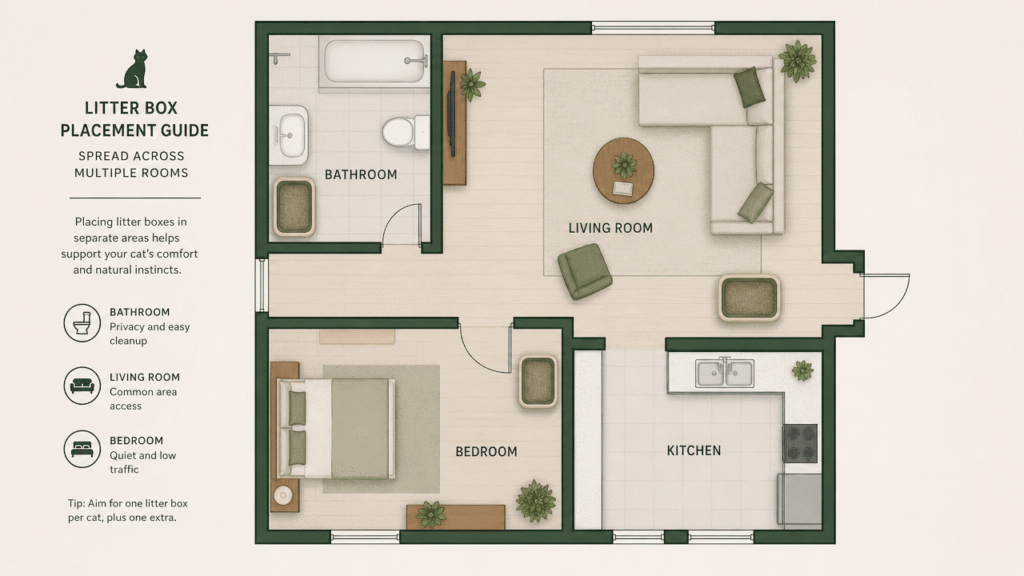
The N+1 rule — one litter box per cat, plus one extra — is the standard veterinary and behaviorist recommendation, endorsed directly by the AAHA/AAFP Feline Life Stage Guidelines and Cornell Feline Health Center. For two cats, that means three boxes. In a house, that’s a straightforward space allocation problem. In a one- or two-bedroom apartment, it’s a genuine design challenge.
The part most owners miss is that the guidelines specifically call for spreading boxes across different locations, not placing them side by side — cats tend to treat adjacent boxes as a single shared resource, which defeats the purpose of having multiple boxes in the first place. In a small apartment, this means genuinely planning box placement across rooms (a bathroom, a corner of a bedroom, a laundry nook) rather than defaulting to a “litter corner” with everything clustered together, even if that’s more convenient for cleaning.
Litter Box Air Quality: The Numbers That Actually Matter
This is where enclosed apartment living genuinely changes the calculation, not just the inconvenience level. Ammonia from a litter box becomes noticeable around 5 parts per million and starts causing real eye and throat irritation above roughly 25 ppm — and in a small, poorly ventilated room, a neglected multi-cat box can climb toward 50-100 ppm, high enough to aggravate asthma in both cats and humans.
The good news: the most effective single intervention is simply shortening the time between use and cleanup, since ammonia production compounds the longer waste sits. A modest exhaust fan or airflow near the box can reduce localized ammonia meaningfully in a small room.
Activated carbon — whether mixed into litter or run through a nearby air purifier — works by adsorbing ammonia molecules directly rather than just masking the smell, the same mechanism we’ve covered in more depth in our air purifier for pets guide, which is worth pairing with litter box placement specifically in a small apartment.
The Noise Your Pet Hears That You Don’t
Apartment living increasingly means smart home tech — smart plugs, routers, smart speakers, robot vacuums — packed into a smaller footprint than a house would spread them across. Dogs can hear frequencies up to roughly 45,000 Hz and cats up to 64,000 Hz, compared to a human ceiling of about 20,000 Hz, which means a “silent” smart home to you can carry a real, ongoing stress signal to your pet.
The genuinely counterintuitive finding here: research suggests high-frequency, intermittent noises — like a smoke detector’s low-battery chirp — are more likely to cause anxiety in dogs than louder, continuous, low-frequency noise. A quiet, occasional beep is often worse for a pet than a loud vacuum running the whole time, precisely because the unpredictability keeps them on alert rather than habituating to a constant sound.
In a small apartment where a pet can’t simply retreat to a distant room, this matters more — set up one genuinely quiet space, away from smart plugs and appliance clusters, that your pet can retreat to.
Worth knowing too: some chargers, AC adapters, and switching power supplies produce a coil whine that varies with load and build quality — cheaper units are more prone to it. Well-designed units typically switch at frequencies above 20 kHz, out of human hearing range but still potentially within a dog’s or cat’s — one more reason to keep beds and favorite resting spots away from clusters of chargers and smart plugs specifically, not just loud appliances.
Vertical Territory: The Small-Space Hack Most Guides Skip
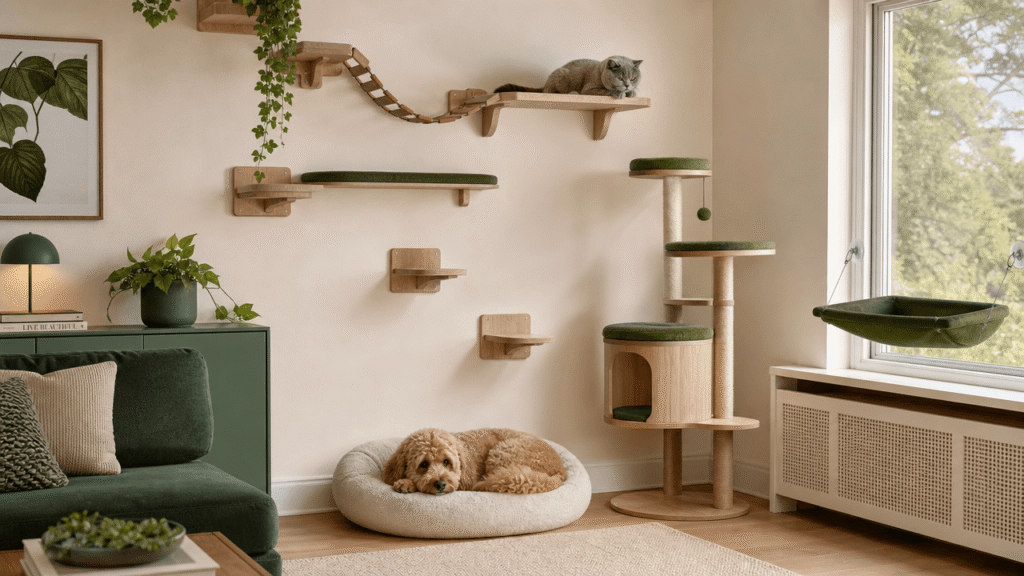
This section covers cats specifically, and it’s the piece most small-space guides leave out entirely while focusing only on litter boxes. Cats are territorial in a way that isn’t limited to floor space — a cat’s usable territory can expand significantly through height alone, without taking up any additional square footage.
Wall-mounted shelves, window perches, and a tall cat tree let multiple cats occupy the same small room without the constant close-quarters friction that comes from everyone sharing the same limited floor-level space. In a genuinely small apartment, vertical space is often the single most efficient way to reduce multi-cat tension without a larger home.
Singapore-Specific: HDB Pet Limits Are Real Constraints
This is worth covering in detail because it’s a genuine, binding rule rather than general advice. HDB flats — home to roughly 80% of Singapore’s population — permit one approved dog and, since the Cat Management Framework took effect on 1 September 2024, up to two licensed cats per flat, ending a 34-year ban on cats in public housing. Private premises allow up to three cats and/or dogs in any combination, a higher limit than HDB flats.
Licensing and microchipping are mandatory for every pet cat under the framework, not optional add-ons. A two-year transition period runs from 1 September 2024 to 31 August 2026, and cat owners who already had more than two cats before the framework started can keep all of them, provided every cat is licensed by that deadline — a genuine grandfathering provision, though it’s conditional on actually completing the licensing, not automatic. Both the dog and cat limits are hard caps regardless: keeping more than one dog in an HDB flat can result in a fine of up to SGD 4,000.
Dog breed approval in HDB flats also factors in apartment suitability directly: size and height relative to typical flat dimensions, barking tendency, exercise drive, and brachycephalic heat tolerance in Singapore’s year-round humidity all factor into which breeds get approved. If you’re planning to adopt in Singapore specifically, checking the current approved breed list and cat licensing requirements before bringing a pet home avoids a genuinely costly and stressful situation later.
Matching Energy Level to Space, Not Just Breed Size
A small dog isn’t automatically a good apartment fit, and a large dog isn’t automatically a bad one — energy level and exercise needs matter more than physical size for small-space living. A high-drive working breed confined to a small apartment without adequate outlets is a well-documented setup for anxiety-driven destructive behavior, regardless of how compact the dog itself is. Calmer, lower-energy breeds of any size tend to settle into apartment life more easily than a small but high-energy dog that isn’t getting enough physical and mental stimulation.
What People Get Wrong
The most common mistake is treating the N+1 litter box rule as satisfied by adding boxes without changing their location. Three boxes in one corner of one room function, behaviorally, much closer to one box than to three genuinely separate options.
The second mistake is assuming a quiet apartment is a low-stress environment for a pet by default. Smart home devices and appliances can produce real, ongoing stress signals at frequencies you can’t hear at all, which means “it’s quiet in here” from a human’s perspective doesn’t necessarily match your pet’s actual experience of the same room.
The Bottom Line
An apartment guide for dogs and cats has to treat small-space living as a set of specific, solvable constraints rather than a vague “make do with less” framing. Spread litter boxes across genuinely separate locations rather than clustering them for convenience, take the actual ammonia chemistry seriously with daily scooping and real ventilation, and remember that your pet’s sound environment is different from yours in ways that matter.
If you’re in Singapore specifically, check HDB’s pet limits before you adopt, not after — the rules are real, binding, and not the kind of thing worth finding out about the hard way.
If you like this article, you might also like dog anxiety symptoms by breed
Sources Referenced
Editorial and government sources (linked):
AVS/NParks — Cat Ownership Limits (Official)
Honest Whiskers — How Many Litter Boxes Should You Have? (N+1 Rule)
Huckwell — How Big Should a Litter Box Be? What the Veterinary Guidelines Actually Say
AARP — Is Your Smart Home Bad for Your Pet’s Health?
Animals Around The Globe — 9 Everyday Household Sounds That Can Secretly Terrify Your Dog
Pawrenthood — HDB Approved Dogs: What Pawrents Need to Know