Air Purifier for Pets: What Actually Works (And What’s Marketing)
An air purifier for pets can lose 41% of its airflow within 60 days in a multi-pet home, according to one independent tester who ran side-by-side units in a four-cat household and tracked the decline with an actual laser particle counter. That’s not a defective unit. That’s just what happens when fur and dander hit a filter that wasn’t built for a pet household in the first place.
This is the part most buying guides skip, because most of them are written without ever testing a unit in a home with real shedding animals for months at a time. Here’s what genuinely matters if you’re buying an air purifier for pets — the marketing terms designed to confuse you, the filter costs nobody mentions upfront, and the specific feature that determines whether you’re paying $40 a month in replacement filters or $40 a year.
Quick Answer for choosing an air purifier for pets:
| Your Situation | What to Look For |
|---|---|
| Heavy shedding (Maine Coon, Labrador, double-coated breeds) | A washable pre-filter, non-negotiable |
| Litter box odor specifically | Activated carbon, 5+ lbs minimum — HEPA alone does nothing for ammonia |
| Pet seems bothered by the unit | Check for a DC brushless motor — cheap AC motors emit a whine pets can hear and humans can’t |
| Small bedroom, sealed space | High CADR matters more than top-tier HEPA grade |
| Budget-conscious, long-term cost matters | Factor in filter replacement cost, not just unit price — it’s often the bigger expense |
Table of Contents
- The HEPA Marketing Trick Every Air Purifier for Pets Buyer Should Know
- Why the Pre-Filter Matters More Than the Headline Spec
- HEPA Doesn’t Touch Odor — Here’s What Does
- The Motor Noise Pets Can Hear and You Can’t
- Safety Features Worth Checking
- Comparison Table
- The Good, The Bad, and The Verdict — By Model
- US vs. Australia vs. Singapore: What Changes
- The Verdict
1. The HEPA Marketing Trick Every Air Purifier for Pets Buyer Should Know
“True HEPA” is a regulated term: it means a filter captures at least 99.97% of particles at 0.3 microns, the hardest particle size to trap. “HEPA-type” or “HEPA-style” are not regulated terms at all — they’re marketing language that can describe filters performing as low as 85% efficiency, a real and meaningful gap when you’re trying to actually clear dander from the air.
Pet dander itself is comparatively large (5-10 microns), which is actually good news — a genuine True HEPA filter catches it even more effectively than the 0.3-micron benchmark particles, closer to 99.99%. But that only holds if the filter is actually True HEPA. Always check the box or spec sheet for the literal phrase, not just “HEPA filtration” in the marketing copy.
2. Why the Pre-Filter Matters More Than the Headline Spec
This is the single most important practical finding from real multi-pet testing, and it’s the one detail most air purifier for pets buying guides bury or skip entirely: a washable pre-filter isn’t a nice-to-have feature. It’s the difference between a $40/year filter cost and a $200+/year filter cost. If your household is dealing with heavy shedding specifically, it’s worth pairing an air purifier with the right upstream grooming tool too — see our dog dryer by coat type guide for reducing loose fur at the source rather than only filtering it after the fact.
Independent hands-on testing in a four-cat household found that without a pre-filter, fur and dander form a dense, rigid mat directly on the HEPA filter’s intake face — described as thick enough that light couldn’t pass through it — within 60 days, with airflow dropping 41% from baseline and the unit becoming audibly strained well before the typical recommended replacement interval. At roughly $39 per replacement HEPA filter and a 60-day lifespan instead of the usual 6-12 months, that works out to well over $200 a year — more than many units cost to buy outright.
A model with a slide-out or vacuumable pre-filter catches the bulk of fur and dander before it ever reaches the expensive HEPA layer, dramatically extending the real filter life. When comparing models, this single feature matters more for a pet household than almost any other spec on the page.
3. HEPA Doesn’t Touch Odor — Here’s What Does
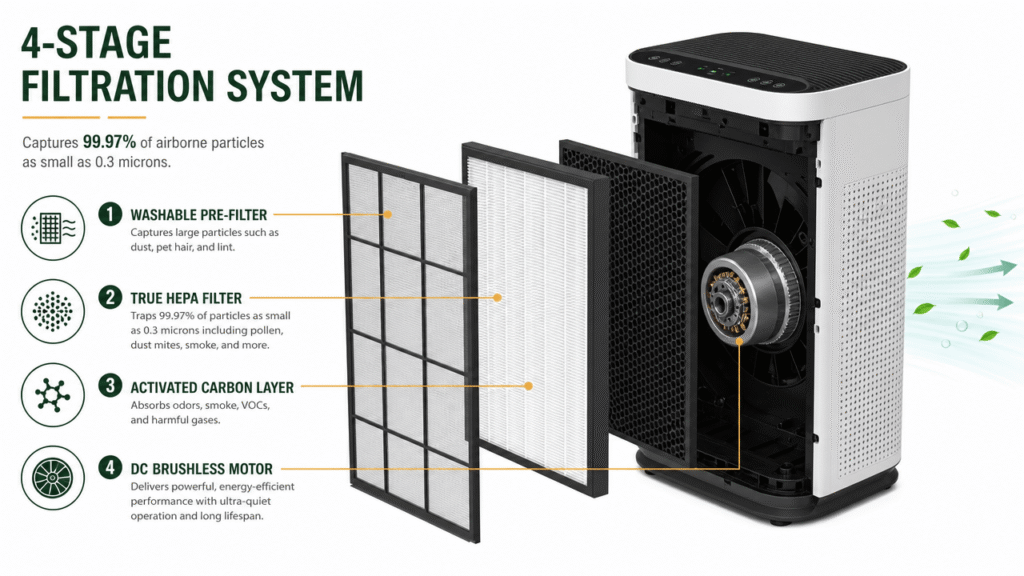
This trips up a lot of buyers shopping for an air purifier for pets: HEPA filtration captures particles, not gases. Litter box ammonia, urine odor, and similar smells are airborne molecules, not particles — a HEPA filter, no matter how good, does essentially nothing to remove them on its own.
Activated carbon is the actual answer, and quantity matters: units with only a thin carbon layer make a marginal difference at best. Units with a substantial carbon load (5 lbs or more) make a genuine, noticeable difference on litter box odor specifically. If odor control — not just dander and hair — is your main reason for buying, check the carbon weight specifically, not just whether “odor reduction” appears somewhere in the feature list.
One honest caveat: even strong activated carbon doesn’t fully solve a flea problem. Purifiers can catch flea eggs (they’re light enough to go airborne briefly), but adult fleas don’t stay airborne long enough to be pulled into a unit — that’s a treat-the-pet-and-the-carpet problem, not an air purifier problem.
4. The Motor Noise Pets Can Hear and You Can’t
A genuinely underreported issue with any air purifier for pets: cheaper purifiers using standard AC motors can produce a high-frequency whine that’s outside typical human hearing range but audible — and apparently unpleasant — to some dogs and cats. If a pet seems unexpectedly avoidant of a room after you’ve installed a new purifier, this is worth considering before assuming it’s unrelated.
DC brushless motors don’t have this issue and tend to run quieter overall in normal human-audible terms too. If you’re buying for a household where a pet has shown sound sensitivity in other contexts, this is worth checking on the spec sheet specifically — and a gradual introduction (running on the lowest setting for the first few days) gives a sensitive pet time to acclimate either way.
5. Safety Features Worth Checking
This is the piece most air purifier for pets buying guides skip entirely,
and it matters more with pets in the house than without them. A cat jumping
onto or knocking into a tall, top-heavy unit is a real, common scenario —
check for a wide, stable base rather than assuming any unit is tip-resistant
by default.
Stiftung Warentest’s 2024 comparison, the same test that rated the Levoit Vital 200S “Satisfactory,” gave the winning Bosch Air 4000 a near-perfect safety score specifically for being tip-resistant, having no sharp edges, and passing electrical safety checks cleanly
— a concrete example of what a genuinely safety-tested unit looks like,
rather than a vague “safe for pets” marketing claim.
Also worth checking if you have a curious cat or a chewer: a physical child/pet
lock button that disables the control panel, and a cord that’s either short
or routed somewhere a pet can’t easily reach and chew through. Neither
feature shows up on most spec sheets unless you look specifically, so it’s
worth checking product photos and the manual (often available as a PDF on
the manufacturer’s site) before buying if either is a concern for your
household.
6. Comparison Table
| Model | True HEPA | Washable Pre-Filter | Carbon Load | Motor Type | Best For |
|---|---|---|---|---|---|
| Levoit Core 600S | Yes | Limited (bottom panel, not slide-out) | Moderate | DC brushless | Large rooms, general use |
| Levoit Vital 200S | Yes | Yes | Moderate | DC brushless | Mid-size rooms; rated only “Satisfactory” by Stiftung Warentest in one independent comparison |
| Winix 5500-2 | Yes | Yes | Moderate (PlasmaWave tech) | — | Pet hair and hay dust (good for small mammal owners too) |
| Austin Air HealthMate | Yes | — | Heavy (15 lbs) | — | Litter box odor specifically — the strongest carbon option tested |
| Bosch Air 4000 | Yes | Yes (vacuumable) | Moderate | — | Independent test-winner (Stiftung Warentest) over Levoit Vital 200S |
7. The Good, The Bad, and The Verdict — By Model
Picking the right air purifier for pets really does come down to matching the model to your specific problem, not just grabbing whatever’s top of a generic list.
Levoit (Core/Vital series) — The Good: widely available, generally good reviews, DC brushless motors across the relevant models. The Bad: an independent German consumer testing body (Stiftung Warentest) rated the Vital 200S “Satisfactory” (grade 2.6 on Germany’s 1-to-6 school-grading scale, where 1 is best) in a 2024 comparison, placing 3rd, behind the Bosch Air 4000 — a useful counterweight to the constant “Levoit is the best” recommendation that dominates most casual buying guides. The Verdict: a solid, safe default, but not automatically the top performer every list claims it is.
Winix 5500-2 — The Good: handles pet hair and hay dust (relevant if you also own small mammals) well, thanks to a genuinely washable pre-filter. The Bad: PlasmaWave technology (an ionizing feature) is debated in efficacy and some users prefer to disable it. The Verdict: a strong, balanced pick for mixed-pet households.
Austin Air HealthMate — The Good: the heaviest carbon load on this list (15 lbs) makes it the standout pick specifically for litter box ammonia odor — independent testing calls it the only unit that genuinely eliminates that smell rather than masking it. The Bad: it’s overkill if odor isn’t your main problem, and the unit itself is bulkier and pricier than dander-focused alternatives. The Verdict: worth the premium specifically for multi-cat litter box odor; skip it if dander is your only concern.
Bosch Air 4000 — The Good: outperformed the popular Levoit Vital 200S in independent third-party testing, with a genuinely vacuumable pre-filter that protects the HEPA layer well. The Bad: less widely available and less frequently reviewed in English-language pet buying guides, since most US-focused content defaults to Levoit and Winix. The Verdict: worth seeking out specifically if you’ve found Levoit underwhelming.
8. US vs. Australia vs. Singapore: What Changes
Choosing an air purifier for pets means weighing different climate and availability factors depending on where you live.
United States: Widest selection at the most competitive prices, with Levoit, Winix, and Austin Air all readily available through Amazon and direct retail.
Australia: Available through Amazon.com.au and general electronics retailers, generally at a price premium over US listings. Australia uses 230V/50Hz with Type I plugs — most air purifiers run on standard internal power adapters that handle the voltage difference automatically, but always check the unit’s rating label rather than assume, especially with units imported directly rather than bought from an Australian retailer.
Singapore: This is the region where humidity changes the actual buying calculus, not just the plug type. Singapore’s near-constant high humidity accelerates filter saturation — a HEPA or carbon filter in a humid climate can clog and lose effectiveness faster than the same filter would in a drier climate, simply because moisture in the air adds to what the filter has to process alongside dander and odor particles. This makes the washable pre-filter feature even more valuable in Singapore specifically than in a drier US or Australian climate — and it’s worth checking filter replacement schedules a little more conservatively than the manufacturer’s default recommendation, which is often calculated for a temperate climate. Singapore uses 230V/50Hz with Type G plugs.
9. The Verdict
An air purifier for pets is genuinely worth it — multiple independent sources, including veterinary input cited by Live Science and CNN-style consumer testing, confirm real reductions in airborne dander when the right unit is used correctly. But “the right unit” specifically means: True HEPA (not HEPA-style), a washable pre-filter if you have a heavy shedder, real carbon weight if odor is the issue, and a DC brushless motor if your pet is sound-sensitive. Skip any unit that doesn’t disclose these specifics clearly — that’s usually a sign the marketing is doing more work than the actual filter.
Odor and dander control usually isn’t a one-appliance problem — if you’re also dealing with litter box smell specifically, our Litter-Robot alternatives under $400 guide covers odor-control performance across several self-cleaning boxes directly. For more air-quality-adjacent product coverage, browse our full Pet Tech & Gadgets section.