
AVS Dog & Cat Licensing in Singapore — The Complete Guide
AVS Pet Licensing Singapore — The Complete Guide
AVS pet licensing in Singapore isn’t a paperwork formality — it’s a legal requirement, and an unlicensed pet can mean a fine of up to S$5,000. As of today, the free licensing window for cats has a little over two months left before that risk applies to cat owners too.
This guide goes deeper than the basics of AVS pet licensing in Singapore. It covers every fee tier (not just the headline “S$15”), the actual step-by-step PALS process, what happens at every life event — moving, losing your pet, ownership changes — and the extra layer of rules that apply if your dog happens to be on the Specified list.
Quick Answer:
| Question | Answer |
|---|---|
| Do I need a licence for my dog? | Yes, mandatory from 3 months old, always |
| Do I need a licence for my cat? | Yes, but it’s free until 31 Aug 2026 |
| Where do I apply? | PALS at pals.avs.gov.sg, via SingPass |
| What do I need before applying? | A microchip number and a completed Pet Ownership Course |
| Cheapest path? | Sterilise before applying — it roughly halves most fees |
| What if my dog is a Specified breed? | Extra rules apply — insurance, muzzle, guarantee — and it’s never permitted in HDB |
All fees below are in SGD. USD figures are rough conversions for reference only.
Table of Contents
- AVS Pet Licensing in Singapore: Who Needs It, and By When
- Step-by-Step: How the PALS Process Actually Works
- Every Fee Tier, Not Just the Headline Number
- The Cat Licence Deadline: What Changes on 1 September 2026
- Specified Dogs: The Extra Licensing Layer
- Life Events: Moving, Losing a Pet, Change of Ownership, Death
- The Conditions You’re Actually Agreeing To
- What People Get Wrong
- Official Links
- The Verdict
1. AVS Pet Licensing in Singapore: Who Needs It, and By When
Every dog and cat in Singapore aged 3 months or older must be licensed, under the Animals and Birds (Licensing and Control of Cats and Dogs) Rules. This applies regardless of breed, housing type, or whether the animal ever leaves the home. There’s no “indoor cat exemption” and no “small dog exemption.”
AVS pet licensing in Singapore is administered by AVS (Animal & Veterinary Service, under NParks) through PALS — the Pet Animal Licensing System — not by HDB, even for HDB residents. HDB enforces its own separate breed and quantity rules; AVS enforces licensing. They’re related but administratively distinct, which is part of why people get confused about who to contact for what.
2. Step-by-Step: How the PALS Process Actually Works
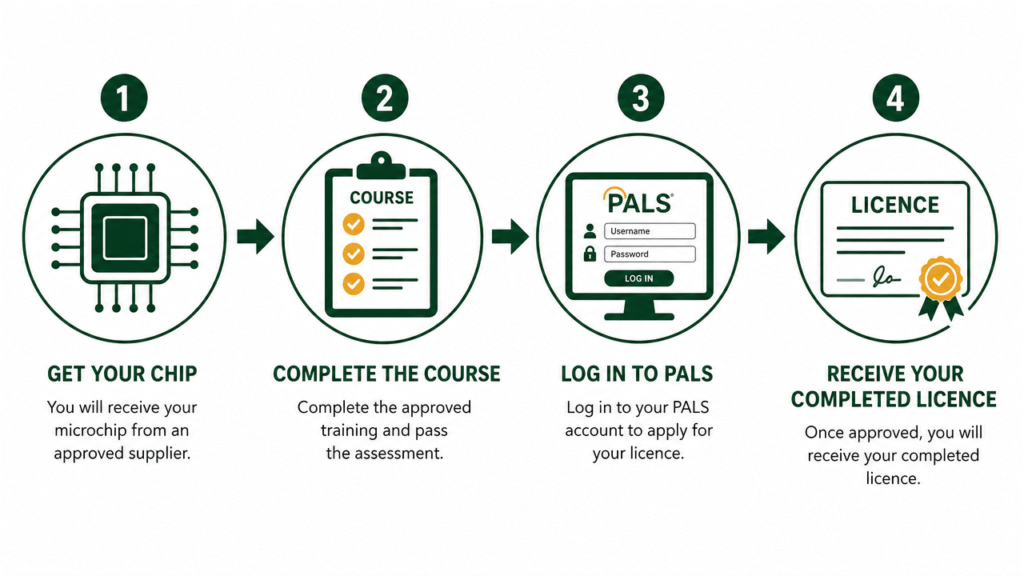
Step 1 — Microchip first. You cannot start a licence application without a microchip number. Your vet implants the chip and issues a certificate containing the number — keep this, you’ll need it on the portal.
Step 2 — Complete the Pet Ownership Course. This is a free, one-time, roughly 30-minute online course required of all first-time applicants, dog or cat. It’s closer to a short orientation than an exam — it covers your legal obligations and basic responsible ownership, not a pass/fail test.
Step 3 — Log into PALS with SingPass. Go to pals.avs.gov.sg and authenticate with SingPass — most Singapore residents already have this set up for other government services.
Step 4 — Select “Apply Licence” and enter your pet’s details. You’ll need the microchip number, your address (this becomes the registered address AVS contacts you at), and sterilisation status if applicable.
Step 5 — Upload supporting documents. If your pet is sterilised, upload the certificate to qualify for the reduced fee. During the cat licensing transition period, you can self-declare sterilisation status without the certificate if you don’t have it on hand — but uploading it when you can is worth doing, since it locks in the cheaper lifetime rate.
Step 6 — Choose your licence duration and pay. Options typically include 1-year, 2-year, 3-year, or one-time (lifetime) licences — pricing differs significantly by duration and sterilisation status, covered in the next section. Payment can be made online, via GIRO, or at an AXS station.
Step 7 — Receive your e-licence. Once approved, it’s viewable anytime under “My Licences” in PALS. A physical tag may also be issued depending on current AVS process — check your confirmation for details.
The whole process, if you already have the microchip number ready, generally takes 10–20 minutes for the PALS portion specifically (excluding the vet visit and course).
3. Every Fee Tier, Not Just the Headline Number
Most coverage of this topic quotes a single number (“S$15”) and stops there. Here’s the actual full breakdown.
| Pet | Sterilisation Status | Duration | Fee (SGD) | USD equivalent* |
|---|---|---|---|---|
| Dog | Sterilised | 1-year | S$15 | ~US$11 |
| Dog | Sterilised | One-time (lifetime) | S$35 | ~US$26 |
| Dog | Unsterilised | 1-year | up to S$90 | ~US$66 |
| Dog | Unsterilised | Ongoing renewal | ~S$30/year | ~US$22 |
| Dog | Adopted via Project ADORE (sterilised, AWG partner) | Reduced rate | Confirm current rate with AVS | — |
| Cat | Any | During transition (now – 31 Aug 2026) | S$0 | $0 |
| Cat | Sterilised | One-time (lifetime), from 1 Sept 2026 | S$35 | ~US$26 |
| Cat | Unsterilised | Annual, from 1 Sept 2026 | up to S$90/year | ~US$66 |
The 10% rebate: payments made via GIRO, online, or AXS qualify for a 10% rebate on the quoted fee — the numbers above are pre-rebate. Over a one-time lifetime licence, that’s a small but real saving for choosing the right payment method.
Why sterilisation status matters so much to the fee: AVS deliberately prices unsterilised pets significantly higher — both as a population-management measure and because sterilised pets are statistically lower-risk for the kind of incidents licensing exists to trace. If you’re planning to sterilise anyway, doing it before your first licence application (or promptly uploading the certificate afterward) is the financially obvious move.
Three-year licences for unsterilised pets automatically convert to a one-time licence once you update the sterilisation status and upload the certificate — you don’t need to cancel and reapply.
4. The Cat Licence Deadline: What Changes on 1 September 2026
Cats were excluded from HDB flats for 34 years. The Cat Management Framework 2024 ended that on 1 September 2024, and introduced a two-year transition period running through 31 August 2026 — during which cat licensing is entirely free.
After that date:
- Sterilised cats: S$35 one-time, lifetime licence
- Unsterilised cats: up to S$90/year
- Unlicensed cats: fines of up to S$5,000
If you’re reading this before the deadline, there is no financial reason to wait. The free lifetime licence for a sterilised cat, once issued during the transition period, doesn’t expire or require renewal — registering now versus registering in August produces the same outcome at zero cost either way, except that waiting carries the real risk of simply forgetting before the window closes.
During the transition period specifically, owners unable to produce a sterilisation certificate can self-declare sterilisation status on the application form rather than being blocked from applying — a concession that goes away once the transition period ends.
5. Specified Dogs: The Extra Licensing Layer
AVS maintains a “Specified Dogs” classification for breeds it considers higher-risk. Two different things can be true of a Specified breed, and they’re often confused:
Prohibited from import entirely (Part 1 of the list): Pit Bull types (American Pit Bull Terrier, American Staffordshire Terrier, Staffordshire Bull Terrier, American Bulldog), Akita, Neapolitan Mastiff, Tosa, Dogo Argentino, Fila Brasileiro, Boerboel, Perro de Presa Canario, and any crosses involving these breeds. These cannot enter Singapore for sale, temporary visit, or permanent stay — full stop, regardless of licensing.
Already licensed under older rules, kept in non-HDB housing: if a Specified Dog was grandfathered in before current rules, it can continue to be licensed, but under materially heavier conditions:
- Must be leashed and securely muzzled at all times in any public place — no exceptions for trained or familiar dogs
- Must be sterilised if over six months old
- Owner must hold a liability insurance policy of at least S$100,000 covering injury to people/animals or property damage
- Owner must provide a banker’s guarantee — figures cited in different sources range from S$2,000 to S$5,000, so confirm the current exact figure directly with AVS before relying on either number
- The guarantee must be submitted via PALS within 4 weeks of licence application, or 4 weeks of the dog’s arrival in Singapore, whichever is later — and renewed alongside every licence renewal
- Mandatory obedience training with an AVS-recognised trainer
- Never permitted in HDB housing, under any circumstances, regardless of licensing status. Only one Specified Dog is allowed per non-HDB residential unit, out of a maximum of three pets total on that property.
- If the owner fails to comply with any condition, the existing guarantee is forfeited and a fresh guarantee must be taken up immediately — there’s no grace period built in.
Crosses count the same as purebreds. A Labrador/Pit Bull mix is treated identically to a purebred Pit Bull for licensing purposes, regardless of how the dog actually looks or behaves.
6. Life Events: Moving, Losing a Pet, Change of Ownership, Death
Licensing isn’t a one-time transaction — several common events require you to update PALS, and missing them can result in fines independent of whether your original licence is still technically valid.
Moving house: you must inform AVS of an address change within 28 days. Your pet must be kept at the address registered on its licence — if it’s kept somewhere else, you’re required to notify AVS or risk a fine.
Change of ownership: the new owner needs to be registered on PALS to complete the transfer. This is a separate step from microchip registration — having the microchip details updated doesn’t automatically update the licence.
Pet goes missing, is exported, or passes away: you must cancel the licence on PALS and submit the relevant supporting documents for that specific situation. This isn’t optional housekeeping — AVS explicitly lists this as a requirement, not a courtesy.
Fostering: fosterers should license animals they’re fostering while in their care. When the animal is adopted or rehomed, the licence transfer to the new owner is initiated via PALS by the fosterer.
7. The Conditions You’re Actually Agreeing To
A licence isn’t just a fee receipt — it comes with ongoing conditions that are easy to miss when you’re focused on getting the application submitted:
- Keep your cat or dog in an environment that minimises risk of death or serious injury
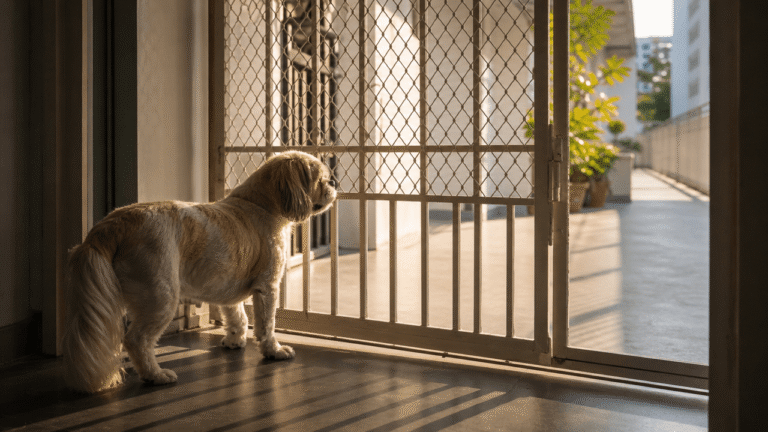
- For units above ground level: prevent the animal from being in any place exposing it to a fall risk — this specifically includes mesh requirements on windows for cats in high-rise units
- Properly confine your pet at all times
- Cats must be kept under physical control in public spaces; dogs must be leashed and properly supervised at all times when outdoors
These conditions exist independently of the breed-specific Specified Dog rules — they apply to every licensed pet in Singapore.
8. What People Get Wrong
The most common error: assuming the microchip and the licence are the same administrative step, or that registering the microchip with a vet automatically creates the AVS licence. It doesn’t. The microchip number is an input to the licence application — a separate, deliberate step on PALS.
Cat owners specifically keep treating “free” as synonymous with “not urgent” or “optional.” Neither is true. The fee is waived; the legal requirement to be licensed by 31 August 2026 is not.
People who already licensed a dog assume the same process applies identically to a cat, or vice versa — the underlying portal is the same, but eligibility windows, fee structures, and historical context (cats weren’t even legal in HDB until 2024) differ enough that treating them as interchangeable causes mistakes.
Owners of Specified or mixed-breed dogs frequently underestimate how strictly the cross-breed rule is applied. “He’s mostly Labrador” doesn’t change the classification if there’s documented Pit Bull lineage anywhere in the mix.
9. Official Links
- Apply for or renew any pet licence: Pet Animal Licensing System (PALS) — requires SingPass
- Full current fee schedule: AVS Licence Fees
- Licensing requirements and process: AVS Licensing Requirements
- Application steps and required documents: AVS — Applying for a Dog or Cat Licence
- Specified Dogs classification and conditions: AVS — Specified Dogs
- Cat-specific framework and transition period details: AVS — Licensing of Cats
- New pet at home, or still deciding what else to prepare? See our full New Pet Owner’s Starter Guide — Singapore Edition for the breed rules, costs, and checklist that sit alongside licensing.
10. The Verdict
AVS pet licensing in Singapore is genuinely reasonable once you’ve been through it once — the friction is almost entirely in not knowing the sequence (microchip, then course, then PALS) and not knowing the deadline that actually applies to you. For dog owners, that means understanding your exact fee tier before you assume the cheapest one applies. For cat owners specifically, right now, it means one thing: if you haven’t licensed yet, the clock that matters is 31 August 2026, and there’s no upside to waiting.

2 Comments