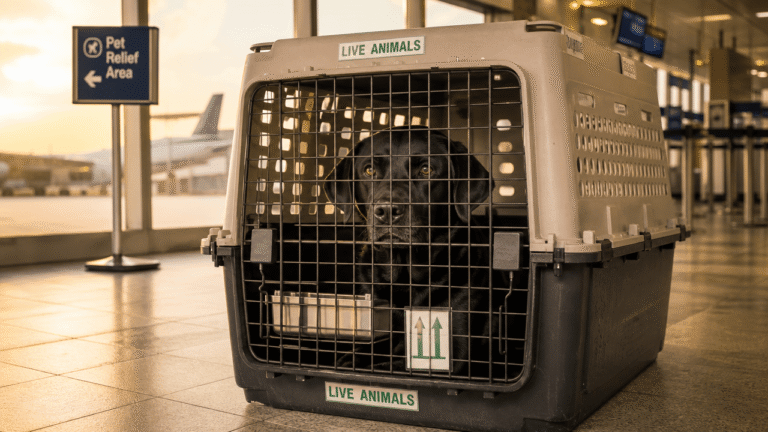
Traveling Overseas With Your Pet From Singapore: 2026
Singapore has been rabies-free for decades, and it genuinely doesn’t matter to Australia. A dog leaving Singapore for Melbourne still faces a mandatory 10-day quarantine on arrival, real cost included, purely because of how Australia classifies country risk — Singapore’s own clean rabies status doesn’t exempt you from the destination’s rules.
Traveling overseas with your pet from Singapore is really two separate processes stacked on top of each other: what Singapore’s AVS requires you to do before you leave, and what your destination country requires before it lets your pet in. Getting Singapore’s side right doesn’t mean the destination side is automatically handled too.
Quick Answer
| Question | Short Answer |
|---|---|
| Do I need a Singapore export licence? | Yes — apply via the GoBusiness Licensing Portal within 90 days of departure; the licence is valid for 90 days |
| Does Singapore’s rabies-free status help at the destination? | Not automatically — some countries (like Australia) still require quarantine regardless of your pet’s origin |
| What’s the biggest planning mistake? | Assuming Singapore’s export process and the destination’s import process run on the same timeline — they usually don’t |
| Do I need to do anything after my pet leaves? | Yes — cancel your dog’s PALS licence once it’s exported, since it isn’t cancelled automatically |
| How far ahead should I start? | For strict destinations like Australia, 6 months minimum; for others, at least a few weeks |
Table of Contents
- Singapore’s Export Process
- Australia: Rabies-Free Origin, Quarantine Anyway
- The UK: A Different Kind of Checklist
- What People Get Wrong
- The Bottom Line
Singapore’s Export Process
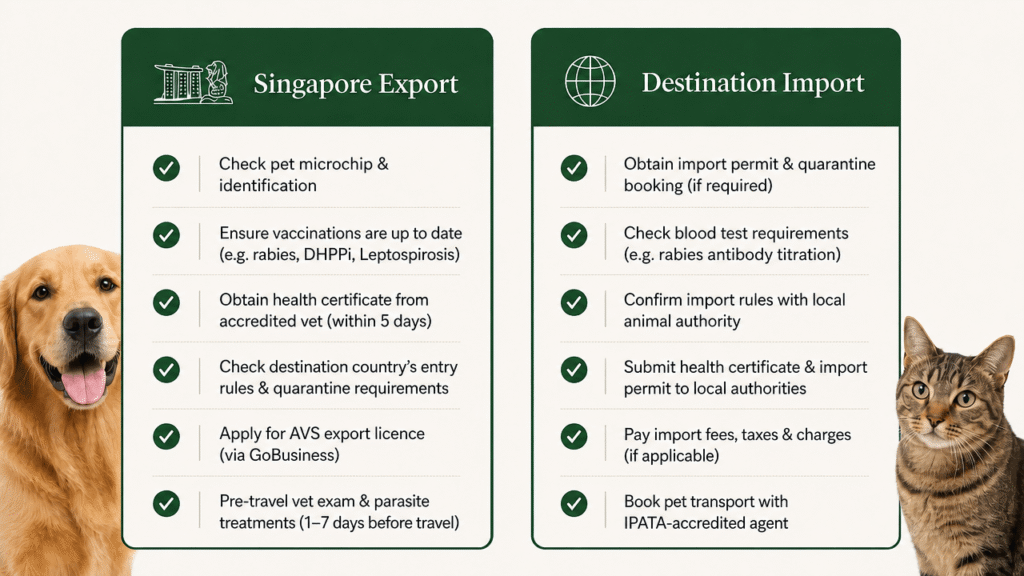
Before leaving Singapore, AVS’s first instruction is to check your destination country’s own import requirements directly — vaccinations, lab tests, and health certificates vary by country, and Singapore’s export process doesn’t verify any of this for you. The export licence itself is applied for through the GoBusiness Licensing Portal within 90 days of departure, and it’s only valid for 90 days once issued — apply too early and it can lapse before you actually travel.
One detail that’s easy to miss: if your destination requires a veterinary health certificate, you’ll need to submit the original certificate along with vaccination and lab test records for AVS endorsement before departure. You’ll also need to book your pet’s pre-departure inspection appointment through AVS’s e-services at least five days before departure, separate from whatever your destination country’s own timing requirements turn out to be.
Many destinations, including the US and UK, require the health exam and any parasite treatments to fall within a specific window — often a matter of days — immediately before travel, so check your destination’s exact timing rules directly rather than assuming a general “get it done before you leave” approach covers it. And once your dog has actually left Singapore, you’re responsible for cancelling its dog licence in PALS — it doesn’t happen automatically just because the pet is gone, and an uncancelled licence can keep generating renewal obligations you no longer need.
Australia: Rabies-Free Origin, Quarantine Anyway
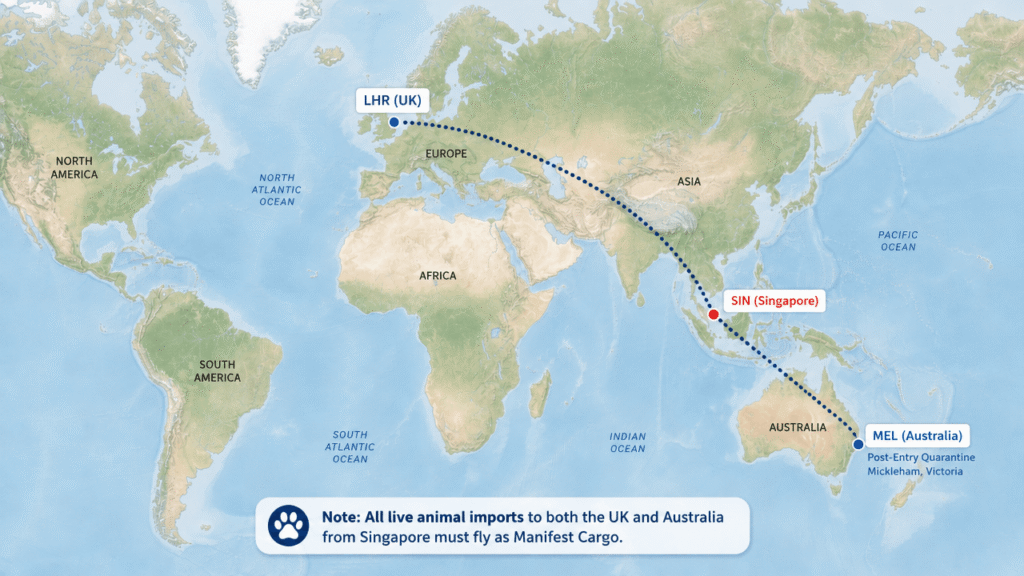
This is the clearest example of why “Singapore is rabies-free” doesn’t simplify things as much as it sounds like it should. Australia’s Department of Agriculture, Fisheries and Forestry classifies Singapore as a Group 2 country — approved and rabies-free, which skips the rabies antibody blood test (RNATT) and the 180-day waiting period required for Group 3 countries like the US, UK, and most of Europe. That’s the genuine advantage of Singapore’s status.
What Singapore’s status doesn’t skip: Group 2 pets still face a mandatory minimum 10-day quarantine at the government-run Mickleham Post-Entry Quarantine facility in Melbourne, with no exception for rabies-free origin.
The quarantine stay itself costs a minimum AUD $1,877 — a $269 reservation fee, a $1,078 importation charge, and $530 for 10 days of accommodation — and that figure doesn’t include the separate import permit fee. The import permit itself runs around AUD $603, on top of quarantine costs, putting the real mandatory government-fee floor closer to AUD $2,480 before flights, vet visits, or anything else. Total realistic costs including transport commonly land between AUD $4,100 and significantly more depending on flight and crate size.
Dogs also face a newer requirement as of 2026: proof of approved desexing or a negative Brucella canis test within 45 days before export, on top of the standard permit and identification steps.
The most common failure point, according to import specialists, isn’t the paperwork itself — it’s sequencing: letting a vaccination lapse, missing the identity-verification-before-blood-test order, or applying for a permit too late relative to Australia’s own timelines. Since a permit doesn’t automatically reserve you a quarantine slot, book Mickleham space early and separately.
The UK: A Different Kind of Checklist
The UK’s Pet Travel Scheme runs on a different logic than Australia’s country-tier system. The baseline sequence is microchip first, then rabies vaccination, then a mandatory 21-day wait before travel — straightforward if your pet is coming from a country the UK doesn’t classify as high-risk.
There’s a separate, strict requirement worth knowing about specifically for dogs (cats are exempt): a vet must administer a tapeworm treatment containing praziquantel between 24 and 120 hours — 1 to 5 days — before your dog’s scheduled arrival in the UK, and the exact treatment time has to be recorded on the health certificate. This window is stricter than it sounds — arrive even a few hours outside it, and the treatment is considered invalid, which can mean your dog being held or facing quarantine on arrival rather than a minor paperwork correction.
Pets from countries the UK considers high-risk or “unlisted” face an additional rabies antibody titer test taken at least 30 days after vaccination, followed by a further 3-month wait before travel is permitted — a meaningfully longer runway than the standard 21-day sequence.
Since exact country classifications can shift, confirm Singapore’s current listing status directly with the UK’s Animal and Plant Health Agency before assuming which sequence applies to you, rather than relying on a generalized guide. Budget roughly $30-50 for the microchip, $100-200 for the health certificate, and — if the titer test path applies — another $100-250 for that test specifically, plus the real time cost of whichever waiting period turns out to apply.
What People Get Wrong
The most common mistake is treating Singapore’s export licence as confirmation that the trip is fully arranged. AVS’s own process explicitly puts the responsibility for meeting the destination country’s specific requirements on the owner — Singapore’s paperwork and the destination’s paperwork are two separate systems that happen to need to align on your calendar, not one combined process.
The second mistake is assuming a rabies-free origin like Singapore removes quarantine risk entirely. Australia’s Group 2 classification proves otherwise — a clean health status shortens some requirements (no RNATT test, no 180-day wait) without eliminating the quarantine stay itself.
The Bottom Line
Traveling overseas with your pet from Singapore means running two checklists at once: Singapore’s export licence process, applied for within the right 90-day window, and your destination’s own import requirements, which have their own separate timeline and don’t care how rabies-free your pet’s origin is.
Australia and the UK are useful examples precisely because they’re structured so differently — one runs on country-risk tiers with a guaranteed quarantine stay, the other on a vaccination-and-waiting-period sequence that changes based on classification. Check both sides independently, and start with whichever destination has the longer lead time, since that’s what actually determines your realistic departure date.
If you like this post, you might like our gadgets section => New Gadgets
Sources Referenced
Editorial and government sources (linked):
EntryBrief — Bringing a Pet to United Kingdom: Dog, Cat & Ferret Import Rules (2026)
AVS/NParks — Exporting Dogs and Cats (Official)
WorldCarePet — Australia Pet Quarantine Requirements for Dogs & Cats
Travelnuity — How Much Does It Cost to Bring a Dog to Australia?
GOV.UK — Bringing Your Pet Dog to Great Britain: Tapeworm Treatment