Flying With Pets to Singapore: Honest 2026 Guide
Singapore Airlines does not allow pets in the cabin. Not for an extra fee, not for a small carrier, not under any circumstances — cats and dogs travel as checked baggage or cargo only, full stop. If you assumed your national carrier would be the easy option, that assumption is wrong, and it’s worth knowing before you book anything else.
Flying with pets to Singapore comes down to two separate problems: getting your pet on the right flight with the right carrier, and getting through Changi’s quarantine clearance process once you land — which changed significantly as of April 2026. This guide covers both.
Quick Answer
| Question | Short Answer |
|---|---|
| Can my pet fly in the cabin with Singapore Airlines? | No — checked baggage (under 32kg combined) or cargo only |
| Are there aircraft or route restrictions? | Yes — no Boeing 737 flights, and SQ21/SQ23 (Newark/New York ultra-long-haul) ban pets entirely; SQ25 allows them |
| Which airlines allow pets in the cabin into Singapore? | Select carriers like KLM, Lufthansa, and Korean Air, typically for pets under 7-8kg |
| Do I need an agent to clear my pet at Changi? | Yes, as of 1 April 2026 — owners can no longer self-clear; an AVS-recognized pet agent is mandatory |
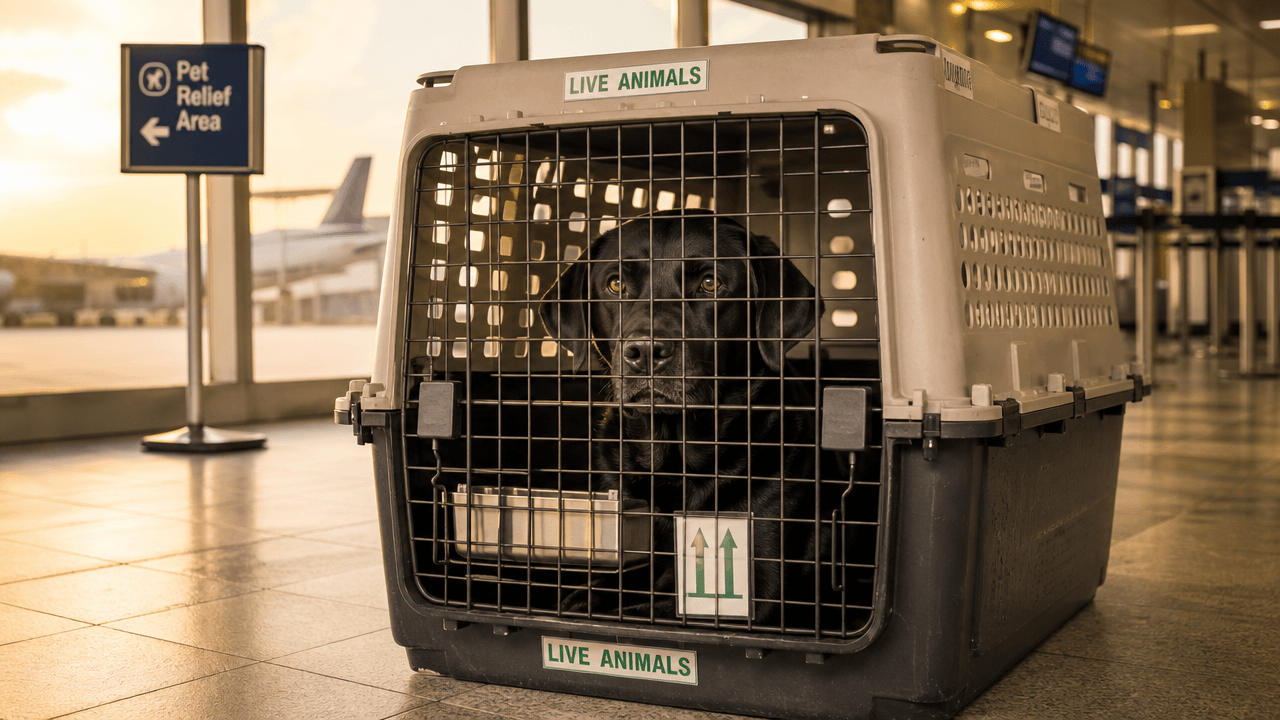
| What crate do I need? | A rigid, IATA-compliant hard crate — soft in-cabin carriers aren’t accepted for the CAPQ inspection, even if your pet flew in-cabin |
| Does quarantine length vary by origin country? | Yes, significantly — from zero days (Australia, NZ, UK) to 30+ days (higher rabies-risk countries), and quarantine space must be booked months ahead |
| How far in advance should I book? | At least 2 weeks for most airlines; Singapore Airlines specifically recommends 14 days minimum for cargo bookings |
Table of Contents
- Singapore Airlines: Cargo Only, No Exceptions
- Airlines That Do Allow In-Cabin Pets
- What Happens at Changi: The April 2026 Changes
- Quarantine Length Depends Heavily on Where You’re Flying From
- The Documentation Checklist
- Booking a Cargo Agent Without Getting Scammed
- What People Get Wrong
- The Bottom Line
Singapore Airlines: Cargo Only, No Exceptions
Singapore Airlines does not permit any pets in the passenger cabin — cats and dogs travel exclusively as checked baggage or cargo, regardless of how small the carrier is, and checked baggage is capped at a combined pet-plus-container weight of 32kg before you’re pushed into cargo-only arrangements. Contact Singapore Airlines at least 14 days before departure to arrange pet travel — one of the longer advance-booking windows in the industry.
Aircraft type matters more than most people expect. Boeing 737-operated flights don’t accept pets at all, since that aircraft’s cargo hold has no temperature control, and two specific ultra-long-haul routes — SQ21 from Newark and SQ23 from New York — ban pets entirely regardless of aircraft; SQ25, also New York to Singapore, allows them. Checked baggage is also unavailable on flights to or from Australia, Brunei, Bali, New Zealand, South Africa, Dubai, Hong Kong, Taipei, and the UK, due to those destinations’ own regulations rather than anything Singapore Airlines controls.
Breed restrictions go well beyond the commonly-known brachycephalic list — banned dog breeds include Akitas, Boerboels, Boxers, Chow Chows, Dogo Argentinos, Bulldogs, Mastiffs, Pit Bulls, Pugs, Shar-Peis, Shih Tzus, and several spaniel and terrier types, and on the cat side, British Shorthairs, Burmese, Exotic Shorthairs, Himalayans, Persians, and Scottish Folds are all banned from flying with Singapore Airlines specifically — a longer list than the generic “flat-faced breeds” framing usually suggests. Check your specific breed against the current list directly rather than assuming a near-miss is fine.
Pets travel in a pressurized, temperature-controlled section of the cargo hold, and Changi’s cargo handling infrastructure is generally well regarded. That doesn’t change the core fact: if traveling in the cabin with your pet matters to you, Singapore Airlines isn’t an option, regardless of price or route convenience.
Airlines That Do Allow In-Cabin Pets
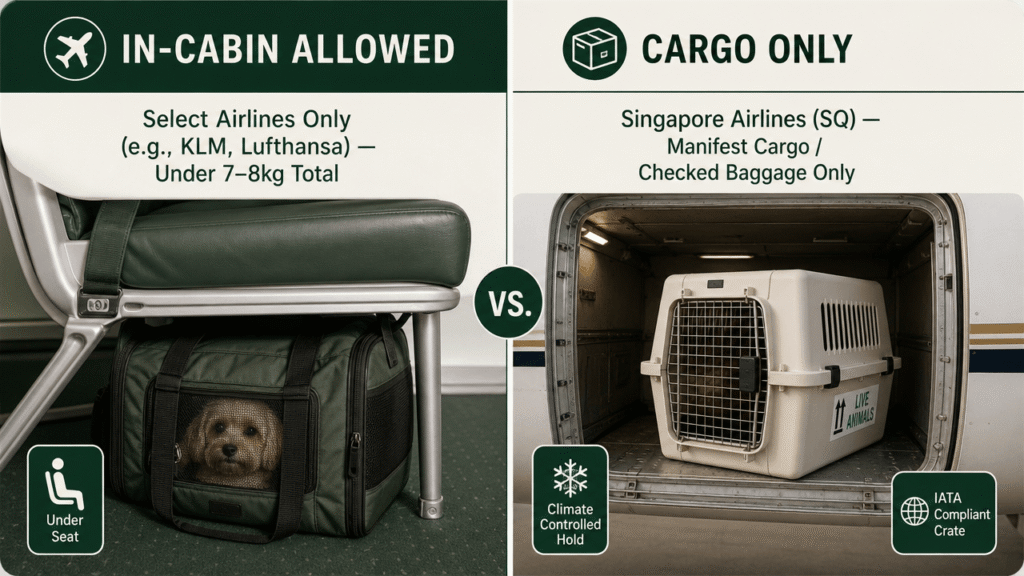
If keeping your pet with you in the cabin is the priority, a handful of carriers — including KLM, Lufthansa, and Korean Air — allow small pets in the cabin on flights into Singapore, typically for animals under about 7-8kg including the carrier. This is airline-specific and route-specific, so confirm directly with the carrier for your exact route rather than assuming a airline’s general pet policy applies to every flight it operates.
One detail worth being clear on: flying in-cabin doesn’t exempt your pet from Changi’s ground clearance requirements. You’ll still need a rigid, hard-shell crate ready for the mandatory AVS inspection upon landing — the soft in-cabin carrier gets your pet through the flight, not through quarantine clearance.
What Happens at Changi: The April 2026 Changes
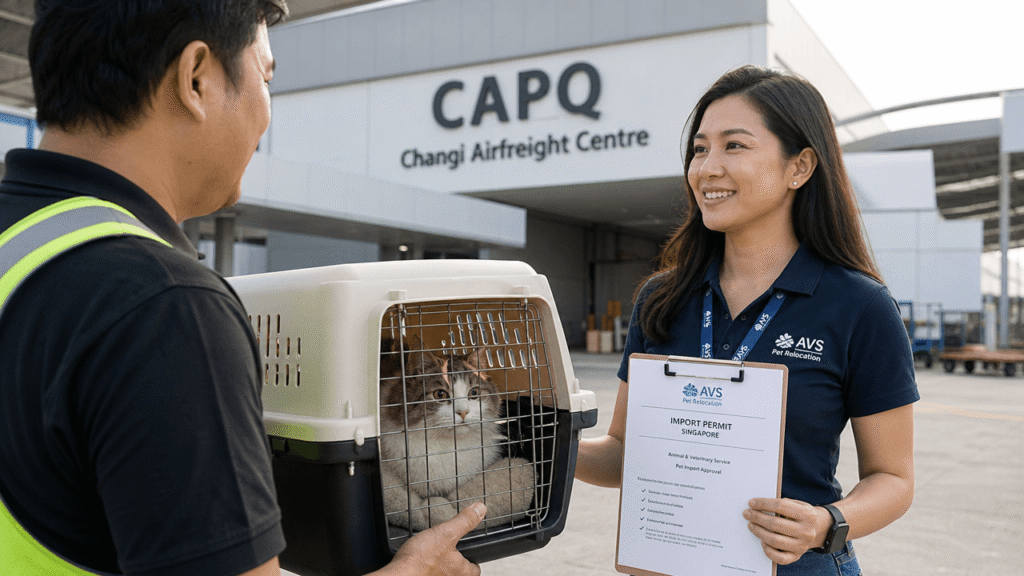
This is the part that’s changed most recently, and it affects every pet entering Singapore regardless of airline or cabin arrangement. As of 1 April 2026, pet owners can no longer clear their pet themselves at the Changi Animal & Plant Quarantine Station (CAPQ) — an AVS-recognized pet agent must handle all documentation and inspection procedures, and owners aren’t permitted into the Changi Airfreight Centre where CAPQ is located at all.
We’ve covered this requirement, along with the rigid crate rule and CAPQ’s new operating hours, in more detail in our Singapore Pet Import Guide — worth reading in full if you’re bringing a pet to live in Singapore rather than just visiting, since the licensing and housing-eligibility steps go well beyond the flight itself.
One practical implication worth flagging here specifically: CAPQ now operates Monday and Tuesday 9am-5pm, Wednesday to Friday 9am-8pm, with a daily lunch closure and no weekend hours at all. A flight that lands late Friday night or over the weekend means your pet either waits for the next available slot or you absorb extra holding costs — factor CAPQ’s hours into your flight booking, not just the airline’s own schedule.
Quarantine Length Depends Heavily on Where You’re Flying From
This is worth knowing before you book anything, since it can add weeks and real cost to your plans depending on origin country. Singapore classifies countries into rabies-risk tiers — sometimes labeled Category A through D, sometimes Schedule I through III depending on which document you’re reading — and the quarantine length that applies to your pet depends entirely on which tier your departure country falls into.
Pets from rabies-free countries like Australia, New Zealand, the UK, and Ireland typically face no quarantine at all if fully compliant; pets from countries with a higher documented rabies risk can face a mandatory 10 to 30+ days at the Sembawang Animal Quarantine Station, and that quarantine space needs to be reserved up to three months ahead of your pet’s expected arrival — not something you can arrange after booking a flight for next month.
If you’re coming from the US, Canada, or much of Western Europe specifically, don’t assume “developed country” means no quarantine — check your exact origin country’s current classification directly with AVS before finalizing any travel dates, since the required lead time can be longer than most flight booking windows.
The Documentation Checklist
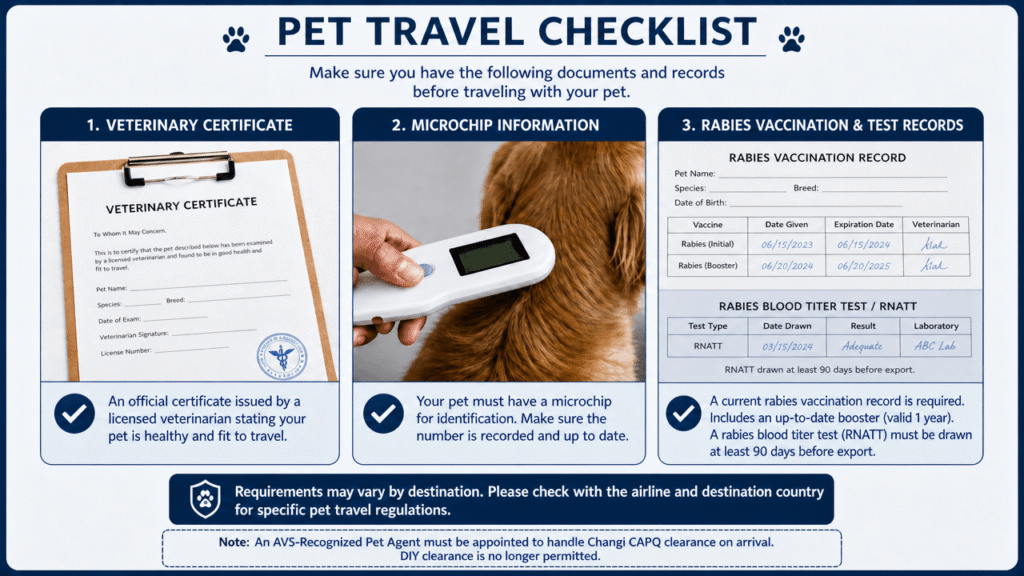
A veterinary health certificate must be completed by a government-approved veterinarian within seven days of arrival, and proof of a valid rabies vaccination is required alongside it. Your pet’s microchip needs to meet international ISO standards — a non-compliant chip can lead to entry being denied outright, which is a genuinely costly mistake to discover at the airport rather than weeks beforehand.
The import permit itself is issued through AVS’s GoBusiness licensing portal, and — as covered in our import guide — must be applied for after your pet’s PALS licence, not before. Missing any single document in this list can mean your pet is refused entry and, in the worst case, flown back to its origin at your expense, so treat this checklist as sequential and non-negotiable rather than something to assemble loosely.
Booking a Cargo Agent Without Getting Scammed
Worth a direct warning here: search results for “flying pets to Singapore” are thick with spam pages that repeat a fake customer service phone number dozens of times throughout otherwise-generic content, formatted with unusual symbols to dodge spam filters. These aren’t real airline or agent contact numbers. If a page reads like it exists to get you to dial a number rather than actually explain policy, close it and go directly to the airline’s official site or a verified IPATA-accredited freight forwarder instead.
An IPATA-accredited freight forwarder — a member of the International Pet and Animal Transportation Association — is the standard, verifiable credential to look for when hiring an agent to handle cargo booking and paperwork, separate from the AVS-recognized agent required for the CAPQ clearance step itself. The two credentials cover different parts of the process, and a legitimate agent should be able to explain clearly which one they hold and what it actually covers.
What People Get Wrong
The most common mistake is assuming Singapore’s own airline will be the simplest option because it’s the national carrier. Singapore Airlines’ cargo-only policy actually makes it a more involved process than several international carriers that permit small pets in-cabin, and assuming otherwise can mean discovering the cargo-only rule after you’ve already booked.
The second mistake is treating the flight and the Changi clearance process as one combined booking. They’re separate systems handled by separate parties — the airline gets your pet to Singapore, and a completely different AVS-recognized agent handles what happens after landing. Booking one doesn’t automatically arrange the other.
The Bottom Line
Flying with pets to Singapore starts with accepting that your pet almost certainly won’t be in the cabin with you unless you’re specifically booking one of a small number of carriers that allow it. Beyond that, the documentation has to be sequenced correctly, and the rigid crate requirement applies regardless of how your pet flew.
Since April 2026, an AVS-recognized agent handles clearance whether you like it or not. Book the flight and the clearance agent as two separate tasks, and start both well before the 14-day minimum most airlines quote, since Singapore’s own paperwork sequence takes real time to get through properly.
If you like this post, you might like our gadgets section => New Gadgets
Sources Referenced
Editorial and industry sources (linked):
Shiloh Animal Express — Pet Import Services: Importing Dogs, Cats & Pets Into Singapore
CatAbroad — Singapore Airlines Cat & Pet Policy 2026
Singapore Airlines — Travelling With Pets (Official)
BringFido — Singapore Airlines Pet Policy
Pet Adventures — Best Airlines for Pet Travel to Singapore (And Which to Avoid)
Pet Holiday Club — Singapore Airlines Pet Policy 2026: Cargo & Full Rules