Flying With Pets US Checklist: Honest 2026 Guide
A dog barked nonstop for seven hours on a flight from Paris to Newark. Passengers later learned why: the dog was too big for its carrier and couldn’t stand or lie down without the expansion panel open. The owner had insisted, at the gate, that the dog fit fine. It’s the clearest illustration of the one rule that actually matters most in pet air travel — carrier size isn’t a suggestion.
A flying with pets us checklist in 2026 looks meaningfully different than it did even a few years ago. The biggest shift: cargo pet transport for the general public has quietly shrunk to almost nothing at major carriers, which changes the entire calculus for anyone with a dog too large for the cabin.
Quick Answer
| Question | Short Answer |
|---|---|
| Can my large dog fly as checked cargo? | Increasingly no — American and United now restrict cargo to military/State Department only; Alaska and Hawaiian remain the main options for the general public |
| What documents do I need domestically? | A health certificate from a vet issued within 10 days of travel, plus proof of rabies vaccination |
| Are emotional support animals treated as service animals? | No — since 2021, ESAs fly under standard pet policy on every major US airline; only trained service dogs fly free |
| Are flat-faced breeds restricted? | Yes — most major airlines won’t accept brachycephalic breeds (Pugs, French Bulldogs, Boxers, Persians, Himalayans) in cargo due to respiratory risk |
| Should I sedate my pet for the flight? | No — most vets strongly discourage it; altitude pressure changes can worsen sedation’s effects on heart rate and breathing |
Table of Contents
- The Cabin-vs-Cargo Reality in 2026
- What You Actually Need, Document-Wise
- Breed and Size Restrictions
- The Carrier-Size Mistake That Gets Pets Denied Boarding
- Can You Buy an Extra Seat for Your Pet?
- What Airline-by-Airline Actually Looks Like
- Products Worth Packing
- What People Get Wrong
- Tips From Real Flights Gone Wrong
- The Bottom Line
The Cabin-vs-Cargo Reality in 2026
This is the single biggest change worth knowing before you book anything. A growing number of major US carriers have stepped back from checked-pet and cargo programs for the general public — American and United now restrict cargo pet transport largely to military and State Department personnel with permanent-change-of-station orders, not ordinary travelers. Alaska Airlines and Hawaiian Airlines remain the main carriers still offering general-public cargo transport, with Alaska’s program serving mostly western US and Hawaii routes.
If your dog is too large to fit in an under-seat cabin carrier and you’re not flying Alaska, Hawaiian, or a semi-private option like JSX (which allows larger dogs on a purchased adjacent seat on limited routes), your realistic options have narrowed considerably compared to a few years ago. Plan around this constraint before you book, not after.
What You Actually Need, Document-Wise
Domestically, most airlines require a health certificate from a vet issued within 10 days of travel, plus proof of rabies vaccination. International travel requires more: a USDA-endorsed health certificate (APHIS Form 7001) plus destination-specific requirements that can include microchip verification, titer tests, and import permits depending on where you’re headed.
Book your vet appointment for the health certificate close to your travel date — the 10-day window is tighter than it sounds once you factor in a pet needing any last-minute treatment before the certificate can be signed.
Breed and Size Restrictions
Brachycephalic (flat-faced) breeds face the most consistent restrictions across airlines — Pugs, French Bulldogs, Boxers, and similarly-built cat breeds like Persians and Himalayans are excluded from cargo at most major carriers due to their elevated risk of breathing difficulty at altitude and under stress. American Airlines is notably stricter than most on breed restrictions — if you have a flat-faced breed and genuinely need cargo transport, checking a different carrier’s policy is worth the extra step.
Cabin travel is generally unaffected by breed restrictions, since the pet stays with you in a climate-controlled cabin rather than the cargo hold where the actual risk lives.
The Carrier-Size Mistake That Gets Pets Denied Boarding
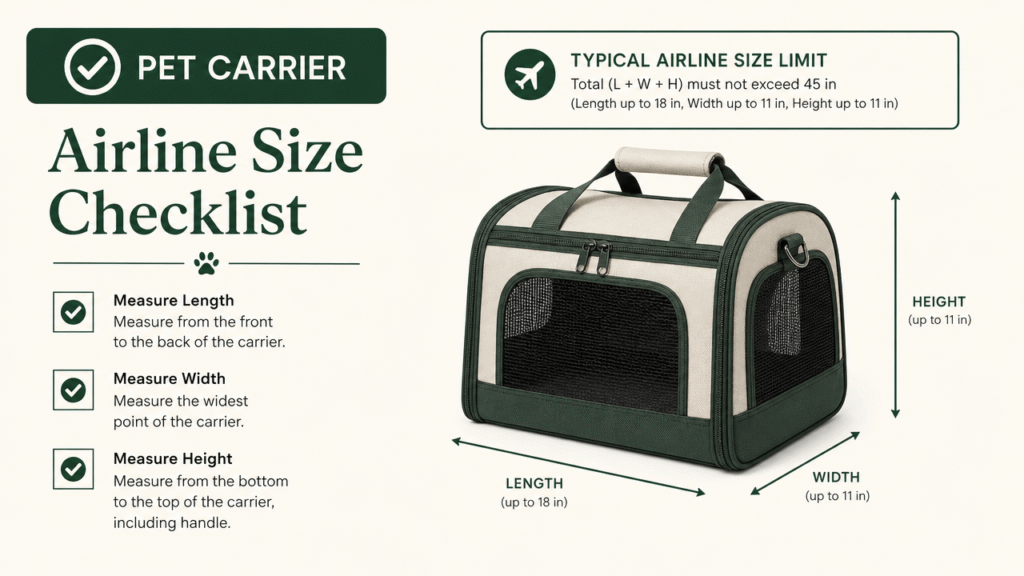
This is worth its own section because it’s the single most common, most avoidable failure point. Carriers are increasingly measured at the gate, not just at booking, and a carrier that’s even slightly oversized — or a dog that’s simply grown since you last measured — can mean denied boarding after you’ve already gotten through security.
Measure your pet and your carrier together before travel day, not from memory, and check the specific airline’s dimensions rather than assuming “standard size” is universal, since limits genuinely vary — Delta and United both cap pet-plus-carrier around 20 pounds on some routes, while others measure by carrier dimensions alone.
Can You Buy an Extra Seat for Your Pet?
This is a common question, and the honest answer depends entirely on which airline you’re booking, not a single universal rule. On most major carriers, buying an extra seat gets you more floor space, not seat space — the carrier still has to go under the seat in front of you. American Airlines explicitly states that customers can purchase an extra seat to stow a carrier, but the kennel and pet must never be placed on the seat cushion itself, even with the extra seat purchased.
JetBlue is the notable exception among major US carriers. JetBlue allows the carrier to be stowed under the seat for taxi, takeoff, and landing, but once you’re at cruising altitude, the carrier can be placed on the extra seat you purchased for the rest of the flight. That’s a real, meaningful difference if you specifically want your pet up at seat height during the flight rather than on the floor the entire time.
If your dog is genuinely too large for any under-seat carrier regardless of an extra seat, JSX allows dogs up to 79 pounds to fly without a carrier at all, provided you purchase the adjacent seat — the dog stays leashed and lies on the floor space directly in front of that seat rather than on the cushion.
That’s a genuinely different experience than squeezing a large dog into a carrier that barely qualifies as “under-seat.” JSX is a semi-private carrier with limited routes, so it won’t work for every trip, but it’s worth knowing about if carrier size is the main obstacle for a larger dog.
What Airline-by-Airline Actually Looks Like
Delta allows in-cabin pets with a domestic fee around $95 each way, limits vary by cabin class (two pets in first/business, up to four in main cabin), and pets must be at least 10 weeks old. United accepts up to two dogs in the cabin and recommends booking as early as possible, with reservations accepted up to 30 days ahead and required no later than 5 days before departure.
Southwest is in-cabin only with no cargo option at all — if your pet doesn’t fit under the seat, Southwest isn’t an option regardless of fee. Alaska Airlines remains one of the more pet-accommodating carriers, with cargo available up to 150 pounds including kennel and relatively broad breed acceptance, though seasonal temperature restrictions still apply.
Policies shift often enough that any specific fee or limit here should be treated as a starting point for your own verification, not a final answer — always confirm directly with the airline within a few weeks of booking.
Products Worth Packing

A collapsible, leak-proof portable water dispenser is one of the more genuinely useful travel purchases for pet owners specifically because airport layovers and gate delays are unpredictable — a pet that can’t access water for several extra hours during a delay is a real, avoidable discomfort. Look for one with a sealed, no-spill design rather than an open bowl, since it needs to survive being tossed in a carry-on bag without leaking on your other belongings.
For anyone driving to or from the airport, or managing a layover with a dog that needs a relief break, a hands-free waste bag dispenser that clips to a leash and closes with a simple drawstring pull is a small but genuinely practical upgrade over fumbling with a loose roll of bags one-handed while also holding a leash and luggage.
Ideas for pet comfort on air
- Airline-approved pet carrier small or Large
- Portable pet water or snack dispenser
- Hands-free dog waste bag dispenser and scooper
- Pet Odor Eliminator Spray
- waterproof blanket for pets
- Cooling pads for pets
What People Get Wrong
Fees, cabin pet limits, breed restrictions, and cargo availability all vary meaningfully carrier to carrier, but plenty of travelers check one airline’s policy and assume it applies broadly. That’s exactly how someone ends up with a non-compliant carrier at the gate.
ESA status is the other trap. Since 2021, every major US airline treats emotional support animals as standard pets — same fees, same carrier requirements — and only a trained service dog performing a specific task travels free and outside a carrier. Assuming otherwise, right up until check-in, is a common and avoidable surprise.
Tips From Real Flights Gone Wrong
The Paris-to-Newark case at the top of this guide is a useful cautionary tale precisely because it was preventable — the dog owner insisted the carrier fit at the gate when it clearly didn’t. A separate, well-documented incident involved a woman removed from a United Express flight, and the flight returned to the gate, after she refused a flight crew’s request to place her dog back in its carrier following a snapping incident. Both incidents trace back to the same root cause: treating the carrier requirement as optional rather than a hard rule crew will enforce.
The Bottom Line
The realistic flying with pets us checklist for 2026 starts with a hard question most owners skip: does your pet actually, measurably fit an under-seat carrier, and if not, do you have a real cargo option left given how much that field has narrowed?
Get the health certificate timing right, don’t assume ESA status changes anything, and treat carrier-size requirements as non-negotiable rather than something to argue about at the gate.
IF you like this article, you might also like other article from US pet travel -> Here
Sources Referenced
Editorial and community sources (linked):
TravelVlog — Traveling With Pets 2026 Guide
Autopilot Travel — Airline Pet Policies 2026
Pet Travel Advisors — Airline Pet Policies: Cargo and Cabin Guide
Pet Magasin — Your Ultimate Guide to Airline Pet Travel Requirements
Kayak — What to Know About Pet Policies From Major Airlines
CBS News Chicago — Woman Kicked Off Flight for Refusing to Crate Dog