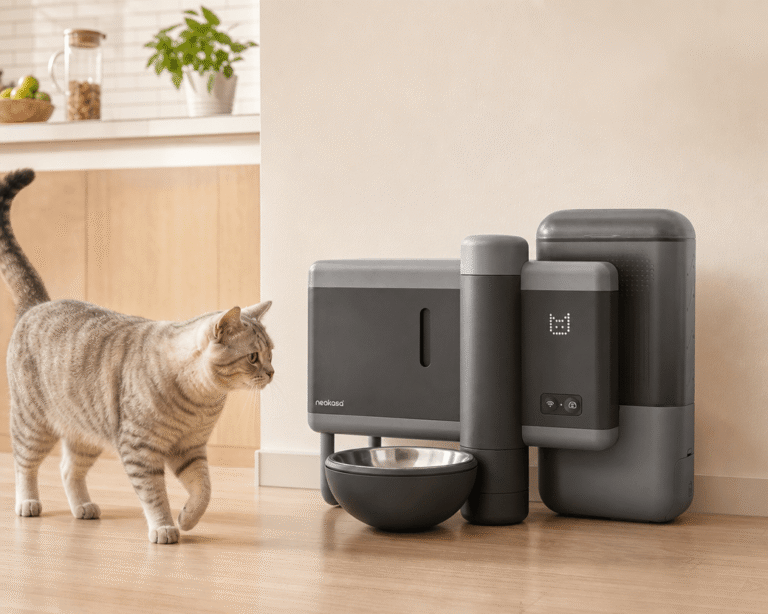
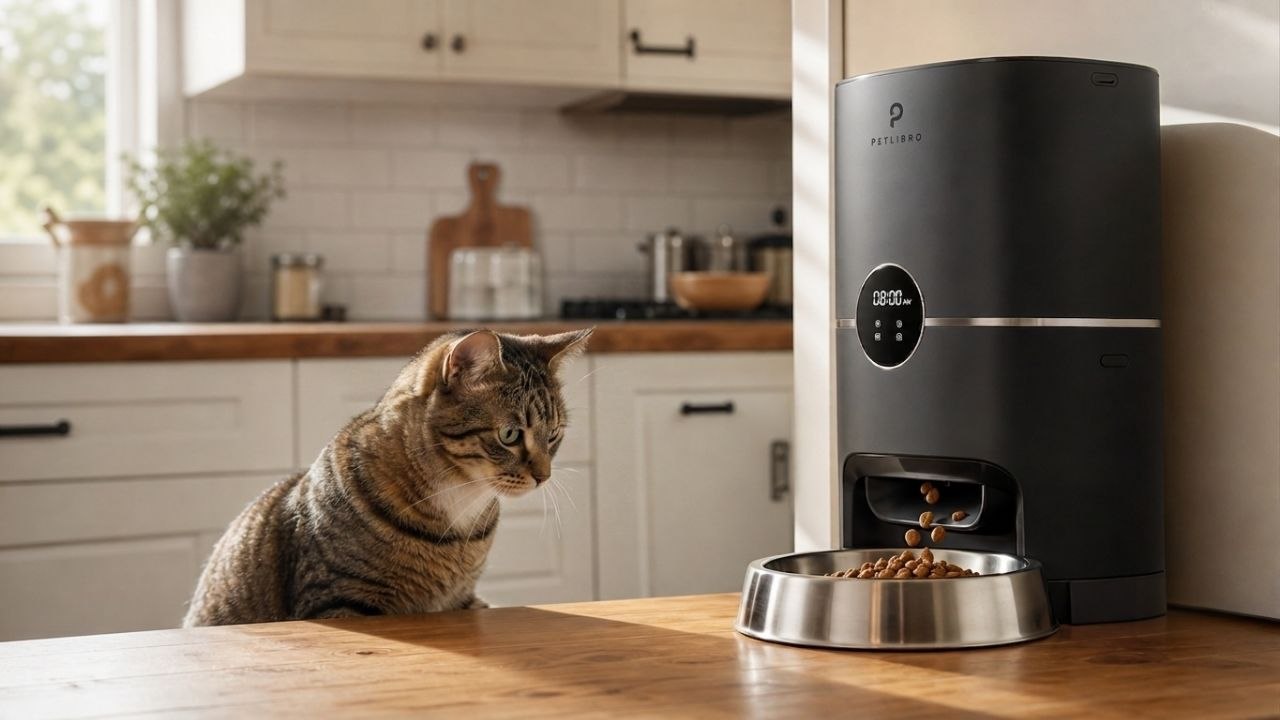
Smart Cat Feeder Review: What Actually Happens After 6 Months of Use
Here’s a smart cat feeder review you won’t get from a brand’s own product page: one of the most common complaints isn’t about the tech failing. It’s about the cat figuring out how to trigger the “quick feed” button on top, on purpose, and eating twice as much as it should.
That’s the thing nobody puts in the marketing photos. A smart cat feeder review based on actual long-term use looks completely different from a spec sheet. So this is built from what people are actually saying after living with these things for months — what jams, what breaks, what the subscription situations really cost, and which models are worth it depending on whether you’ve got one cat or four.
Quick Answer — Jump to What You Need:
| Your Situation | Best Pick | Why |
|---|---|---|
| Single cat, want it simple | PETLIBRO Granary | Reliable, no subscription, good battery backup |
| Multi-cat household, food stealing is a problem | A microchip/RFID-recognition feeder | Only the right cat’s chip opens their bowl |
| Cat eats wet food | PETLIBRO Polar (refrigerated) | Actually keeps wet food safe for hours, not minutes |
| Want full integration with an existing ecosystem | Whisker Feeder-Robot | Same app as Litter-Robot if you already own one |
| Tight budget, simple schedule | PetSafe 5-meal dispenser | No app, no WiFi, no extra failure points |
All prices below are in USD with AUD/SGD notes where relevant. Prices and exact specs shift often — verify current pricing before buying.
Table of Contents
- Why “Smart” Doesn’t Always Mean Reliable
- The Button Problem Every Smart Cat Feeder Review Should Mention
- Wet Food Feeders: The One Category Worth Paying More For
- Multi-Pet Households: Why RFID Recognition Actually Matters
- Comparison Table
- The Good, The Bad, and The Verdict — By Model
- US vs. Australia vs. Singapore: What Changes
- The Verdict
1. Why “Smart” Doesn’t Always Mean Reliable
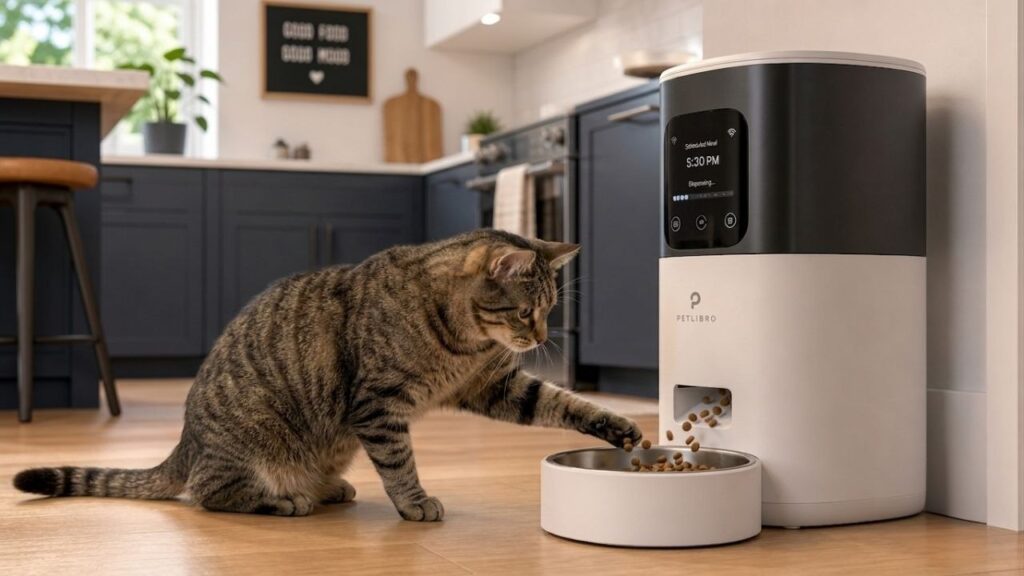
This is the part every smart cat feeder review should lead with, and most don’t: jamming and malfunction aren’t rare edge cases. Cats.com, which tested 13 different automatic feeders side by side, found that jamming and inconsistent dispensing are “constant realities” with poorly designed units — food gets stuck in the auger mechanism, portions come out wrong, or the unit just stops working mid-cycle.
The fix isn’t avoiding smart feeders entirely. It’s understanding that this category has a real range — from units that fail constantly to ones that genuinely hold up. The brands that consistently show up as reliable in independent testing (CNN Underscored tested 13 models too) are the ones with simpler mechanical designs and better build quality, not necessarily the ones with the most app features.
2. The Button Problem Every Smart Cat Feeder Review Should Mention
Here’s a specific, real complaint that came up in hands-on testing of the PetSafe Smart Feed: the manual “quick feed” button sits right on top of the unit, within easy reach — and curious cats can and do trigger it themselves, leading to actual overfeeding. One reviewer who tested the unit long-term flagged this directly: it’s convenient for a human to press, but it’s also exactly the kind of raised, tappable surface a cat investigates with a paw.
This is a genuinely overlooked design flaw category. If you’re choosing between feeders and portion control matters for your pet’s health, check specifically whether the manual-feed button is flush, recessed, or requires a deliberate press — not just whether the feature exists.
3. Wet Food Feeders: The One Category Worth Paying More For
Most automatic feeders are built for dry kibble, and for good reason: wet food left sitting at room temperature in a standard hopper starts to spoil within hours, not days. If your cat or dog eats wet food or a prescription diet, a standard timed feeder is a real food-safety risk, not just an inconvenience.
The PETLIBRO Polar solves this properly rather than pretending the problem doesn’t exist — it uses actual semiconductor cooling to keep food below 50°F until a scheduled 30-minute warm-up period right before each meal, with infrared anti-pinch sensors and a 12-hour power backup to keep the cooling cycle running through a power outage. Independent reviewers (including coverage from TechCrunch and Apartment Therapy) have called it the only automatic feeder that makes wet food scheduling genuinely safe rather than a gamble.
The trade-off: this category costs meaningfully more than a basic dry-food hopper, and that premium is the actual cost of refrigeration hardware, not just branding. If your pet only eats dry kibble, skip this entirely — you’re paying for cooling tech you don’t need.
4. Multi-Pet Households: Why RFID Recognition Actually Matters
This is a category most generic smart cat feeder review roundups gloss over. If you’ve got more than one cat and one of them is a food thief, a standard feeder does nothing to stop that — it’ll happily dispense a meal that the wrong cat eats in thirty seconds while the slower eater goes hungry. This is one of the most common reasons multi-cat households end up frustrated with a feeder that worked fine when they only had one pet.
The fix is a feeder with RFID or microchip recognition, which only opens for the specific pet wearing the registered chip or tag. It’s a meaningfully different category from a basic scheduled hopper, and worth the extra cost specifically if food-guarding or weight management between pets is already a problem in your household — not a nice-to-have for every multi-pet home.
5. Comparison Table
| Model | Food Type | Connectivity | Standout Feature | Real-World Issue to Know |
|---|---|---|---|---|
| PETLIBRO Granary | Dry | WiFi + app | Reliable, good outage protection | Basic; no RFID multi-pet recognition |
| PETLIBRO Polar | Wet (refrigerated) | WiFi + app | Semiconductor cooling, 12hr backup | Premium price reflects the cooling hardware |
| Whisker Feeder-Robot | Dry | WiFi + AutoPets Connect app | Integrates with Litter-Robot ecosystem | Manual “quick feed” button can be cat-triggered |
| PetSafe Smart Feed | Dry | WiFi + app | Established brand, Alexa-compatible | Requires 2.4GHz WiFi specifically — won’t connect to 5GHz-only routers |
| PetSafe 5-Meal (non-WiFi) | Dry | None — manual programming | Simple, fewer failure points | No remote control or alerts at all |
6. The Good, The Bad, and The Verdict — By Model
PETLIBRO Granary — The Good: consistently shows up as a top pick across CNN Underscored, Cybernews, and multiple independent test panels for reliability and value, with solid outage protection so a power blip doesn’t ruin your pet’s schedule. The Bad: it’s a straightforward dry-food dispenser, so if you need RFID multi-pet recognition or wet food handling, this isn’t built for that. The Verdict: the safest default choice for a single-pet, dry-food household that wants smart features without paying for a system they won’t use.
Whisker Feeder-Robot — The Good: if you already own a Litter-Robot, this slots into the same AutoPets Connect app, which genuinely simplifies managing multiple smart devices from one place. The Bad: the same accessible top-button overfeeding risk applies here as with other brands, and at roughly $299, it’s priced at the premium end for what’s still fundamentally a dry-food hopper. The Verdict: makes the most sense as an ecosystem purchase, not as a standalone “best feeder” pick on pure features.
PETLIBRO Polar — The Good: genuinely solves a real food-safety problem that no standard feeder addresses, verified by multiple independent outlets as the benchmark for refrigerated feeding. The Bad: premium pricing, and it’s solving a problem you simply don’t have if your pet eats dry kibble. The Verdict: worth every extra dollar for wet-food or prescription-diet pets; skip it entirely otherwise.
PetSafe Smart Feed — The Good: an established brand with broad retail availability and Alexa integration for voice-triggered feeding. The Bad: the 2.4GHz-only WiFi requirement trips up a real number of households running modern dual-band or 5GHz-only routers — check your router settings before assuming it’ll connect. The Verdict: solid if your network is compatible; a real setup headache if you haven’t checked first.
7. US vs. Australia vs. Singapore: What Changes
Every smart cat feeder review aimed at a single country misses how much availability and price shift once you cross a border.
United States: Widest selection, lowest prices generally, available through Chewy, Amazon, and Petco with the most frequent sales.
Australia: Available through Pet Circle and Amazon.com.au, but expect a real price premium over US listings — shipping and import costs on bulkier appliances like feeders add up. Australia runs on 230V/50Hz with Type I plugs, so units bought directly from a US Amazon listing and shipped internationally will need both a plug adapter and confirmation the unit is dual-voltage (most WiFi-connected feeders are, since the actual electronics run on low-voltage DC power from an internal adapter — but always check the label rather than assume).
Singapore: Available via Lazada, Shopee, and Amazon.sg, with similar import-cost considerations to Australia. Singapore uses 230V/50Hz with Type G (UK-style) plugs. One Singapore-specific note worth flagging: in a humid climate, dry kibble left in any hopper-style feeder for days at a time is more prone to moisture clumping than in a drier climate — a unit with a tight-sealing hopper lid matters more here than the spec sheet might suggest, and topping up smaller, more frequent batches of food rather than filling a large hopper for a week-plus trip reduces the risk of clumped food jamming the dispensing mechanism.
8. The Verdict
A smart cat feeder review that actually means something has to start from real failure points, not feature lists — the jamming, the cat-triggered overfeeding button, the wet-food spoilage risk that most feeders simply don’t address. The honest takeaway: match the feeder category to your actual problem (multi-pet food theft, wet food, simple scheduling) rather than buying the most feature-loaded option and hoping it covers everything. The PETLIBRO Granary is the safest general starting point; everything past that is solving a specific problem you either have or don’t.
If you like this post, you might like our self-cleaning litter boxes for cats => Meow