
Dog Registration Laws Australia — Every State Compared
Dog registration laws Australia? There isn’t one set of rules — there are eight. Move from Brisbane to Adelaide and you’re not just changing address — you’re switching from a council-run system to a state-run online portal called Dogs and Cats Online, with a completely different renewal date attached.
This is the guide that actually breaks down what changes between jurisdictions, instead of giving you one generic “register your dog” checklist that quietly only applies to whichever state the author happened to live in.
Quick Answer:
| State/Territory | Register By | Renewal/Expiry | System |
|---|---|---|---|
| NSW | 6 months old | Lifetime fee, no annual renewal | NSW Pet Registry |
| VIC | ~3 months (council-set) | 10 April annually | Local council |
| QLD | 12 weeks old | Council-set | Local council |
| SA | 3 months old | 31 August annually | Dogs and Cats Online (DACO) |
| WA | 3 months old | 31 October annually (most councils) | Local council |
| TAS | 6 months old | 31 July annually (varies by council) | Local council |
| ACT | 8 weeks old | One-off, lifetime | ACT Dog Database |
| NT | ~3 months (council-set) | 1 September annually (most councils) | Local council, no microchip law |
All fees below are in AUD. USD figures are rough conversions for reference only.
Table of Contents
- Dog Registration Laws Australia: Why There’s No National System
- NSW: The Lifetime Registration Model
- Victoria: Council-Set Fees and the State Animal Levy
- Queensland: Fast Deadlines, Council-by-Council Variation
- South Australia: The Only Fully State-Run Portal
- Western Australia: Sterilisation Refunds and an Incoming Mandatory Desexing Rule
- Tasmania: Concession Cards and Collar-Linked Compliance
- ACT: The Simplest System in the Country
- Northern Territory: The One Jurisdiction Without a Microchip Law
- Identification Rules When Out in Public
- Restricted & Dangerous Dog Declarations: The Actual Process
- What People Get Wrong
- Official Links by State
- The Verdict
1. Dog Registration Laws Australia: Why There’s No National System
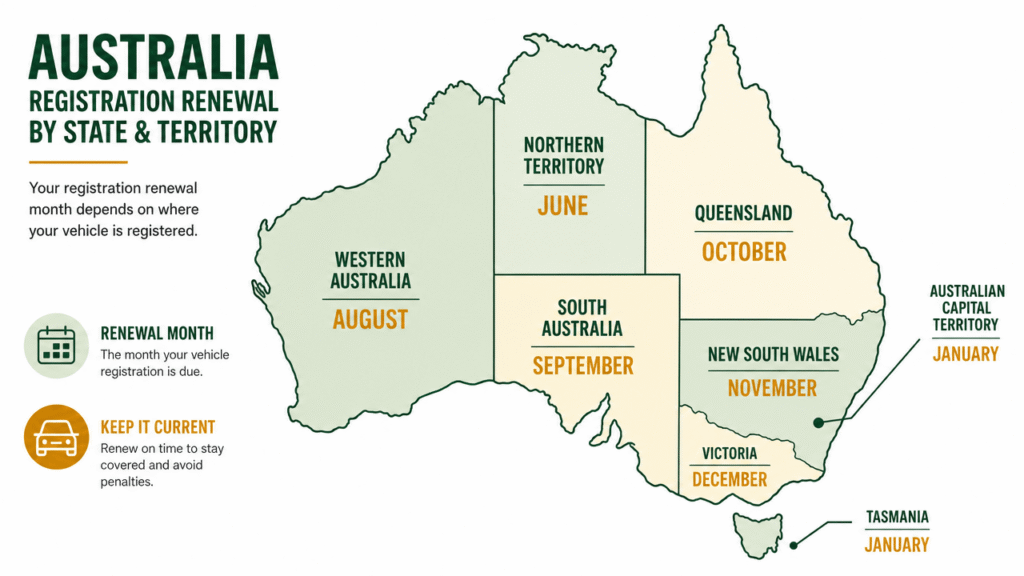
Animal welfare and companion animal management in Australia sits with the states and territories, not the federal government — there’s no Commonwealth dog registration act. Each state’s legislation (the Companion Animals Act in NSW, the Domestic Animals Act in Victoria, the Dog Control Act in Tasmania, and so on) creates its own registration framework, and several states then delegate the operational detail down to individual local councils. That’s why “dog registration in Australia” doesn’t have one answer — it has eight, and in council-run states, potentially dozens more at the local level.
2. NSW: The Lifetime Registration Model
NSW uses a lifetime registration fee model — you pay once, through the NSW Pet Registry, and there’s no recurring annual registration cost afterward (though annual permits still apply for non-desexed animals and restricted/dangerous breeds specifically).
- Microchip required by 12 weeks of age
- Registration required by 6 months of age
- Late registration (after 12 weeks of age at chip time) triggers a late fee (cited around $22–23 in some council examples)
- Desexed pets pay a lower lifetime fee than non-desexed
- Since 1 July 2020, restricted/dangerous dog registrations no longer last for life — they require annual renewal regardless of the standard lifetime model
- Assistance and companion animals must still be microchipped and registered, though typically without a registration fee
3. Victoria: Council-Set Fees and the State Animal Levy
Victoria operates under the Domestic Animals Act 1994, administered by individual local councils, with a fixed $4.64 Victorian Animal Levy added to every registration fee regardless of council.
- All registrations renew by 10 April each year, statewide
- Fees vary by council but commonly land in the $50–100/year range for a desexed dog
- Cats must be desexed before registration — this is a legal requirement, not a discount incentive
- Desexing a dog isn’t legally mandatory, but unlocks the discounted registration rate
- Pensioner concession cards (Department of Human Services or Veterans’ Affairs) and registered foster carers both qualify for reduced fees
- Transferring between Victorian councils generally only requires paying the difference for the remainder of the year, not a fresh full fee
4. Queensland: Fast Deadlines, Council-by-Council Variation
Queensland’s biggest trap for new owners is speed: registration is required by 12 weeks of age, considerably earlier than several other states, and if you’ve relocated into QLD with an older dog, you have only 14 days to register with the new council.
- Each council runs its own registration process and fee schedule independently — there’s no single QLD-wide portal
- Information required includes whether the dog is desexed, microchipped, and whether it’s a “regulated dog” (QLD’s term encompassing restricted and declared dangerous dogs)
- Breeding or working dogs may have separate registration categories — check with your specific council before assuming standard rates apply
5. South Australia: The Only Fully State-Run Portal
South Australia is the outlier — instead of council-by-council registration, the entire state uses one centralised system: Dogs and Cats Online (DACO).
- Microchipping has been mandatory in SA since 2018
- Registration required by 3 months old, in the name of a family member over 16
- Annual renewal due by 31 August
- Cats must also be microchipped and registered, though visible ID (collar/tag) is encouraged rather than strictly mandated the way it is for dogs
- “Individual Registration” applies to ordinary pets; “Business Registration” is a separate category for breeding, training, or security animals
- Address changes must be reported within SA’s required timeframe — DACO tracks this centrally rather than through a local council
6. Western Australia: Sterilisation Refunds and an Incoming Mandatory Desexing Rule
WA’s registration year runs 1 November to 31 October, set by the Dog Act 1976 (cats fall under the separate Cat Act 2011), with individual councils setting and collecting fees.
- Dogs must be microchipped and registered from 3 months old; cats from 6 months old, and all cats over 6 months must be sterilised under the Cat Act 2011 — this is mandatory, not optional, for cats specifically
- New 1-year registrations made after 1 June are charged at half price, since they still expire the same 31 October regardless of start date
- A genuinely useful detail most guides skip: if you register an unsterilised dog and then sterilise it within the registration period, several councils offer a prorated refund of the fee difference — the proration scales down the later into the period you sterilise (full difference in year one, two-thirds in year two, one-third in year three, for multi-year/lifetime registrations)
- Pensioner and Seniors Card holders typically qualify for a 50% discount; Health Care Cards are explicitly not accepted as a qualifying concession in most WA council areas
- Unregistered dogs risk an on-the-spot fine, commonly cited around $200, issued directly by council rangers
- Coming change to watch: several WA councils note the state is moving toward mandatory desexing for dogs aged two years and over under updates to the Dog Act 1976 — confirm current status with the Department of Local Government, Industry Regulation and Safety before assuming your dog is exempt
7. Tasmania: Concession Cards and Collar-Linked Compliance
Tasmania requires registration of all dogs over 6 months old, administered individually by each local council under the Dog Control Act 2000, with no single statewide portal — Service Tasmania provides a directory pointing to each council’s own system.
- Typical annual renewal deadline is 31 July, though confirm with your specific council since this isn’t uniformly legislated statewide
- Fee structures vary meaningfully by council and sometimes by property type (urban vs rural, working dog categories)
- Concession fee eligibility commonly includes Commonwealth Pensioner Concession Card, Repatriation Health Card, or Health Care Card holders — notably, several Tasmanian councils do accept Health Care Cards for concessions, unlike WA
- Tasmania treats the collar and registration disc as part of legal compliance itself — a dog without its disc attached in public can be treated as effectively unregistered, even if the underlying registration is valid
- Change of ownership, death, or relocation to another municipal area must be reported within 14 days
8. ACT: The Simplest System in the Country
The ACT runs the most straightforward model of any jurisdiction covered here.
- Microchipping and registration required by 8 weeks of age
- Registration is a one-off fee with lifetime validity — no annual renewal at all
- Managed centrally through the ACT Dog Database via Access Canberra
- Registration can be completed entirely online using microchip details, with no council-by-council variation to navigate
9. Northern Territory: The One Jurisdiction Without a Microchip Law
The NT is the only Australian state or territory with no territory-wide legal requirement for microchipping. This doesn’t mean microchipping is discouraged — most councils still strongly recommend it, and individual councils can and do set their own local requirements — but there’s no single overarching NT law mandating it the way every other jurisdiction has.
- Registration itself is required, generally by around 3 months of age, but the exact deadline and fee are set independently by each local council (Darwin and Palmerston being the two largest)
- Renewal is commonly cited as due by 1 September annually, though again, confirm with your specific council rather than assuming this applies everywhere in the NT
- Some councils waive registration fees for rescue dogs — this is council discretion, not a territory-wide policy
- If you relocate within the NT, you need to inform your new local council directly; there’s no centralised database tracking this for you the way DACO does in SA
10. Identification Rules When Out in Public
Registration and visible identification are related but legally distinct in most states — and several jurisdictions treat a missing collar/disc as equivalent to non-compliance even when the underlying registration is valid.
| State | Public ID Requirement |
|---|---|
| NSW | Identification disc on collar expected in public |
| VIC | Council-issued marker must be worn when off the owner’s property |
| QLD | Tag requirements set by individual council |
| SA | Registration disc must be worn when outside the property |
| WA | Registration tag required; replacement tags available from council |
| TAS | Collar and disc are treated as part of legal registration compliance itself |
| ACT | Registration tag or a tag showing the registration number required in public |
| NT | Council-set; varies by local government area |
The practical takeaway: “my dog is registered” and “my dog is compliant right now, in public” aren’t always the same statement if the tag isn’t physically on the collar.
11. Restricted & Dangerous Dog Declarations: The Actual Process
Most coverage of this topic stops at “these five breeds are banned nationally.” The process for how an individual dog gets declared dangerous or restricted — which can apply to any dog, any breed — matters just as much and is rarely explained.
In NSW, for example, if a council issues a Notice of Intention to Declare a Dog to be a Restricted Dog, the owner has a defined process available:
- 28 days to contest the notice
- The option to obtain a certificate from an approved breed assessor confirming the dog is not a restricted breed or cross
- If the dog is assessed as a cross-breed of a restricted breed, a separate temperament assessment from an approved assessor can result in a certificate stating the dog poses no threat — avoiding the declaration despite the breed ancestry
- Failing to obtain either certificate, or failing the assessment, results in the dog being formally declared restricted, with all associated obligations (compliant enclosure, signage, mandatory muzzling and leashing in public, no breeding, no sale or transfer of ownership)
- If a declared restricted dog goes missing, the owner must notify council within 24 hours, and the dog’s microchip record is locked on the register until it’s found
- If a restricted dog attacks or injures a person or animal without provocation, this must be reported to council within 24 hours
Victoria runs a parallel dual system: a fixed list of automatically restricted breeds, plus a separate behaviour-based “dangerous dog” declaration that can apply to literally any dog regardless of breed, based on actual incidents rather than ancestry.
12. What People Get Wrong
The most consistent mistake across every state: assuming a previous dog’s registration experience transfers directly to a new dog, a new council, or — worst case — a house move to a different state entirely. The deadlines, the systems, and even the renewal month are frequently completely different.
Many WA dog owners don’t realise the sterilisation refund exists, and simply eat the higher unsterilised fee for the full registration period rather than notifying their council after a later sterilisation and claiming the prorated difference back.
Tasmanian and NT owners in particular tend to assume “I registered once, I’m done,” without realising compliance is partly tied to physically wearing the tag — a valid registration with no disc on the collar can still result in a fine in some jurisdictions.
Owners frequently treat “my dog isn’t one of the five banned breeds” as the end of the risk assessment, without understanding that behaviour-based dangerous dog declarations apply regardless of breed in states like NSW and Victoria.
13. Official Links by State
- NSW: NSW Pet Registry / Restricted Dogs — Office of Local Government
- Victoria: Agriculture Victoria — Dog and Cat Registration
- South Australia: Dogs and Cats Online (DACO)
- Western Australia: Check your specific local council’s animal services page — there is no single WA-wide registration portal
- Tasmania: Service Tasmania — Dog Registration by Council
- ACT: Access Canberra — Dog Registration
- Northern Territory: Check your specific local council (e.g. City of Darwin, City of Palmerston) directly — there is no NT-wide portal
- New pet at home, or still deciding what else to prepare? See our full New Pet Owner Guide Australia for breed rules, costs, and the wildlife-safety checklist that sits alongside registration.
14. The Verdict
There’s no shortcut to “just knowing” dog registration laws Australia, because there genuinely isn’t one law — there are eight frameworks and, in several states, dozens of council-level variations underneath those. The only reliable approach is to check your specific council or state portal directly rather than trusting a general rule of thumb, especially around deadlines (which range from 8 weeks to 6 months depending entirely on where you live) and fees (which can differ by hundreds of dollars a year for the exact same dog in two neighbouring council areas).




One Comment