Singapore Pet Import Guide: Risks, Costs, Honest 2026
A man was paid S$500 to smuggle six puppies and a songbird into Singapore, hidden in a cramped, poorly-ventilated car compartment. All but two of the dogs died of dehydration before he was caught. This isn’t a rare, isolated case — Singapore courts have prosecuted pet smuggling cases involving dead and dying animals repeatedly over the past decade, most recently as recently as February 2026.
This singapore pet import guide isn’t about scaring you away from importing a pet — plenty of people do it legitimately and safely every year. It’s about making sure you’re not unknowingly buying into the same supply chain that killed those puppies, since Singapore has started prosecuting buyers, not just smugglers, for exactly that.
Quick Answer
| Question | Short Answer |
|---|---|
| Can I import any breed? | No — Pit Bull-type breeds, Akita, Boerboel, Dogo Argentino, Fila Brasileiro, Neapolitan Mastiff, Tosa, and Perro de Presa Canario are prohibited, along with wild-hybrid cats |
| Do I need an agent? | Yes, as of 1 April 2026 — owners can no longer self-clear at CAPQ at all; every dog and cat requires an AVS-recognized pet agent, no exceptions |
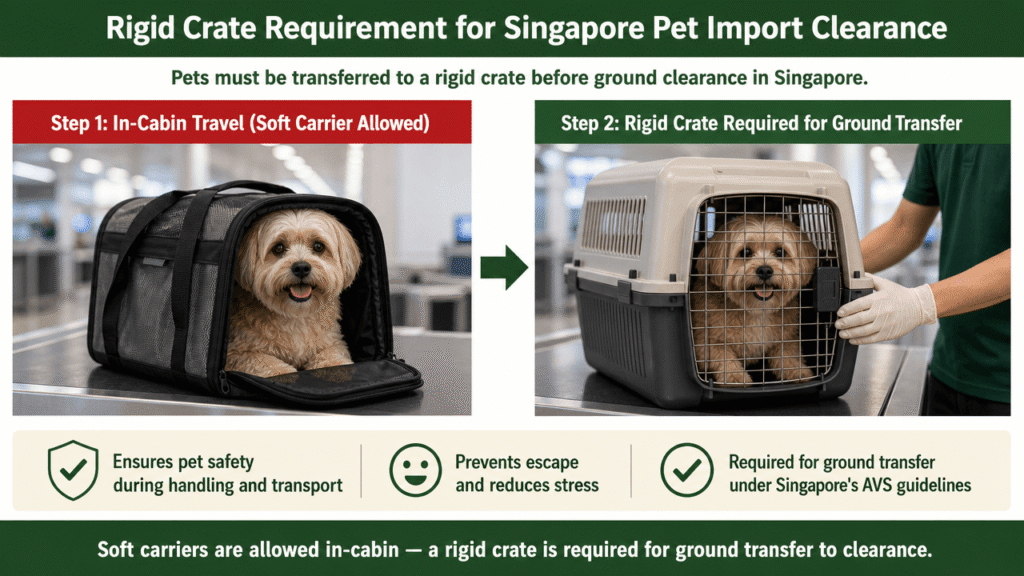
| Can I bring my pet in a soft carrier? | Not for clearance — as of April 2026, pets must be transferred into a rigid, IATA-compliant hard crate before CAPQ inspection, even if they flew in-cabin in a soft bag |
| Is buying from an unlicensed overseas seller illegal? | Importing without a valid AVS licence is illegal regardless of who sells you the pet, and buyers have been prosecuted for knowingly supporting it |
| Does my home even allow the pet I’m importing? | Check before you import, not after — AVS’s own checklist requires confirming your dog or cat is allowed at your intended residence before applying |
| How do I verify a legitimate import agent? | Check the official AVS-recognized pet agent list directly — a downloadable PDF from NParks, not a claim on a company’s own website |
Table of Contents
- What Can and Cannot Be Imported
- Verify Your Home Actually Allows the Pet First
- The Licence Order-of-Operations Trap
- CAPQ’s April 2026 Changes: Agent-Only, Rigid Crates, New Hours
- Home Quarantine and the Smart Collar Option
- Hidden Costs Beyond the Obvious
- What Singapore Courts Have Actually Prosecuted
- Buyers Have Been Prosecuted Too
- Puppy Mill and Scam Red Flags to Check Before You Pay
- How to Verify a Legitimate Import Agent
- What People Get Wrong
- The Bottom Line
What Can and Cannot Be Imported
Only dogs and cats are covered under Singapore’s standard personal pet import process — other animals require special permission and aren’t covered by this guide. A specific list of dog breeds is prohibited from import regardless of documentation: Pit Bull-type breeds (American Pit Bull Terrier, American Staffordshire Terrier, Staffordshire Bull Terrier, American Bulldog and crosses), Akita, Boerboel, Dogo Argentino, Fila Brasileiro, Neapolitan Mastiff, Tosa, and Perro de Presa Canario, along with wolf hybrids and wild-hybrid cat breeds like Savannah and Bengal unless five generations removed from their wild ancestor.
Your pet’s required documentation and quarantine length depend on which “schedule” category their country of origin falls into. Schedule I countries (Australia, New Zealand, Republic of Ireland, United Kingdom) require no rabies vaccination or serology test at all, and no post-arrival quarantine if fully compliant. Schedule II is the largest category and includes most expat-origin countries — the USA, Canada, Japan, and most of the EU — and requires a valid rabies vaccination plus a blood serology test taken at least 90 days after vaccination and within 12 months before export.
Schedule II pets skip post-arrival quarantine entirely only if two specific conditions are both met: the pet arrives in Singapore less than 5 days after the owner’s own entry, and the pet has lived continuously at the same address as the owner for more than 6 months before import. If either condition isn’t met, a minimum 10-day quarantine applies — at home with a Smart Collar for personal imports, or at the Animal Quarantine Centre for commercial imports. Schedule III (everywhere else) requires a mandatory minimum 30-day quarantine at the Animal Quarantine Centre regardless of circumstances.
Verify Your Home Actually Allows the Pet First
This is a step AVS itself flags directly in its own import checklist, and it’s easy to skip when you’re focused on the pet rather than the paperwork: AVS explicitly instructs owners to “ensure your dog or cat is allowed at your intended residence in Singapore” before proceeding, and specifically points to the published list of dog breeds permitted in HDB flats as a required check.
We’ve covered HDB and private-property pet limits — including the 2024–2026 Cat Management Framework transition, licensing requirements, and the specific caps for each housing type — in detail in our apartment and small-space guide. The point worth adding here specifically: importing a pet without confirming your housing type actually permits it isn’t just a future inconvenience, it’s a real reason a PALS licence application gets rejected at the application stage, after you’ve already committed time and money to the import process. Check this before you start, not after.
The Licence Order-of-Operations Trap
This catches more people off guard than almost anything else in the process, according to pet relocation professionals who deal with it regularly. In Singapore, you must obtain a dog or cat licence on the Pet Animal Licensing System (PALS) before you can apply for the import licence — the reverse of how many other countries structure the process, where the import approval typically comes first. Once issued, the import licence is valid for 90 days, so getting the sequence wrong can cost real time re-doing paperwork, not just cause minor confusion.
CAPQ’s April 2026 Changes: Agent-Only, Rigid Crates, New Hours
This is the single most consequential recent change for anyone importing a pet into Singapore, and any guide written before April 2026 won’t reflect it. As of 1 April 2026, pet owners can no longer self-clear their pet at the Changi Animal & Plant Quarantine Station (CAPQ) at all — every dog and cat entering Singapore now requires an AVS-recognized pet agent to handle clearance, with no exceptions, and owners are no longer permitted to enter the Changi Airfreight Centre where CAPQ is located.
This is a genuinely different requirement than simply “hiring help is recommended” — it’s now the only legal pathway, regardless of experience or how many times you’ve imported a pet before.
Two further changes took effect the same date. Soft in-cabin carriers are no longer accepted for the CAPQ clearance inspection — pets must be transferred into a rigid, IATA-compliant hard crate before inspection, even if they traveled in-cabin in a soft bag, with your appointed agent typically arranging this crate swap at Changi.
CAPQ’s operating hours also became significantly more restricted: Monday and Tuesday 9am to 5pm, Wednesday to Friday 9am to 8pm, closed daily for a 1pm to 2pm lunch break, and closed entirely on weekends and public holidays — there are no more evening or Saturday clearances, which means your flight timing now needs to be planned around CAPQ’s hours, not the other way around.
Home Quarantine and the Smart Collar Option
When the 10-day home quarantine applies, AVS monitors compliance via a smart collar tag fitted to the pet, confirming the animal remains at the approved quarantine address for the full period. The cost is S$29 per animal per day, paid upfront in full before the pet arrives — for the 10-day minimum, that’s S$290 per animal, and the application needs approval before you submit your import licence application, not after.
This isn’t available to every import automatically — eligibility depends on your pet’s specific circumstances and schedule classification. Breaching the home quarantine conditions can result in the pet being transferred to the Animal Quarantine Centre at the owner’s own expense, so this option trades physical separation from your pet for a real compliance responsibility on your part.
Hidden Costs Beyond the Obvious
Vaccinations, health certificates, and airfare are the costs most people plan for. The ones that catch people off guard are procedural. A Customs GST permit, typically arranged through a licensed forwarding agent, is required before arrival, and arriving without a confirmed CAPQ appointment results in an inspection fee of S$133 per hour or part thereof — a fee that applies whether or not you have an agent, if the appointment itself wasn’t properly booked.
The mandatory agent requirement introduced in April 2026 adds its own real cost on top of everything else, with real total relocation costs across established Singapore pet agents ranging from roughly S$400 to S$5,000+ depending on origin country, quarantine needs, and service level — a genuinely wide range worth getting multiple quotes across before committing to one agent.
What Singapore Courts Have Actually Prosecuted
This isn’t a hypothetical risk — it’s a documented, recurring pattern in Singapore courts, and the outcomes for the animals involved are frequently fatal. In one case, 26 puppies and a kitten were smuggled hidden in laundry bags and plastic containers in a lorry; one was found dead on discovery, and 18 more died later of canine parvovirus. In a separate, more recent case from February 2026, a Singaporean man was fined S$15,000 for coordinating with a Malaysian breeder via TikTok to acquire toy poodles for resale without a pet shop licence.
NParks has stated plainly that animals smuggled into Singapore are from unknown sources with unknown health status, and that smuggling risks introducing exotic diseases into the country — a real biosecurity concern for a country that has maintained rabies-free status for over 50 years, not just an animal welfare one.
Buyers Have Been Prosecuted Too
This is the detail most people researching pet imports don’t realize applies to them. In one case, a buyer who knowingly purchased a smuggled dog was fined S$7,000 — the first time NParks prosecuted a buyer specifically for abetting animal smuggling, not just the person who physically transported the animal. Under the Animals and Birds Act, importing animals without a licence can result in fines of up to S$10,000, imprisonment for up to 12 months, or both — a penalty that isn’t limited to the smuggler.
The practical implication: an unusually cheap price, a seller unwilling to provide proper import documentation, or a delivery method that avoids the official AVS import process are all signals that you could be knowingly or unknowingly stepping into criminal liability, not just a bad purchase.
Puppy Mill and Scam Red Flags to Check Before You Pay
While documented Singapore-specific online puppy-scam cases are less publicly reported than the physical smuggling cases above, the general pattern of overseas puppy scams is well-documented internationally and the red flags translate directly. One documented case involved a supposed breeder using stock photos, an AKC-registration claim that didn’t check out, and payment requests routed through Zelle, Venmo, or PayPal to a personal name rather than a business account — with additional “fees” requested for crates, shipping, or insurance after the initial payment, and no further contact once paid.
Applied to a Singapore import specifically: a legitimate breeder or seller will have no issue with you requesting proof of the export-country health certificate, working directly (or through your own chosen AVS-recognized agent) rather than insisting on their preferred unlicensed “shipper,” and providing verifiable, checkable business registration rather than only a personal messaging account. A seller who pressures you to skip the licence-before-import-permit sequence, or who offers to arrange “faster” unofficial transport, is describing the exact pattern that’s landed multiple people in a Singapore courtroom.
How to Verify a Legitimate Import Agent
NParks/AVS publishes an official, downloadable list of AVS-recognized pet agents — checking a company against this list directly is a more reliable verification step than trusting claims made on the company’s own website, since NParks explicitly notes the list doesn’t constitute an endorsement, only confirmation of recognized status, and pet owners should still exercise their own due diligence beyond just checking the list. Since April 2026, this check matters more than ever — an agent isn’t just a convenience, they’re now the only legal route through CAPQ clearance.
What People Get Wrong
The most common mistake is assuming that if a seller “seems legitimate” — a nice website, photos of healthy-looking animals, a professional-sounding name — the transaction itself is automatically legal and safe. Multiple prosecuted cases in this guide involved coordination through ordinary social media and messaging apps, not obviously sketchy channels.
The second mistake is assuming the licence-before-import-permit sequence is a minor bureaucratic detail rather than something worth getting right the first time. Getting the order wrong, or trying to skip it through an unofficial “faster” channel a seller suggests, is precisely the pattern behind several of the prosecuted smuggling cases above.
The Bottom Line
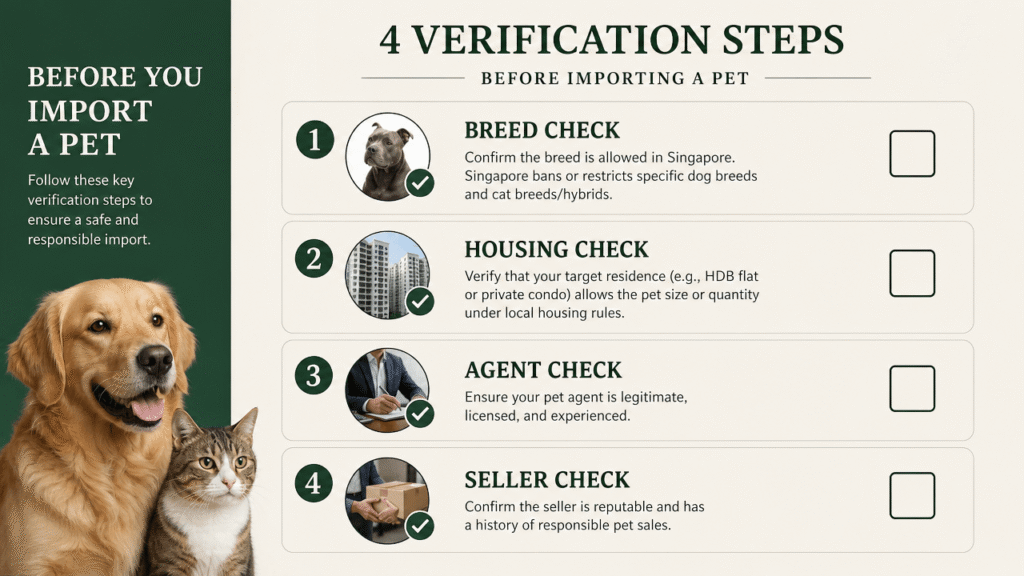
A singapore pet import guide worth following comes down to four checks most people skip: confirm the breed is actually permitted before you fall in love with a specific puppy, confirm your home is actually eligible to house that pet before you start the paperwork, verify any import agent against the official AVS-recognized list rather than trusting a company’s own claims, and treat any seller who suggests skipping official channels as a serious red flag rather than a convenient shortcut.
The documented court cases in this guide involve real animal deaths and real financial penalties for buyers, not just sellers — due diligence here is worth the extra week it takes.
If you like this post, you might like our gadgets section => New Gadgets
Sources Referenced
Editorial, news, and government sources (linked):
Patch — Better Business Bureau Warns Against Waltham Puppy Scam
AVS/NParks — Importing Dogs and Cats (Official)
AVS/NParks — List of AVS-Recognised Pet Agents (Official)
PetTravel.com — Singapore Pet Import Requirements
PetRelocation — Singapore Pet Quarantine Rules & Advice
PetRelocation — Singapore’s 2026 Pet Agent Mandate
PetRelocation — Singapore Pet Home Quarantine: Smart Collar
Club Pets Singapore — Taking Your Furkid Abroad: What Changed in 2026
Pawrenthood — Pet Relocation Singapore: Agents & Costs
Malay Mail — Jail for Man Who Smuggled Six Puppies, Bird Into Singapore
Malay Mail — Malaysian Gets One Year Prison for Smuggling 26 Puppies Into Singapore
Malay Mail — From JB to Jail: Singapore Couple Smuggled Dogs Across Causeway
Malay Mail — Singapore Man Fined S$15,000 for Conspiring to Smuggle Puppies