Pet Dryer Box Review: A Practicing Groomer’s Honest 6-Month Verdict
A practicing cat groomer who added an enclosed drying cabinet to her salon in October 2025 has a blunt finding after using it daily for months: most cats don’t actually come out fully dried hands-free. They tolerate the box reasonably well, then still need a few minutes of hand-finishing afterward — which quietly undercuts the core promise on most of these products’ listings.
This pet dryer box review is built around that kind of real, working-groomer account rather than marketing copy, because this category makes a specific, testable promise — quiet, hands-free, stress-free drying — and it’s worth knowing exactly how much of that promise holds up before you spend $150 to $500 on one.
Quick Answer:
| Your Situation | What to Know |
|---|---|
| Cat that’s anxious about traditional dryers | Genuinely worth it — but expect to still hand-finish paws and the belly |
| Large or giant dog breed | Most consumer boxes don’t fit comfortably — check interior dimensions first |
| Multi-pet household | Look for a model rated for 2 cats or a cat + small dog simultaneously |
| Flat-faced (brachycephalic) breed | Use extra caution — these breeds already struggle to regulate heat |
| Just bathed your dog in a robotic wash station | Check our robotic dog wash machine review for the full wash-to-dry routine |
| Considering for a large dog instead | A genuine high-velocity dryer is the better-suited tool |
Table of Contents
- Pet Dryer Box Review: The “Hands-Free” Claim, Tested by a Real Groomer
- How a Dryer Box Actually Works, and Why It’s Slower
- Cats vs. Dogs: A Genuinely Different Buying Decision
- The Brachycephalic Breed Warning
- Accessories That Actually Help, and One Step Nobody Mentions
- Comparison Table
- The Good, The Bad, and The Verdict — By Model
- What People Get Wrong, According to This Pet Dryer Box Review’s Research
- US vs. Australia vs. Singapore: What Changes
- Pet Dryer Box Review: The Verdict
1. Pet Dryer Box Review: The “Hands-Free” Claim, Tested by a Real Groomer
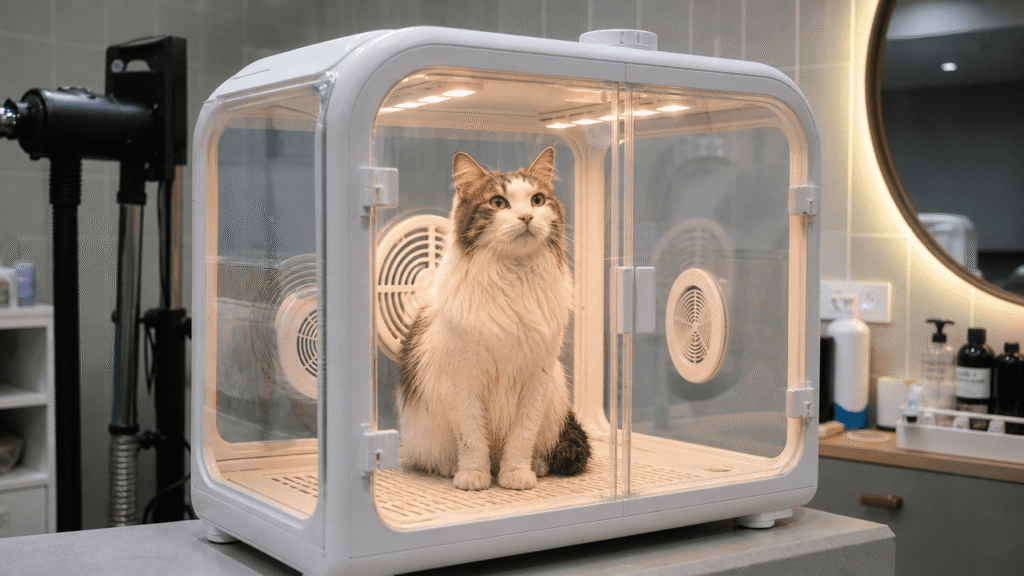
Most listings in this category lead with the same pitch: put your pet in, walk away, come back to a fully dry, calm animal. A working cat groomer’s real account — six months of daily use of a HomeRunPet Drybo Plus, plus feedback from another groomer using a Kiss Grooming Drying Cabinet — tells a more specific, more useful story.
Her actual usage pattern: she runs the box maybe once every few days, specifically for cats that are frightened of traditional dryer noise, highly aggressive cats, seniors, kittens, or when double-booked and needing to dry one cat while bathing the next. That’s a real, valuable use case — but it’s a targeted tool for specific situations, not a universal replacement for hands-on drying.
Drying time also runs considerably longer than advertised in casual terms: 45 minutes to 1.5 hours for a full dry, against roughly 15-20 minutes for a high-velocity handheld on the same animal, and feet very often still need a manual touch-up regardless of which box is used.
2. How a Dryer Box Actually Works, and Why It’s Slower
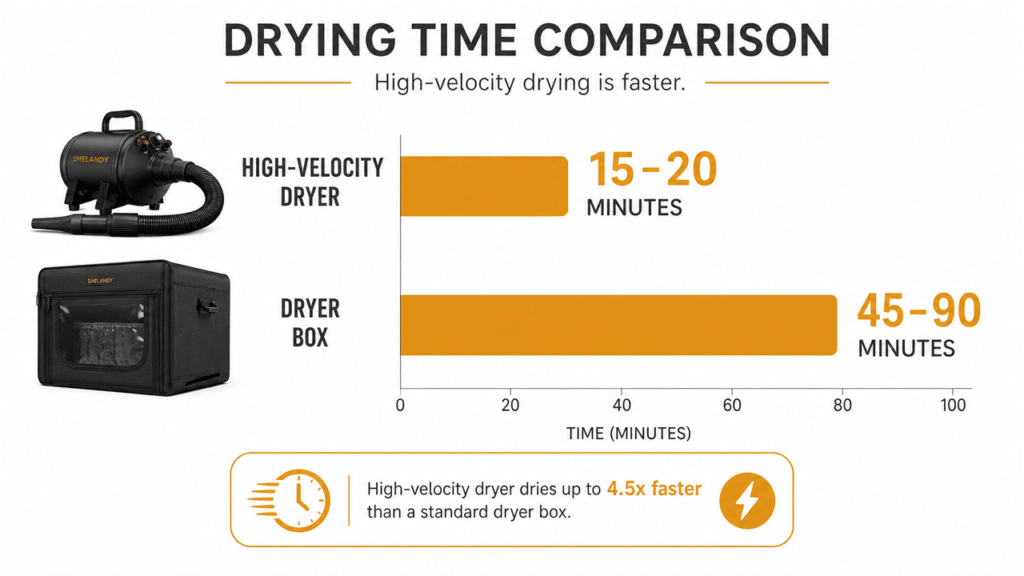
An automatic pet dryer box is an enclosed unit — sometimes called a drying cabinet or drying cage — with built-in fans that circulate warm or room-temperature air around your pet from multiple directions, rather than blasting it from one nozzle the way a handheld dryer does.
That circulating, indirect design is precisely why it’s gentler and quieter, and precisely why it’s also slower: there’s no concentrated, high-velocity airflow physically forcing water off the coat the way a force dryer does. The box dries the coat largely as it lies, rather than separating and fluffing it.
This is a genuine trade-off, not a flaw to be fixed by a better model. Quiet, even, indirect airflow and fast, concentrated, high-velocity airflow are close to mutually exclusive design goals — which is exactly why this category and the high-velocity category serve different situations rather than competing head-to-head on the same job.
3. Cats vs. Dogs: A Genuinely Different Buying Decision
This is the part most generic “best pet dryer” roundups blur together, and it shouldn’t be blurred. Cats and dogs have measurably different tolerances that change what “the right box” actually looks like.
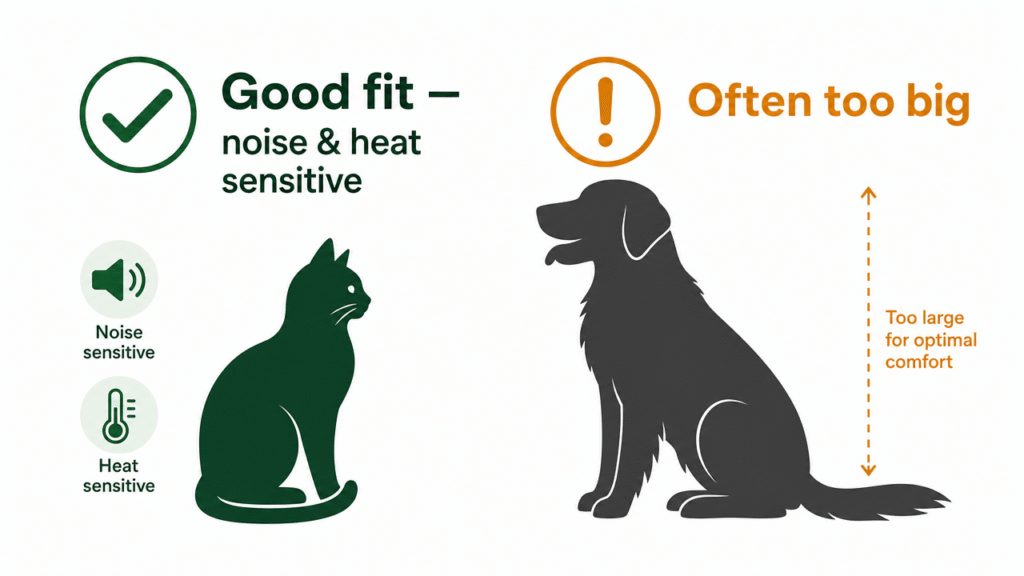
Cats are more noise- and heat-sensitive than dogs as a general rule. Multiple independent sources agree on this specific point, not just one. A cat’s comfortable temperature range for drying sits notably lower than what most consumer dryers default to even on a “low” setting, and cats are particularly prone to going still, curling up, or becoming defensive rather than calmly tolerating an unfamiliar enclosed space with moving air — which is exactly the behavior the working groomer’s account describes.
Dogs, by contrast, generally tolerate dryer boxes better but hit a different limit: size. Most consumer dryer boxes are explicitly designed around cats and small-to-medium dogs under roughly 15-20kg. A Golden Retriever or a Husky simply won’t fit comfortably in most models, and even where they technically fit, airflow may not penetrate a dense double coat effectively in a box built around lighter-coated cats and small dogs.
The practical rule: if you’re shopping for a cat or a small dog specifically because of noise or anxiety, a dryer box is a genuinely strong fit. If you’re shopping for a large or thick-coated dog, you’re very likely better served by a real high-velocity dryer used with a slow, gradual introduction instead.
4. The Brachycephalic Breed Warning
This is a real safety point that’s easy to miss in a feature-list comparison. Flat-faced breeds — Persians and Himalayans cats; Bulldogs, Pugs, and Boston Terriers in dogs — already struggle to regulate their own body temperature because of their airway structure.
An enclosed box, even one with genuine overheat protection, adds a layer of risk for these specific breeds that a fully open, well-ventilated room doesn’t carry. If you own a brachycephalic pet, treat extra caution here as non-negotiable — shorter sessions, closer monitoring, and a strong preference for a unit with a clear viewing window so you can watch breathing throughout, not just trust the automatic shutoff.
5. Accessories That Actually Help, and One Step Nobody Mentions
Two genuinely useful accessories show up consistently in real grooming guidance, neither of which is part of the box itself.
An Elizabethan-style collar can limit direct airflow exposure to a sensitive cat’s face during a session — the same working groomer’s account cited earlier specifically uses this for cats sensitive to airflow around the face, and E-collars are a standard, widely-stocked veterinary supply item, not a specialty purchase.
Remove your pet’s regular collar before any drying session, box or handheld. This is a small step that’s easy to overlook entirely, but a wet collar left against skin during or after drying is a real, documented cause of skin irritation — confirmed by general veterinary grooming guidance independent of which drying method you use. Dry the collar separately and put it back on once your pet is fully dry.
It’s also worth knowing that dryer boxes are one of three related but distinct categories in professional grooming — alongside force dryers (the high-velocity handheld category) and stand dryers (hands-free, mounted, adjustable-height units that direct airflow without enclosing the pet). If a box doesn’t end up suiting your pet, a stand dryer is the natural next thing to look at before assuming hands-free drying isn’t an option at all.
6. Comparison Table
Any honest pet dryer box review needs real, named models here, since the differences between them matter more than the category label.
| Model | Noise Level | Capacity | Best For | Real-World Note |
|---|---|---|---|---|
| HomeRunPet Drybo Plus | ~40 dB | Single pet | Cats and small dogs, home use | A working groomer’s 6-month account: genuinely useful for specific cats, not a universal hands-free fix |
| Kiss Grooming Drying Cabinet | Low settings tolerated well | Up to 2 cats or a Maine Coon-sized cat | Multi-cat or larger-cat households, commercial use | Reported as more efficient drying underneath larger cats than the Drybo Plus |
| PETKIT AirSalon Max | Quiet | Up to 2 cats | Multi-cat homes wanting a recognized smart-home brand | Smart app control, but a premium price point |
| PetSnowy SMILE | 40-60 dB | Single cat or small dog, 6 months+ | Cats and small dogs specifically, with size/age guidance built into the brand’s own materials | Explicit brachycephalic breed caution from the manufacturer itself |
| Petsuper 75L | Large capacity | 2 cats (20lb each) or a 40lb dog | Larger households or bigger single pets | Award-recognized design; among the largest consumer capacities available |
7. The Good, The Bad, and The Verdict — By Model
This is the part of any pet dryer box review that actually decides the purchase — matching the right model to the right pet, not just picking the most-advertised one.
HomeRunPet Drybo Plus — The Good: genuinely quiet (around 40 dB), front and side windows for visibility, and validated by a real working groomer’s extended use rather than just marketing copy. The Bad: drying time runs 45 minutes to 1.5+ hours, and feet commonly need manual finishing regardless. The Verdict: a strong, well-evidenced choice specifically for noise-sensitive cats in single-pet households; don’t expect a fully passive result every time.
Kiss Grooming Drying Cabinet — The Good: the same groomer’s direct comparison found it more effective at drying underneath larger cats than the Drybo Plus, and capable of fitting bigger cats like Maine Coons. The Bad: less widely reviewed outside that one professional account, and positioned more toward commercial/salon use than casual home buyers. The Verdict: worth seeking out specifically if you have a larger cat or multiple cats and the Drybo Plus’s single-pet sizing feels limiting.
PetSnowy SMILE — The Good: the manufacturer itself publishes clear size, age (6 months+), and brachycephalic-breed cautions rather than burying that information — a real transparency advantage over vaguer listings. The Bad: still limited to cats and small dogs by design; not a fit for anything larger. The Verdict: a sensible, well-documented choice precisely because the brand is upfront about who it isn’t for, not just who it is.
8. What People Get Wrong, According to This Pet Dryer Box Review’s Research
The most common mistake, confirmed directly by a working groomer’s real experience: assuming “hands-free” means zero hands-on finishing required. Even after a full cycle, paws and undersides commonly need a quick manual touch-up — budget that time rather than being caught off guard by it.
A second mistake: buying based on advertised drying time without checking your specific pet’s coat. The 45-minute-to-1.5-hour range varies heavily by coat density and length, and a thick-coated cat can run well past the longer end of that range.
A third: choosing a box sized for the pet you have today without considering whether a kitten or puppy will outgrow it within a year or two — capacity is one of the more expensive specs to get wrong.
9. US vs. Australia vs. Singapore: What Changes
This pet dryer box review’s core findings hold across all three markets — what shifts is price, voltage, and how climate affects real drying time.
United States: The widest model selection, with HomeRunPet, PetSnowy, and PETKIT all readily available through Amazon and Chewy.
Australia: Available through Amazon.com.au and specialty pet retailers, generally at a price premium over US listings. Australia uses 230V/50Hz with Type I plugs — confirm voltage compatibility before importing directly from a US listing.
Singapore: Available via Lazada, Shopee, and Amazon.sg. Singapore’s high humidity is genuinely relevant to drying time specifically — air that’s already humid is less effective at carrying moisture away from a wet coat, meaning real-world drying time in Singapore’s climate may run toward the longer end of any model’s stated range, not the shorter end. Singapore uses 230V/50Hz with Type G plugs.
10. Pet Dryer Box Review: The Verdict
This pet dryer box review comes down to the same finding which the working groomer who actually uses one daily arrived at: genuinely valuable for the specific situations it’s built for — anxious cats, multi-pet households needing to dry one animal while bathing another, seniors and kittens who don’t tolerate a handheld dryer well — and not a universal, fully-hands-free replacement for active drying.
Buy it to solve that specific problem, budget, real time for a manual finish on paws and the belly, and don’t expect a large or thick-coated dog to fit comfortably in a box built around cats and small breeds.
If you like this post, you might like our gadgets section => New Gadgets
Sources Referenced