Pet Grooming Vacuum Review: What Owners and Groomers Actually Say
Your dog might genuinely love this. Your cat in the same house might not — even with the identical “quiet” rating printed on the same box. That contrast shows up repeatedly across real households using these grooming vacuum kits, and it’s exactly the kind of nuance a star rating can’t capture, since one pet’s calm reaction and another’s anxious one both get averaged into the same five-star review.
This pet grooming vacuum review pulls from that kind of real, practical feedback — hands-on tests from Dogster, Rover, and The Gadgeteer, a professional groomer forum thread on personal-use versus commercial durability, and the maintenance reality that most glowing reviews skip past entirely. It also covers something most single-model reviews miss: which specific brand actually fits your dog, because “works great” depends heavily on coat type, size, and how sound-sensitive your particular pet is.
Quick Answer:
| Your Situation | What to Know |
|---|---|
| Heavy-shedding double-coated breed (Maine Coon, Husky-type) | Works well — multiple sources confirm strong results |
| Low-shedding breed (Persian-type) | Deshedding attachment may not do much — there’s just less loose undercoat to remove |
| Large or long-haired dog | The standard 1-liter dust cup fills fast — look for a model with 2L+ capacity instead |
| Sound-sensitive pet | Even “low noise” units startled some pets in real testing — look at models under 50dB specifically |
| Small breed | Look for a compact kit designed for smaller dogs, not a large-breed unit scaled down |
| No outlet access where you groom | A cordless battery model trades some runtime for real flexibility |
| Considering for commercial/multi-pet use | Personal-use reviews don’t reflect daily, heavy-duty durability |
Table of Contents
- Does It Actually Work? It Depends on the Coat
- The Noise Reality, Beyond the Spec Sheet
- Choosing by Breed Size and Sound Sensitivity: What This Pet Grooming Vacuum Review Found
- The Maintenance Every Pet Grooming Vacuum Review Should Mention, but Most Skip
- Cordless vs. Corded: A Real Trade-off
- Personal Use vs. Commercial Use: A Real Distinction This Pet Grooming Vacuum Review Has to Flag
- Comparison Table
- The Good, The Bad, and The Verdict
- What People Get Wrong, According to This Pet Grooming Vacuum Review’s Research
- US vs. Australia vs. Singapore: What Changes
- The Verdict
1. Does It Actually Work? It Depends on the Coat
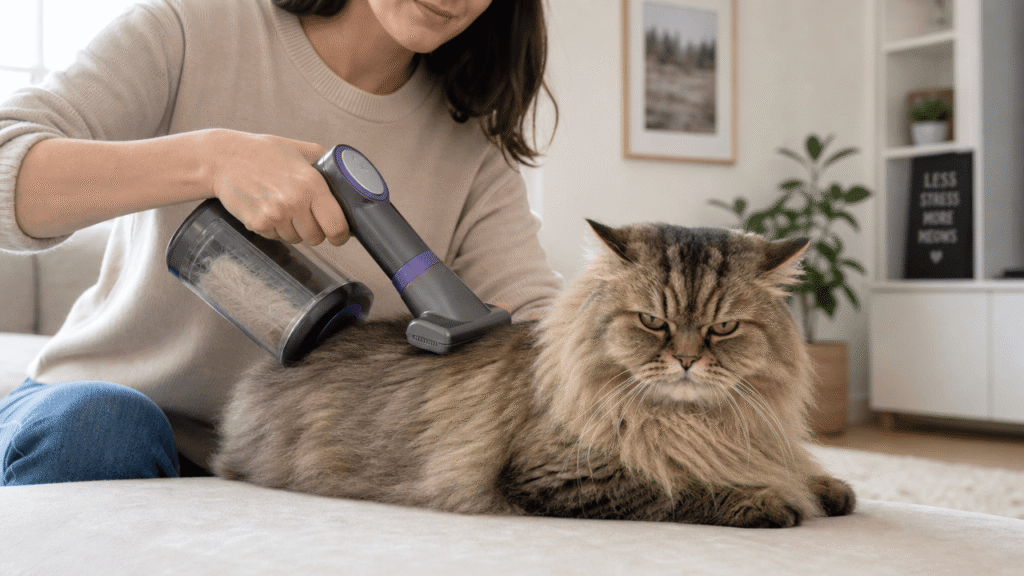
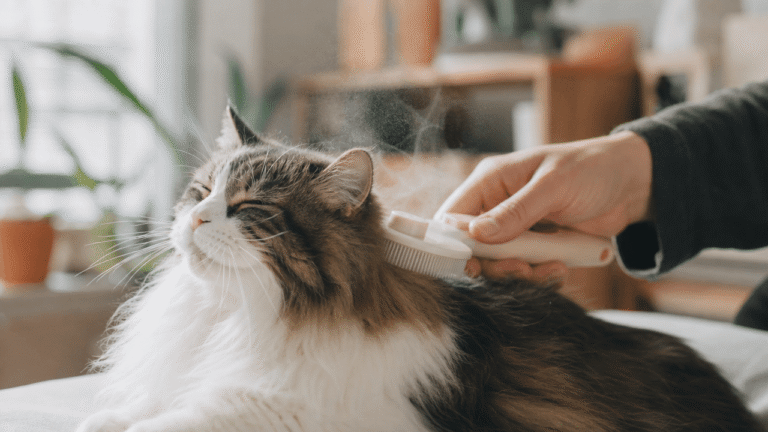
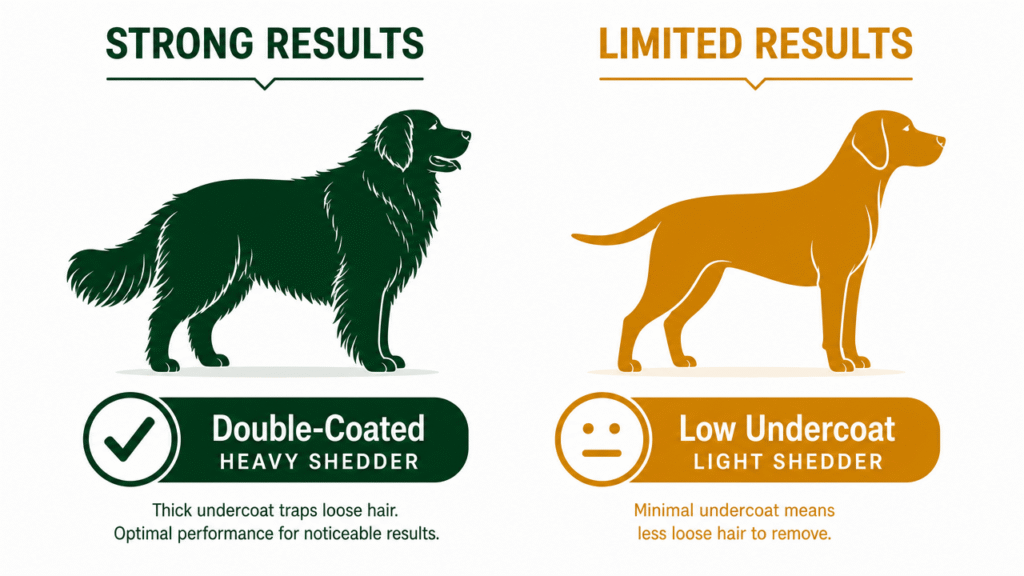
This is the single most useful, least-marketed fact in this entire category, and it comes straight from a professional groomer forum thread comparing results across different breeds. The deshedding attachment removed plenty of fur from a Maine Coon — a breed with a dense double coat and heavy seasonal shedding — but barely affected a Persian, a breed that simply doesn’t carry the same volume of loose undercoat to begin with.
That’s not a flaw in the product. It’s a mismatch between expectation and coat type that nearly every glowing review glosses over, because most reviewers happen to own breeds where the tool performs well.
If you own a low-shedding or single-coated breed, the realistic expectation should be modest — the vacuum function will still help with cleanup during a haircut, but the dramatic “99% of loose hair” results you’ll see in marketing are specifically measured on heavy shedders during a deshedding session, not a quick touch-up on a breed with minimal undercoat.
2. The Noise Reality, Beyond the Spec Sheet
Manufacturer noise specs tell only part of the story, and multiple independent sources confirm the gap between spec and real pet reaction — and the actual numbers vary more between brands than most buyers expect.
Decibel ratings across the category run from under 50dB on the quietest models marketed specifically for sound-sensitive dogs, up to a 42-75dB range on units with multiple power settings, where the top suction mode is noticeably louder than the lowest one — a spread documented directly in BestReviews’ decibel and suction comparison across major brands.
A hands-on review from a professional groomer’s own forum reported a dog enjoying the sensation while a cat in the same household remained visibly nervous throughout, despite the unit’s quiet rating holding up technically.
Fakespot’s review-pattern analysis (which screens out likely-fake reviews before summarizing) independently confirmed the same pattern across the broader review base: most users found it noticeably quieter than a standard vacuum or clipper, but a real minority consistently reported it startling more skittish pets regardless of the published rating.
The practical fix recommended across multiple sources: introduce the device gradually with treats before the first real grooming session, start on the lowest suction setting even if your pet seems unbothered, and brush the pet manually first so the vacuum sound isn’t paired with the first physical contact of the session. This single habit shows up repeatedly as the difference between a calm first use and a stressed one.
3. Choosing by Breed Size and Sound Sensitivity: What This Pet Grooming Vacuum Review Found
This is the part of the category most single-model reviews can’t tell you, because it requires comparing across brands rather than just testing one. iHeartDogs’ breed-specific roundup and several manufacturers have explicitly designed and marketed specific models around exactly this problem.
For small breeds, compact kits with gentler suction and smaller-handed attachments are designed specifically around precision and lighter coats, rather than scaling down a large-breed unit that may be physically awkward to maneuver on a small dog. For large or giant breeds, models marketed specifically for bigger dogs typically pair stronger suction (in the 9,000-12,000 Pa range) with larger dust cups to match the volume of fur a big double-coated dog actually produces in one session.
For sound-sensitive dogs specifically, at least one major brand markets an under-50-decibel model as its dedicated answer to the startling-noise complaint that shows up across this entire category — worth seeking out directly if your dog has shown noise sensitivity with other grooming tools before.
For multi-dog households, larger dust cup capacity (3 liters or more on some kits) matters more than any other single spec, since you’ll be running multiple grooming sessions back to back without a chance to empty and reset between dogs.
One more pattern worth knowing: some manufacturers have released second-generation models specifically to address a first-generation startle-noise complaint. If you’ve read a complaint about an earlier version of a kit being too loud or startling for nervous pets, check whether a newer generation of that same product line exists before ruling out the brand entirely — the fix may already be on the market.
4. The Maintenance Every Pet Grooming Vacuum Review Should Mention, but Most Skip
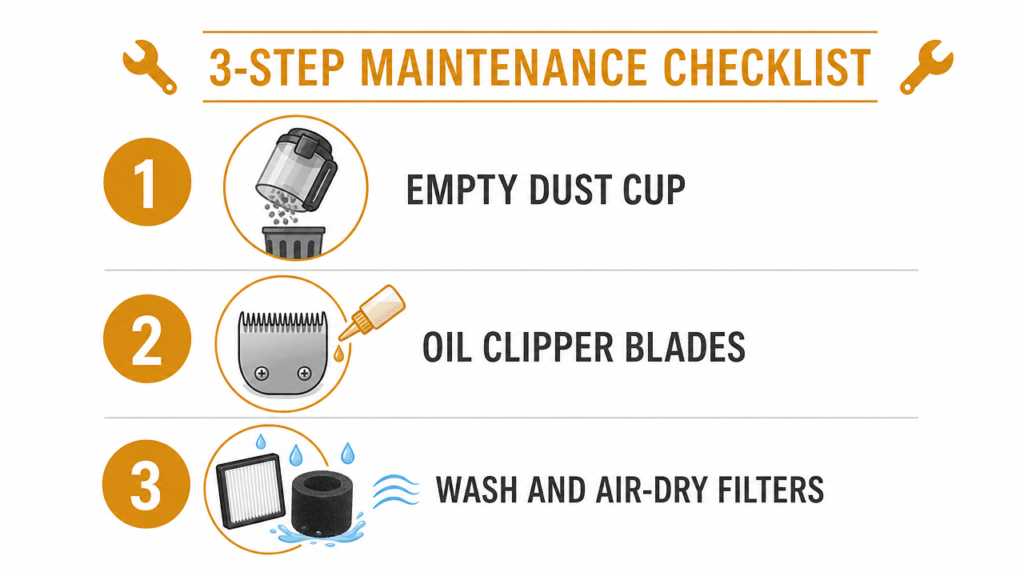
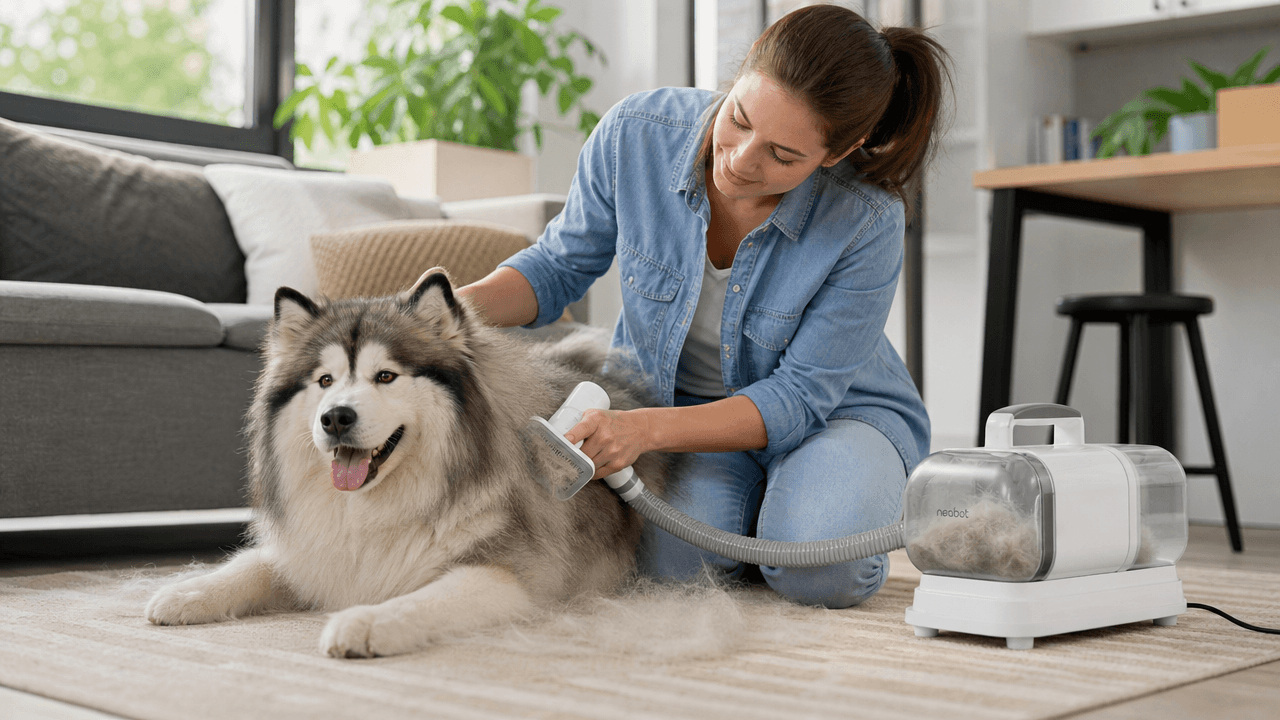
A detailed hands-on review (testing on a senior dog over a full shave-down session) surfaced maintenance realities that most shorter reviews skip entirely. The standard 1-liter dust canister on several popular kits fills up fast on a large or long-haired dog — fast enough that a full shave-down required stopping every minute or two just to empty it.
That’s not a defect; it’s a real capacity limitation worth planning around if you’re grooming anything bigger than a small dog, and it’s exactly why dust cup size deserves more attention than it usually gets in a quick buying guide.
Beyond the dust cup, the clipper blades need periodic lubrication (clipper oil, or according to at least one brand’s own guidance, household cooking oil in a pinch) — a noisy clipper sound during use is the actual signal that lubrication is overdue, not just general wear.
Most kits also include two separate filters, one HEPA and one foam/sponge, that need monthly washing and full air-drying before reinsertion. None of this is unreasonable for an electronic grooming tool, but it’s also not “set it and forget it,” and skipping the filter maintenance specifically will reduce suction performance over time.
5. Cordless vs. Corded: A Real Trade-off
This is a spec most quick buying guides skip, but any thorough pet grooming vacuum review should cover it. Most kits in this category are corded, plugged into a wall outlet for the duration of grooming — fine for an indoor setup near a power source, but a real limitation if you typically groom outdoors, in a garage, or anywhere without convenient outlet access.
A genuine cordless alternative exists in at least one major product line, running on a rechargeable battery (commonly in the 5,000mAh range) for roughly an hour of continuous use per charge. The trade-off is straightforward: you gain the freedom to groom anywhere — backyard, car, a friend’s place — but you’re working against a real time limit per charge, and a long grooming session on a heavily-matted or very large dog could outlast a single charge.
If portability matters more to you than unlimited runtime, the cordless option is worth the modest premium; if you always groom in the same spot near an outlet, a corded model removes the battery-life variable entirely.
6. Personal Use vs. Commercial Use: A Real Distinction This Pet Grooming Vacuum Review Has to Flag
This is a nuance worth taking seriously if you’re considering one of these for anything beyond your own pets. A professional groomer researching this exact category for commercial use got a clear, honest community response: the strong review base reflects personal pet owners using the device occasionally, not professional-frequency daily use across multiple animals — a meaningfully different durability test that star ratings don’t capture.
The practical advice from that same thread: treat the return policy as your actual safety net if testing for commercial viability, since there’s no published data on how these units hold up under daily, high-volume professional use the way there is for genuinely commercial-grade equipment.
7. Comparison Table
Any pet grooming vacuum review worth reading has to be honest that this market has one clear overall leader, with several close competitors built around specific use cases.
| Model | Noise Level | Dust Cup Size | Best For | Real-World Issue to Know |
|---|---|---|---|---|
| Neakasa/Neabot P1 Pro | ~52-55 dB | 1 liter | Heavy-shedding double-coated breeds, overall best-tested | Cup fills fast on large/long-haired dogs; some owners reported the cat in the home stayed nervous despite the dog being fine |
| Neakasa P2 Pro | Improved over P1 Pro | Similar range | Sound-sensitive or nervous dogs specifically | Marketed as the direct fix for the P1 Pro’s startle-noise complaints |
| Oneisall | ~60 dB | 1.5 liters | Small breeds, budget-conscious buyers | A real hands-on review noted a spelling error stamped on the clipper itself — a minor but real QC miss |
| Oneisall Comfy L1 (cordless) | ~60 dB | 3 liters | No-outlet flexibility, multi-pet homes | ~1 hour runtime per charge on a 5,100mAh battery |
| FurMe Professional Plus | 42-75 dB (mode-dependent) | 2 liters | Heaviest shedders, made in the USA | Loudest on its top suction setting; quieter on low/mid |
| AIRROBO | Under 50 dB | Large capacity | Sound-sensitive dogs, heavy shedders simultaneously | Marketed specifically to solve the noise complaint other heavy-duty models have |
8. The Good, The Bad, and The Verdict
This pet grooming vacuum review comes down to one clear market leader with strong independent testing behind it, and a thinner field of close competitors each solving a specific gap.
Neakasa/Neabot P1 Pro — The Good: genuinely strong results on heavy-shedding breeds, confirmed independently across Dogster, Rover, and a professional groomer forum, with a senior-dog test specifically noting the dog wasn’t afraid of the noise.
The Bad: the small 1-liter dust cup is a real limitation for big dogs or long-haired breeds, some units have shipped missing attachments, and the deshedding brush has been reported as harsh enough to bruise on at least some pets. The Verdict: a strong, well-tested pick specifically for heavy shedders; less impressive for low-undercoat breeds where there’s simply less to remove.
Neakasa P2 Pro — The Good: positioned directly as the fix for the P1 Pro’s most common complaint, making it the logical upgrade if a previous nervous-pet experience put you off the brand. The Bad: less independent long-term testing data exists for the newer model compared to the well-established P1 Pro. The Verdict: worth the look specifically if noise sensitivity is your main concern and you still want to stay within a proven product line.
Oneisall — The Good: a genuinely affordable entry point (commonly around $100-110) with a full attachment set and real hands-on praise for ease of use, even for first-time home groomers. The Bad: an independent reviewer found an actual spelling error stamped on the clipper unit itself — a small but real sign of inconsistent quality control at this price point. The Verdict: a reasonable budget pick for smaller dogs, with expectations calibrated to the price.
FurMe Professional Plus — The Good: the highest suction power on this list (10,500 Pa) paired with a 2-liter dust cup, genuinely suited to heavy shedders and multi-pet homes, and notably manufactured in the USA. The Bad: at its highest suction setting it’s the loudest model compared here, reaching into the mid-70-decibel range. The Verdict: choose the lower suction settings for sound-sensitive pets and reserve full power for heavy-coated dogs who tolerate noise well.
AIRROBO — The Good: marketed and reviewed specifically as the quiet-and-powerful combination this category often can’t deliver simultaneously, staying under 50 decibels while still claiming strong suction. The Bad: less independent long-term testing exists compared to the more established Neakasa and FurMe lines. The Verdict: the strongest current pick specifically if you need both heavy-shedder performance and genuine quiet operation.
9. What People Get Wrong, According to This Pet Grooming Vacuum Review’s Research
A consistent mistake across hands-on reviews: buying based on the headline suction number (Pa rating) alone without checking dust cup size. A high-suction unit with a small 1-liter cup on a big, heavily-shedding dog means stopping to empty it every minute or two — the suction power was never the bottleneck, the cup was.
Several real reviews specifically flag inconsistent quality control even on well-regarded models — a misspelled word stamped directly onto a clipper unit being one documented example. This doesn’t necessarily reflect poor performance, but it’s a reasonable signal to inspect a new unit carefully on arrival rather than assuming every unit off the line is identical.
Multi-pet households consistently underestimate how much a small dust cup compounds across back-to-back grooming sessions. What’s a minor annoyance grooming one dog becomes a real time cost grooming three or four in a row without a larger-capacity model.
10. US vs. Australia vs. Singapore: What Changes
The core findings in this pet grooming vacuum review hold across all three markets — what actually shifts is price, voltage, and humidity-driven maintenance timing.
United States: Widest availability and most independent hands-on reviews, through Amazon and Chewy, with the broadest selection of brand variants including cordless options.
Australia: Available through Amazon.com.au, generally at a price premium over US listings. Australia uses 230V/50Hz with Type I plugs — confirm voltage compatibility if importing directly rather than buying through a local listing.
Singapore: Available via Lazada, Shopee, and Amazon.sg. Singapore’s high humidity is worth factoring into the maintenance routine specifically — the foam/sponge filter needs full air-drying before reinsertion, and that takes longer in a humid climate than the manufacturer’s stated drying time, which is typically calculated for a temperate environment.
If you’re more keen on Neakasa products you can visit => here
Here are some of the Neakasa promo codes:
- HONEY10OFF (10% off your entire order)
- VALID (25% off everything + free shipping)
- KITSOFF20 (20% off for grooming kit accessories)
A cordless model may also be worth prioritizing in Singapore specifically, since many HDB flats and condo units have grooming areas (bathrooms, balconies) further from a convenient power outlet than a typical Western home setup. Singapore uses 230V/50Hz with Type G plugs.
11. The Verdict
This category does exactly what it claims for the coat type it’s actually built for — heavy, double-coated shedders — and underdelivers for breeds that simply don’t carry much loose undercoat to begin with.
Coat type and size should drive the purchase, not the marketing’s universal “99% of pet hair” claim. If you’re in a large or multi-pet household, dust cup capacity matters more than the headline suction number on the box. If your pet startles easily, check the decibel rating before anything else. And set aside real time for the maintenance routine — it’s not optional, no matter how the listing frames it.
Using the right coat type and the right model, multiple independent, hands-on reviewers agree it’s a genuine time and money saver over professional grooming visits.
If you like this post, you might like our gadgets section => New Gadgets
Sources Referenced
- Dogster — hands-on Neakasa P1 Pro review, tested on a 12-year-old senior dog
- Rover.com — hands-on Neabot P1 Pro test across a multi-pet household
- iHeartDogs — Neabot P1 Pro review including bruising and missing-attachment complaints, plus breed-specific model roundup
- PetGroomer.com GroomerTALK forum — professional groomers discussing personal-use vs. commercial-use durability
- Fakespot — review-authenticity analysis of the Neabot P1 Pro listing
- The Gadgeteer — hands-on Oneisall Pet Grooming Kit and Vacuum review, including the spelling-error observation
- Pretty Fluffy — Oneisall Comfy L1 cordless model review
- BestReviews — decibel and suction comparison across FurMe, Oneisall, and Uproot models