Road Trip With Pets US Safety: What Actually Works
Most dog car harnesses sold today have never passed a real crash test. The Center for Pet Safety, which independently tests pet travel gear, found that very few products on the market meet their safety standards — most fail catastrophically in testing and can turn into dangerous projectiles in a real accident.
That’s the piece most road trip with pets us safety guides skip in favor of generic “use a harness” advice. Which harness matters as much as whether you use one at all.
Quick Answer
| Question | Short Answer |
|---|---|
| Do most dog harnesses actually work in a crash? | No — independent crash testing found most fail; the Sleepypod Clickit Sport is one of the few verified to pass |
| How often should we stop on a long drive? | Every 2-3 hours for at least 15 minutes |
| Is it ever safe to leave a dog alone in a parked car? | No — cabin temperatures rise fast enough to be dangerous above roughly 70°F outside, and cold poses similar risk below about 35°F |
| Front seat or back seat? | Back seat or a secured cargo-area crate — the front seat’s airbags pose a real risk to a restrained pet |
| Collar or harness for car restraint? | Harness — a collar concentrates crash force at the neck rather than distributing it across the body |
Table of Contents
- The Harness Problem Nobody Mentions
- Crate vs. Harness vs. Barrier
- The Attachment Point and Airbag Details Most Guides Skip
- The Rest Stop Habit That Prevents a Dog From Bolting
- Rest Stop Rhythm That Actually Works
- The Hot Car Risk Is Worse Than You Think
- Getting a Nervous Dog Ready Before the Trip
- Motion Sickness: What Actually Helps
- The Product That Makes Rest Stops Less of a Hassle
- What People Get Wrong
- The Bottom Line
The Harness Problem Nobody Mentions
Car accidents involving unrestrained pets injure thousands of animals annually in the US, and most of those injuries trace back to dogs traveling loose in the vehicle. The gap between awareness and action is real: of 1,000 dog owners surveyed, 80% said they’d taken their dog on car trips, but only 17% reported using any kind of restraint at all.
The instinct to fix that with “just buy a harness” runs into a real problem: the Center for Pet Safety’s crash testing found that very few dog harnesses on the market pass their safety standards — most fail outright, and a failed harness in an accident can become a projectile rather than a protection.
The Sleepypod Clickit Sport was among the first harnesses to pass rigorous crash testing, engineered specifically to withstand real accident forces. On the crate side, the Gunner G1 and Variocage brands are both cited as crash-tested crates that have held up in real-world accidents, absorbing shock rather than letting a dog be thrown around the cargo area. If crash safety is your real priority rather than just general restraint, checking whether a specific product has independent crash-test verification matters more than star ratings or marketing copy.
Crate vs. Harness vs. Barrier
None of the three options is universally correct — it depends on the dog. A crash-tested crate secured in the cargo area is often the most protective option for dogs who find enclosed spaces calming. A harness works well for dogs who tolerate structure without feeling trapped. A backseat barrier or hammock cover adds a layer of containment but isn’t a crash restraint on its own — pair it with a harness or crate rather than relying on it alone.
Whatever you choose, a collar is never the right tool for car restraint. A collar concentrates crash force at the neck, while a properly fitted harness distributes force across the chest and body — the same reason human seatbelts cross the chest rather than the throat.
The Attachment Point and Airbag Details Most Guides Skip
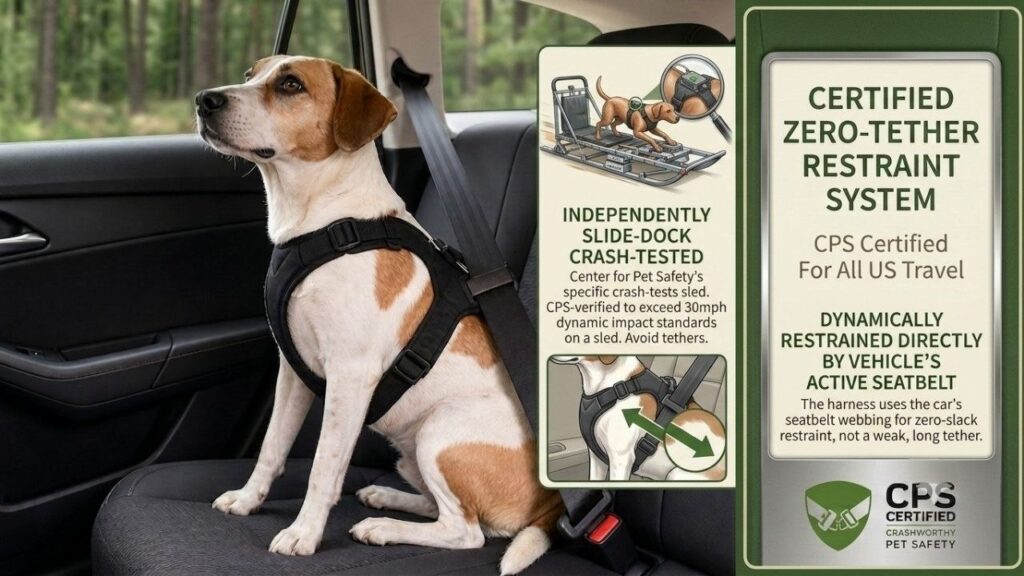
Buying a crash-tested harness is only half the equation — how it’s actually anchored to the car matters just as much, and a genuinely tested harness can still fail if it’s connected wrong.
Crash-tested harnesses like the Sleepypod Clickit Sport are designed to thread the vehicle’s actual seatbelt through reinforced webbing loops, distributing force across the harness rather than concentrating it at one point. Some other products on the market instead anchor to a vehicle’s ISOFIX/LATCH lower anchor points — the same metal loops used for child car seats.
Either method is legitimate, but a cheap aftermarket carabiner or clip-in tether attached to neither system properly can undermine an otherwise well-tested harness. Check your specific product’s instructions for which attachment method it’s actually engineered for, rather than assuming any strap or clip will do.
The other detail worth knowing if your dog ever rides in the front seat: a front passenger airbag deploying at full force can cause fatal injury to a pet in that seat, the same reason rear-facing child seats are never placed there. This mostly comes up for trucks, two-seaters, or any vehicle with no back seat option.
Many modern vehicles use automatic weight-sensing systems that deactivate the passenger airbag on their own with a light enough occupant; older vehicles or specific models may have a manual on/off switch instead, typically on the dashboard or in the glove box. Check your owner’s manual for which system your vehicle has before assuming either one applies — don’t guess, and don’t attempt to disable an airbag without confirming your vehicle actually supports it.
The Rest Stop Habit That Prevents a Dog From Bolting
This is a small habit with outsized consequences. Always clip the leash onto your dog’s collar or harness before you unclip the car restraint or open the door — not after. Highway rest stops are loud, unfamiliar, and full of moving traffic, which is exactly the environment where a startled dog can slip out and be gone in the two or three seconds it takes to reach for a leash that isn’t already attached.
While you’re building good road trip habits, double check your dog’s microchip contact information is current and that their collar has a physical tag with a working cell phone number on it, not a home landline. A dog that bolts at a rest stop hundreds of miles from home depends entirely on whoever finds them being able to reach you immediately, not on you eventually noticing a missed call at home.
Rest Stop Rhythm That Actually Works
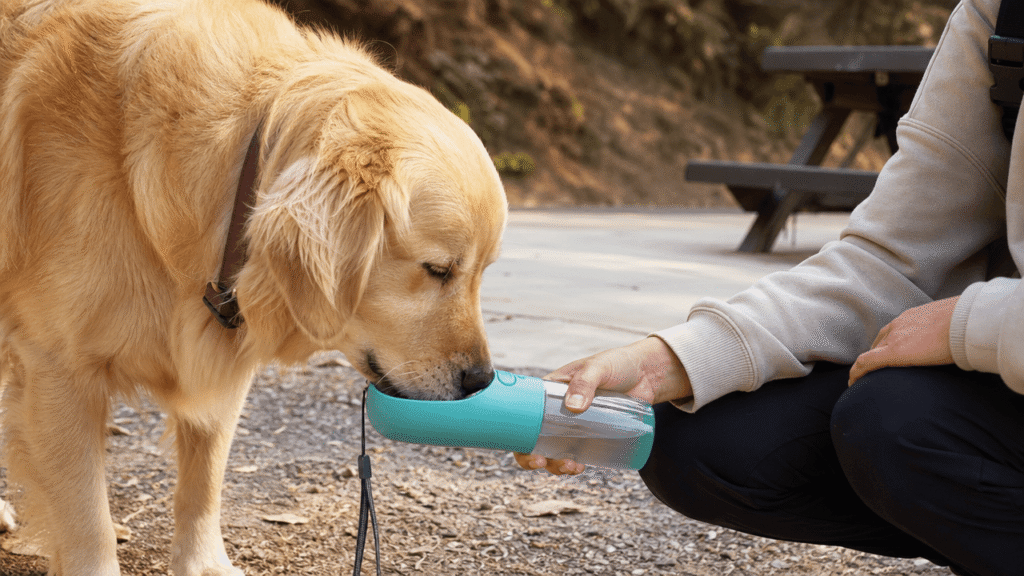
Plan for a stop every 2-3 hours, for at least 15 minutes each time — enough time for a bathroom break, a little movement, and water. Offer water at every stop rather than only when your dog seems thirsty; road trips are more dehydrating than most owners expect, especially in warm weather or with a nervous dog panting more than usual.
The Hot Car Risk Is Worse Than You Think
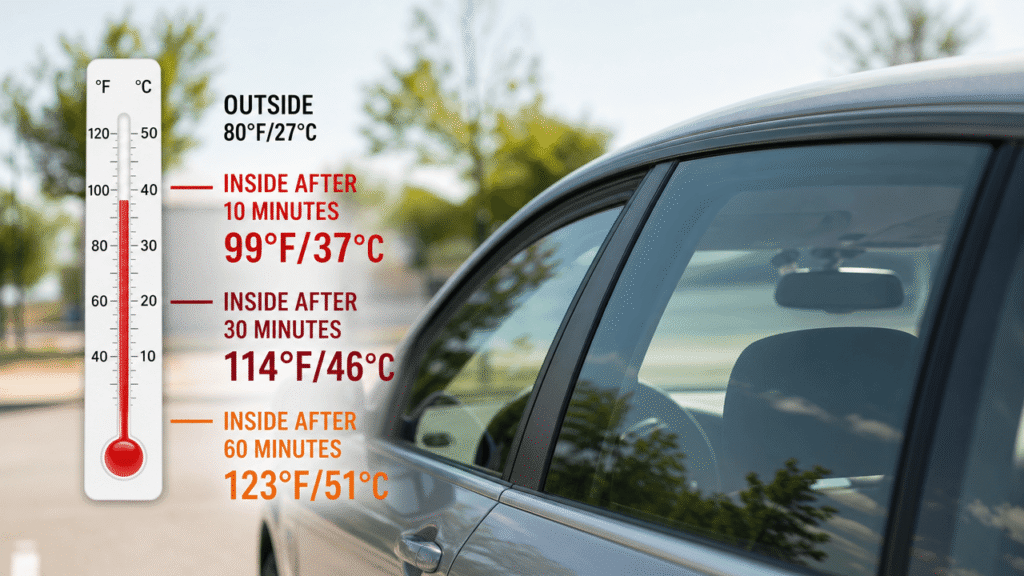
Leaving a dog alone in a parked car is a real safety concern once outside temperatures climb above roughly 70°F, and cold poses a similar risk below about 35°F — vehicle interior temperatures climb far faster than most people expect, reaching dangerous levels within minutes even on a day that doesn’t feel especially hot outside. Keep any unavoidable stop as short as possible, and default to a drive-through option for food rather than leaving your dog in the car while you go inside.
Getting a Nervous Dog Ready Before the Trip
Don’t jump straight to a multi-hour drive if your dog has never been secured in a car restraint before. Start with a short parked-car session, then a trip around the block, then a quiet errand — building tolerance gradually rather than expecting a calm first long trip. Watch your dog’s behavior rather than the product label: panting hard, bracing rigidly, vocalizing, or trying to escape the restraint are all signs to slow the pace down or reconsider the specific restraint style, not signs to push through.
A tired dog also travels better. A long run or a visit to the dog park shortly before departure genuinely helps many dogs settle for a longer stretch of the drive than they otherwise would.
Motion Sickness: What Actually Helps
Avoid feeding a full meal right before departure — a car-sick dog with a full stomach has a much rougher ride than one traveling on a lighter stomach, and this single timing change resolves a meaningful share of mild motion sickness on its own. Positioning matters too: dogs that can see forward out a window tend to fare better than ones facing sideways or with no view at all, likely for the same reason humans feel steadier watching the horizon.
If mild sickness persists after adjusting feeding timing and positioning, that’s a genuine conversation for your vet rather than a guessing game — there are legitimate anti-nausea options for dogs, but they should be selected and dosed by a vet who knows your dog’s history, not chosen off a forum recommendation.
The Product That Makes Rest Stops Less of a Hassle
Beyond the safety restraint itself, a hands-free waste bag dispenser that clips directly to a leash and closes with a simple drawstring pull solves a genuinely annoying road trip problem: managing a leash, a bag roll, and a squirming dog at an unfamiliar rest stop with one hand while the other holds a coffee or a car door. Being able to cinch the bag closed with one pull rather than tying a knot one-handed is a small thing that adds up over a multi-stop trip.
A portable, spill-proof water dispenser is worth keeping in the car too, separate from whatever you pack for flights — rest stops don’t always have a clean water source nearby, and a sealed dispenser means one less thing sloshing around your back seat between stops.
Ideals for pet comfort on road
- Pet Odor Eliminator Spray
- Portable pet water or snack dispenser
- Hands-free dog waste bag dispenser and scooper
- Dog car harness
What People Get Wrong
Buying “a harness” checks the box of restraining your dog day to day, but that’s not the same claim as “this product is verified to hold up in an accident” — most products on the market only satisfy the first one, and treating them as interchangeable is the whole reason crash testing matters.
There’s also a persistent underestimate of how fast a parked car heats up. A “quick stop” on a mild day feels harmless, but vehicle interior temperatures can climb to dangerous levels within minutes, even when it doesn’t feel especially hot outside.
The Bottom Line
Road trip with pets us safety comes down to two things most guides gloss over: verify your specific restraint product has real crash-test backing rather than assuming any harness will do, and never treat a parked car as a safe waiting spot regardless of how quick the errand feels. Everything else — rest stop timing, hydration, gradual conditioning for a nervous dog — is the easier part to get right.
IF you like this article, you might also like other article from US pet travel -> Here
Sources Referenced
Editorial and community sources (linked):
NHTSA — Interpretation Letter on Passenger Airbag Deactivation
Animals Around The Globe — 12 Best Dog-Friendly Road Trip Tips
Jet Set Pets — Dog-Friendly Road Trip Packing List
Chew’ems — Dog Road Trip Essentials
AAA — How to Safely Drive With Pets
AOL — The Best and Safest Ways to Travel With Your Dog in a Vehicle